

Yes. Crocus sativus is a perennial, so a healthy planting can return and flower year after year. The saffron regrowth cycle is unusual, though: it blooms in autumn, grows leaves through the cooler months, and becomes dormant in summer.
Does saffron grow back every year?
Saffron does grow back every year when its corms remain healthy and the site drains well. It does not regrow from the harvested red threads or from a flower that has been cut. New shoots come from living underground corms—structures often called saffron bulbs in ordinary gardening language.
Why does saffron come back every year?
The word “perennial” does not mean one unchanged bulb survives forever. The parent corm is replaced as daughter corms develop. Those new corms carry the planting into its next season, which is why the patch can become denser over time.
The North Carolina Extension Crocus sativus profile identifies saffron as a corm-grown perennial, notes that the corms multiply, and places its flowers in a short autumn window. That annual return depends more on the underground cycle than on the few days when purple flowers are visible.
The saffron life cycle through the year
Late summer: planting and the end of dormancy
Saffron corms are generally planted in late summer, before their autumn growth begins. A dormant corm may look inactive, but it contains stored reserves and developing buds. As soil conditions shift toward the new season, roots and shoots begin to form.
Choose firm corms and plant them in a sunny, free-draining site. The Royal Horticultural Society’s guide to growing saffron recommends late-summer planting, spacing the corms about 10 cm (4 in) apart and setting them at least 10–15 cm (4–6 in) deep.
Autumn: flowers and one harvest season
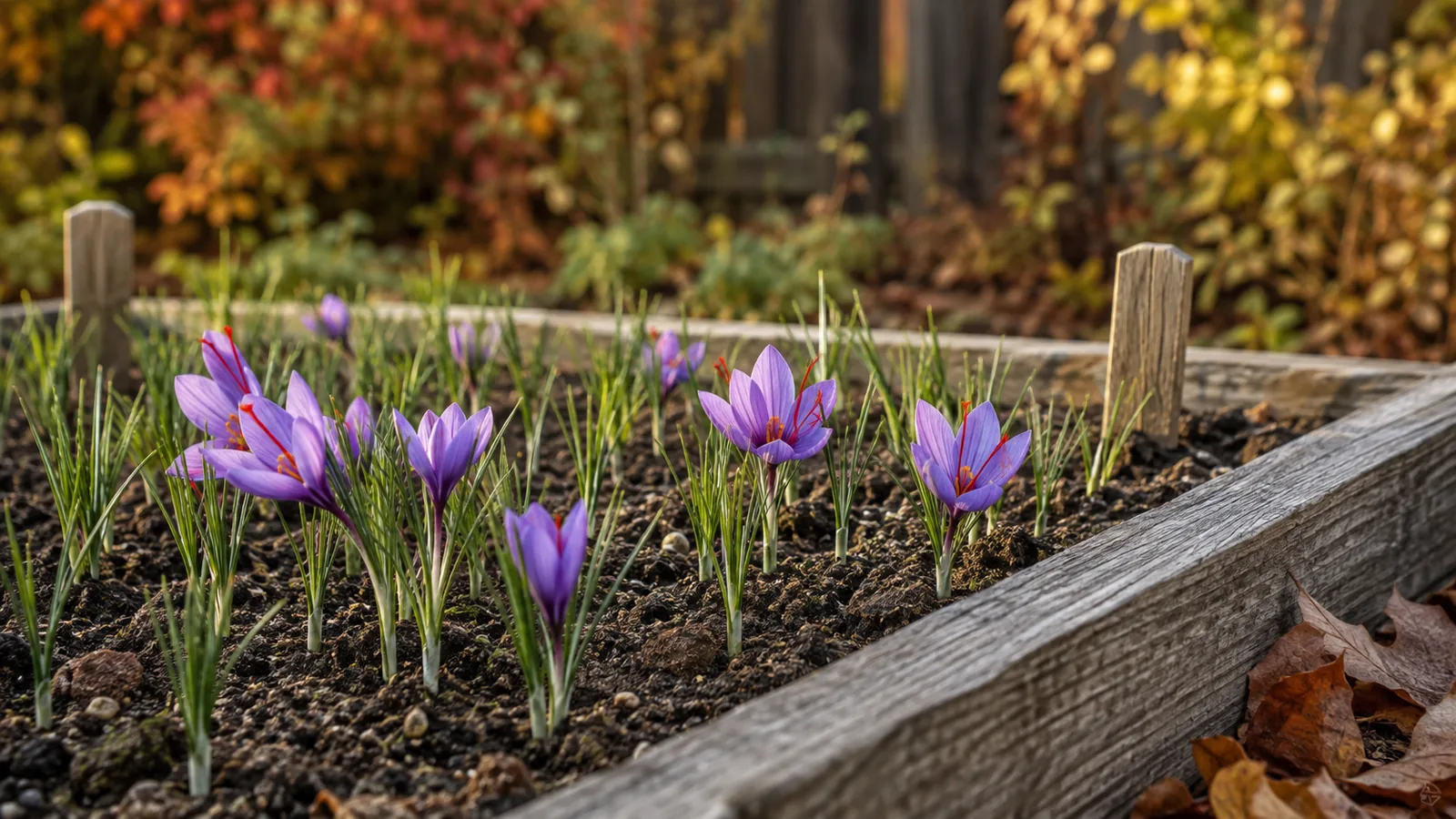
Flowers usually appear in autumn, often in October or November depending on climate and planting time. Each flower contains three red stigmas, the part dried as saffron. A mature corm planted at the right time may flower in its first autumn, although a new bed can be later or sparse.
Saffron normally has one bloom season a year. A grower may pick flowers on several mornings as individual buds open, but that is one seasonal harvest window, not several separate annual crops. Our practical guide to harvesting saffron from crocus flowers covers picking, stigma separation, drying, and storage.
Winter and early spring: leaves feed the next corms
After the flowers fade, the narrow green leaves continue growing. They gather energy while new corms develop below the surface. This is the part of the saffron growth cycle that is easy to overlook because there is no spice to pick.
Leave healthy foliage in place. Cutting it back while green deprives the developing corms of energy and may reduce later flowering. Water according to soil and weather, avoiding both prolonged saturation and a rigid calendar.
Late spring and summer: dieback and dormancy
The foliage yellows and dries naturally as the warm season approaches. Once it is fully brown, it can be cleared gently. The corms then rest underground through summer, and the bare-looking bed is not necessarily dead.
The University of Vermont’s saffron production-cycle guide places flowering in October–November, vegetative growth in the cooler months, daughter-corm development in spring, and dormancy in summer. Local dates vary, but that sequence explains how saffron comes back every year.
How many years can a saffron bed keep returning?
A productive planting can remain in place for several years. There is no universal moment when every corm “loses vigour” at year three or four. The more common issue is crowding: daughter corms multiply, compete for space and nutrients, and eventually benefit from being lifted and divided.
Inspect performance rather than replacing healthy corms on a fixed date. If flower numbers fall, leaves become crowded, drainage has deteriorated, or the bed contains many small corms, divide it during dormancy and replant the best firm corms at proper spacing. Discard anything soft, mouldy, or rotten.
Penn State Extension notes in its home saffron production guide that flower numbers may rise substantially in years two and three as corms establish and increase. A weak first harvest therefore does not predict the lifetime yield of the bed.
What helps saffron return reliably?
Free drainage
Waterlogged soil is one of the clearest threats to corm survival. Improve a heavy site before planting, use a raised bed where appropriate, and never leave a container standing in water. Summer rain is less troublesome when it drains quickly.
Strong light
Saffron favours full sun. Shade may produce weak foliage and fewer flowers. In a hot region, the exact site choice can balance light with local heat and moisture, but a dim position is not a substitute for a well-chosen microclimate.
Leaves left until natural dieback
The harvest ends when the stigmas are collected; plant care does not. Keep the foliage intact through its active season so replacement corms can develop. Remove only dead leaves, not green ones.
Room for daughter corms
Start with sensible spacing and divide an overcrowded clump during dormancy. Replant firm flowering-size corms and give smaller cormlets time to mature. The RHS notes that small cormlets may need two or three years before they flower.
Correct plant identity
Only Crocus sativus produces culinary saffron. It must not be confused with toxic Colchicum, also called autumn crocus or meadow saffron. Buy correctly labelled corms from a specialist plant supplier; Crocus sativus is sterile and is propagated by corm division, not ordinary garden seed.
Will saffron return in pots or indoors?
Saffron can return in a container if the pot is deep enough, drains freely, receives strong light, and is cared for through dormancy. A container is not a one-season floral display unless you choose to treat it that way. The corms need their green leaves after flowering and a comparatively dry summer rest.
Indoor conditions can be more difficult because a warm, dim room blurs the seasonal cues and weakens growth. A bright, cool sunroom or protected structure is usually more suitable. See our separate guide to growing saffron indoors for container depth, lighting, watering, and seasonal care.
Can saffron regrow in hot, wet, or cold climates?
Country or state names alone cannot answer whether a saffron planting will return. A garden in Florida, Texas, Georgia, Michigan, Wisconsin, Canada, the UK, or Australia may have very different winter lows, summer rainfall, soil drainage, humidity, and protected microclimates. Evaluate the actual site rather than copying a regional promise.
In a wet-summer climate, drainage and rain protection during dormancy become especially important. In a very cold climate, the plant itself may tolerate substantial cold, but a shallow pot is more exposed than corms planted correctly in the ground. In a hot humid climate, raised beds or containers can make moisture easier to manage. A local extension service or horticultural society can help translate general saffron requirements into a regional plan.
Does harvesting stop saffron from coming back?
No. Removing the flowers or their three red stigmas does not normally prevent annual regrowth. Over-harvesting is not the central issue; cutting the foliage, injuring corms, poor drainage, disease, or neglecting the seasonal cycle is more damaging.
Pick flowers gently and leave the leaves and corms intact. The following season’s growth depends on the plant’s health after flowering, not on leaving the culinary stigmas attached.
How long does the full cycle take?
The plant completes one seasonal cycle each year, but different milestones use different clocks. Flowers may appear only weeks after a mature corm is planted, while a bed often takes two or three seasons to build stronger yields. Smaller daughter corms may also need years before they bloom. Our detailed saffron growing-time guide separates first flowers, annual growth, and mature-bed yield.
The simple rule for yearly regrowth
Think beyond the autumn flower. Plant sound Crocus sativus corms in sun and free-draining soil, harvest the stigmas without damaging the leaves, let foliage feed the replacement corms, keep dormancy relatively dry, and divide the clump when crowding reduces performance. Follow that rhythm and saffron can return for years.
If you are looking for culinary saffron rather than planting corms, you can compare the formats in our saffron shop.