


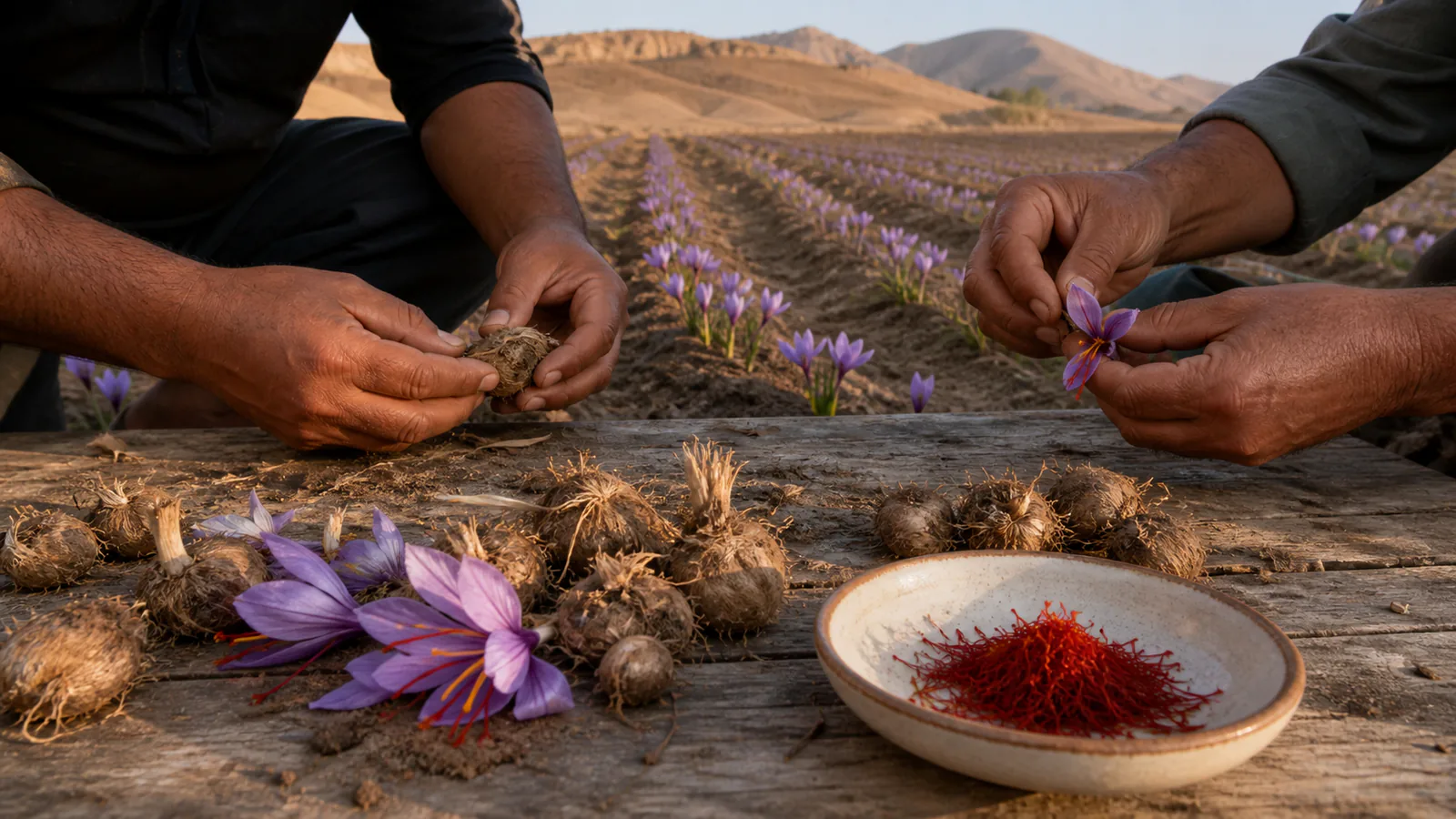
The history of saffron begins with a sterile autumn-flowering crocus, probably domesticated in Bronze Age Greece, and follows the people who carried, cultivated, traded, and interpreted it across the Mediterranean and Asia. Persia became one of saffron’s great cultural and agricultural homes; Iran is now its dominant producer. Those are connected chapters, but they are not the same as the crop’s botanical origin.
Saffron is the dried red stigma of Crocus sativus. Every flower produces only three stigmas, which are separated and dried with care. This small yield, together with hand harvesting and a short flowering season, helps explain why the spice has remained valuable for centuries.
Genetics places saffron’s origin near ancient Athens
Older accounts proposed Greece, Crete, the wider Mediterranean, Iran, or the Zagros Mountains as saffron’s birthplace. Modern genetic evidence has narrowed that debate. A 2019 genome-wide study of cultivated saffron and wild crocuses identified the Greek species Crocus cartwrightianus as the crop’s sole progenitor. The closest sampled wild population was near Athens, leading the researchers to place its evolution and domestication in Attica.
Crocus sativus is an autotriploid: it carries three sets of chromosomes and is sterile. Farmers therefore propagate it by dividing and replanting corms rather than by sowing seed. That biological fact matters to the history. Saffron did not spread as a packet of seed; living planting material and cultivation knowledge had to move together.
Bronze Age art records an early saffron culture
Crocus-gathering scenes survive in Aegean frescoes from Knossos and Akrotiri. A 2022 review of ancient artworks and crocus genetics discusses examples dating roughly to 1700–1500 BCE and finds that the artistic and genetic evidence point in the same Greek direction.
A painted flower cannot always be assigned to a modern species with certainty. The scenes nevertheless show that gathering and using crocuses had cultural importance in the Bronze Age Aegean. They are stronger evidence than the many later legends that attach saffron to famous rulers or miraculous cures.
Saffron moved through several ancient cultures
For more than three millennia, saffron or closely related crocus material appeared in the art, texts, food, fragrance, textiles, and traditional practices of communities around the Mediterranean and western Asia. Ancient Greece and Persia are both central to that record. Assyrian, Egyptian, Roman, and later Islamic sources add further evidence of a spice valued for colour, aroma, ceremony, and trade.
The precise route and date of every transfer are not known. Claims that one named conqueror introduced saffron to an entire region, or that it reached Kashmir or China in one exact year, often repeat attractive stories without enough primary evidence. A sound history separates what is documented from what is merely possible.
Traditional medical use is also historical evidence, not proof that the spice treated the conditions named in old texts. Modern health questions require clinical evidence, suitable doses, and medical context; an ancient remedy should not be presented as a modern cure.
Persia gave saffron a lasting agricultural and cultural home
Persian sources describe saffron in foods, perfumes, cosmetics, dyes, gifts, and trade. Over generations, growers adapted corm selection, field care, flower picking, stigma separation, and drying to Iran’s dry and semi-dry regions. Khorasan became especially closely associated with the crop.
This deep Persian history is why the phrase “Iranian saffron” carries real geographic and commercial meaning even though genetics points to an Attic origin. Readers looking for the Iran-specific chronology, old production records, and modern branding story can continue to the site’s history of Iranian saffron.
How the crop’s biology shaped its journey
Saffron does not behave like a typical spring-sown crop. Flowering usually comes in autumn. Leaves then support growth through the cooler part of the year, replacement corms develop below ground, and the plant enters dormancy during the warmer period. The exact timing changes with location, field management, temperature, water, and the condition and planting depth of the corms.
These features made saffron attractive in some water-limited farming systems, but “low water requirement” should not be mistaken for “no water management.” Establishment, flowering, leaf growth, corm development, drainage, and disease pressure all respond to local conditions.
What the absorbed ecophysiology note adds
The source article made a useful caution: findings from other crops should not automatically be applied to saffron. Much of the plant’s annual cycle happens in the corm and surrounding soil, so air temperature alone does not describe its growing environment. Soil temperature, moisture, precipitation timing, leaf development, and corm reserves interact.
An older preliminary trial quoted by the source reported a low leaf area index of about 1.24 and noted that saffron’s canopy structure had not been studied in detail. Leaf area index describes leaf area relative to ground area; it is not a permanent species constant. Planting density, leaf age, field age, measurement method, climate, and management can change it, so the 1.24 figure should be read as one early observation rather than a universal target.
A later scholarly chapter on saffron ecophysiology reviews temperature and precipitation, flowering and survival, the vegetative and dormant phases, replacement corms, leaf area index, and crop growth. It supports the larger point: saffron has its own seasonal physiology, and important relationships between canopy, corm environment, yield, and quality still need field-specific study.
From regional crop to global commodity
Cultivation spread to areas that could support the crop and the labor needed to pick flowers and separate stigmas quickly. Iran, India, Greece, Spain, Italy, Morocco, Afghanistan, and other producers developed distinct growing and processing traditions. The trade also changed from local exchange to international lots judged by origin, cleanliness, moisture, aroma, colour, and laboratory measures.
Iran eventually became the center of modern production. In 2025, FAO stated that the country produces more than 90% of the world’s saffron. That is a statement about present production leadership, not evidence that the crop was first domesticated there.
An older version of this page recorded 160 tonnes of Iranian output in Iranian year 1380, approximately 2001–02, and 47,208 hectares under cultivation. It also cited 270 person-days of work per hectare. Multiplying those last two figures gives roughly 12.7 million person-days, not 12.7 million permanent jobs. These numbers are preserved as historical snapshots; they should not be used as current statistics.
Quality standards are the modern continuation of an old craft
For much of saffron’s history, buyers relied on sight, smell, reputation, and origin. Those judgments still matter, but modern trade also needs defined sampling and testing. ISO 3632-1:2025 specifies requirements for dried saffron obtained from the stigmas of Crocus sativus.
The emphasis on identity is important. Research into petals, leaves, stamens, or corm by-products does not make those tissues interchangeable with saffron spice, nor does it automatically establish that a proposed food, feed, dye, or starch use is safe and lawful. Product identity, processing, contaminants, dose, and local regulation still have to be assessed.
Why saffron’s history remains unfinished
Saffron survived because people kept moving corms, knowledge, and markets from one generation to the next. Its genetic origin is now clearer, yet the historical record still contains gaps. Its physiology is better studied than the absorbed source suggested, yet growers still need locally tested answers about climate, soil moisture, canopy performance, corm renewal, yield, and quality.
That combination makes saffron unusual: an ancient clonal crop with a well-supported Aegean origin, a profound Persian legacy, and a modern supply chain led by Iran. Its story is not a single national claim or a string of legends. It is the continuing history of one plant and the communities that learned how to keep it alive.