


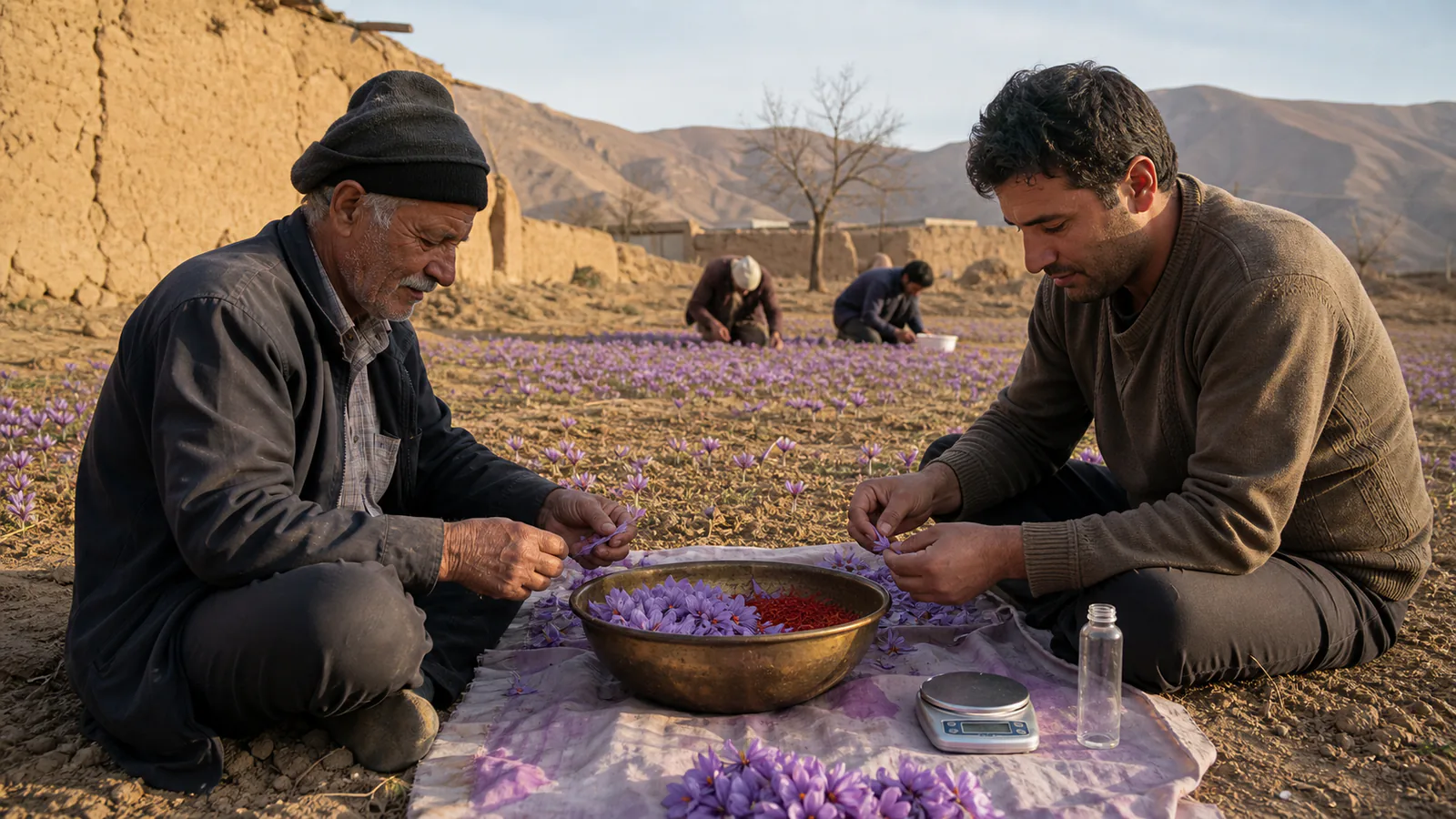
The history of Iranian saffron combines two different stories: the crop’s likely botanical domestication in ancient Greece and its long cultivation, refinement, and commercial importance in Iran. Modern genetic work places the origin of cultivated Crocus sativus near Attica, while historical scholarship documents saffron in Persian food, fragrance, textiles, gifts, and trade. Iran later became the dominant modern producer.
Keeping origin and production leadership separate resolves an old argument. A crop can have been domesticated in one region, carried and cultivated across several ancient cultures, and become economically identified with another over centuries.
Where cultivated saffron most likely originated
The older version of this article presented Greece, the Mediterranean, and Iran’s Zagros Mountains as competing possibilities. That reflected a genuine historical debate, but newer genetic evidence is more specific.
A 2019 genome-wide and chloroplast study identified the wild Greek species Crocus cartwrightianus as the sole progenitor of cultivated saffron. The closest sampled population was near Athens, leading the authors to place saffron’s evolution and domestication in Attica.
Cultivated saffron is a sterile triploid. It does not reproduce reliably from seed and has been propagated by dividing corms, helping explain how one clonal crop could spread along ancient exchange routes while retaining a narrow genetic lineage.
Ancient art supports a Bronze Age Aegean history
Crocus-gathering scenes appear in Bronze Age Aegean art. A 2022 review combining ancient artworks and genetics discusses frescoes from Knossos and Akrotiri dated roughly to 1700–1500 BCE and concludes that the archaeological and genomic evidence point in the same Greek direction.
Art cannot identify every depicted crocus with the certainty of a DNA test. It does show that gathering and using crocus flowers had cultural importance in the Aegean more than three millennia ago.
This evidence corrects a common shortcut: “Iranian saffron” describes a major cultivation and commercial tradition, not necessarily the place where the sterile crop first arose.
Saffron also has a deep history in Iran
Correcting botanical origin does not erase Persian saffron history. A scholarly chapter on saffron in ancient Iran reviews written sources from before and after the Islamic period, including production places and uses in food, cosmetics, fragrance, gifts, textiles, painting, and dyeing.
The old page’s claim of more than 2,500 years should be understood as a broad statement about a long Iranian tradition, not a precise domestication date. Different evidence answers different questions: genetics addresses ancestry; texts and material culture address where people grew, traded, and used the crop.
Over time, cultivation became strongly associated with Iran’s dry and semi-dry regions, particularly the Khorasan provinces, while also extending to provinces such as Fars, Kerman, Yazd, and many smaller production areas. The old wording that cultivation was “limited” to a few provinces is no longer a safe description.
Why Iran became the modern center of saffron
Saffron’s autumn flowering and dormant summer period can fit farming systems in water-scarce regions, provided the field has suitable soil, climate, healthy corms, and managed irrigation. Harvesting and stigma separation also draw heavily on seasonal labor.
FAO stated in a 2025 announcement on saffron authenticity testing in Iran that the country produces more than 90% of the world’s saffron. That official figure supports Iran’s modern production leadership without requiring the old article’s broken “90 . / .” sentence.
Production dominance does not mean every crop year is the same. Area, weather, irrigation, field age, corm health, labor, drying, market access, and reporting methods can all change output.
The old production and labor figures are historical snapshots
The original article recorded 160 tonnes of Iranian saffron in Iranian year 1380, roughly 2001–02. It also cited 47,208 hectares and 270 person-days of work per hectare.
Multiplying those two labor figures gives 12,746,160 person-days, or about 12.7 million. That is consistent with the garbled “7/12 million” wording in the old translation, but it remains an estimate from an earlier production structure.
Person-days are not the same as unique or permanent jobs. A worker employed on ten days contributes ten person-days. A current employment estimate would need the harvest year, tasks included, unique workers, workdays, hours, wages, gender and household distribution, and whether family labor was counted.
The spice is the dried stigma, and quality depends on handling
Commercial saffron is made from the dried stigmas of Crocus sativus. Flowers must be picked, separated, dried, protected, and stored with enough control to preserve a traceable, saleable batch.
The old article speculated about petals, leaves, and small corms as food, feed, pigment, or starch by-products. Those ideas should not be treated as approved uses without identity, safety, processing, contaminant, and regulatory evidence for the intended market.
ISO 3632-1:2025 specifies requirements for dried saffron in filament, cut-filament, and powder forms. Modern value depends not only on growing flowers but also on moisture control, authenticity, lot separation, testing, packaging, and records.
From production leadership to the branding problem
In a later historical interview, Mohsen Ehtesham—identified in the translated source as head of the South Khorasan Chamber of Commerce—argued that Iran’s production advantage was not being converted into enough branded, value-added trade.
He said more than 90% of Iranian saffron was exported without an Iranian name, logo, or consumer brand and was then repackaged or re-exported under other countries’ identities. The article does not provide customs records or a methodology for that percentage, so it should remain an attributed claim from that period.
Bulk export is not automatically abuse. Business-to-business buyers may legitimately need bulk ingredients. The value problem arises when origin, quality, traceability, and bargaining power are weak enough that growers and processors capture little of the final retail margin.
The 17% export rise belongs to Iranian year 1393
Ehtesham said national saffron exports in Iranian year 1393 increased about 17% over 1392, roughly comparing 2014–15 with 2013–14. That is a historical year-on-year statement, not a current export trend.
He also claimed Iran supplied more than 96% of the world’s saffron corms. The translated article gives no dataset, legal-export definition, or distinction between corm stock inside Iran and internationally traded corms. It should not be repeated as a verified current share.
His broader point was that biological and production capacity alone did not guarantee market power. Reliable comparison today would require dated customs codes, shipment weight and value, destination, product form, origin labeling, and branded versus bulk sales.
Finance and exhibition costs were part of the complaint
The Chamber representative contrasted a reported 22% domestic financing rate for production and export with about 3.5% for exporters in Spain. He also said Iranian exporters bore 50% of the cost of participating in international exhibitions.
No loan product, term, currency, security, subsidy, source country program, exhibition, or accounting basis is identified. The percentages are useful evidence of the competitive concern he raised, but not a current financing comparison.
He called for lower-cost finance, stronger specialist exporters, marketing, branding, and sustained international presence. Any current policy assessment would need actual approved rates, total borrowing cost, eligible firms, disbursement, export results, and the value returned to farmers.
Intermediaries and corm movement were also concerns
The interview warned farmers about unrecorded saffron-corm sales and argued that specialist export companies could shorten the chain between growers and overseas markets. It also criticized traders who bought cheaply at the start of the season, stored product, and sold later after prices rose.
Those are allegations about market structure, not proof that every intermediary harms farmers. Storage, aggregation, finance, grading, and market access can provide real services. The relevant question is whether contracts, weights, grades, fees, ownership, and price formation are transparent.
The same speaker used barberry as a parallel example of a high-value South Khorasan crop with weak international recognition. That comparison belongs to the history of the policy argument; it is not evidence about saffron production volume.
What stronger Iranian saffron value capture requires
A credible modern strategy starts before the label. It needs authenticated corm and farm records, clean harvest and drying, batch testing, lot traceability, product specifications, reliable storage, contractual origin, and documentation that follows the product through packing and export.
Branding then has something verifiable to communicate: where the saffron came from, who produced it, how it was handled, what was tested, what grade or specification the buyer receives, and how claims can be checked.
The historical lesson is not that Iran lacks saffron identity. Iran built the world’s dominant production system around a crop with ancient Mediterranean ancestry and a long Persian history. The unfinished task described by the Chamber interview was to convert that scale into transparent origin, consistent quality, stronger brands, and a fairer share of final value.

![Exporting Saffron to Turkey + Price Guide [Complete 0 to 100]](https://img.rowhanisaffron.com/20260827003933/saffron-export-turkey-quality-inspection.webp)



