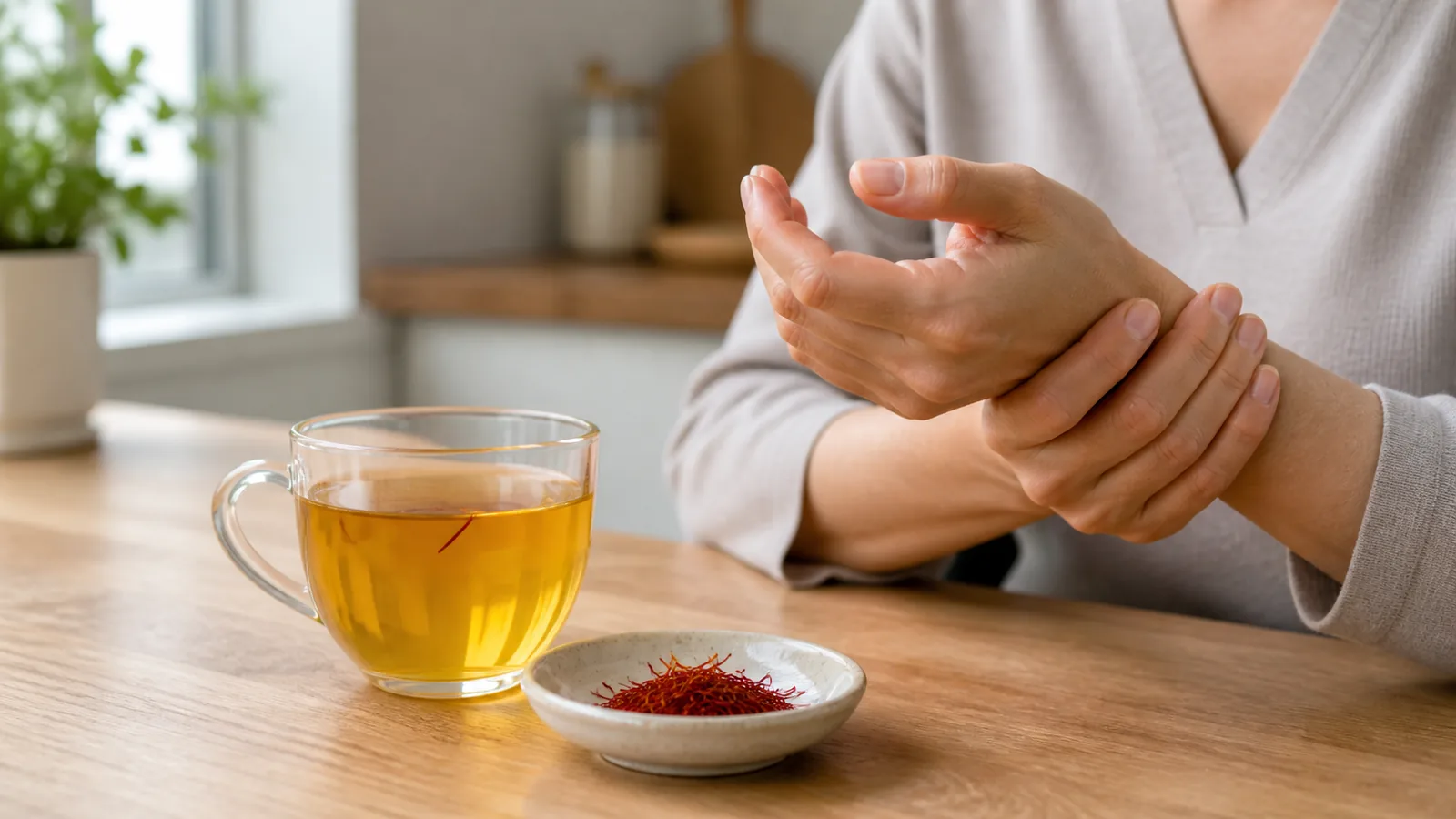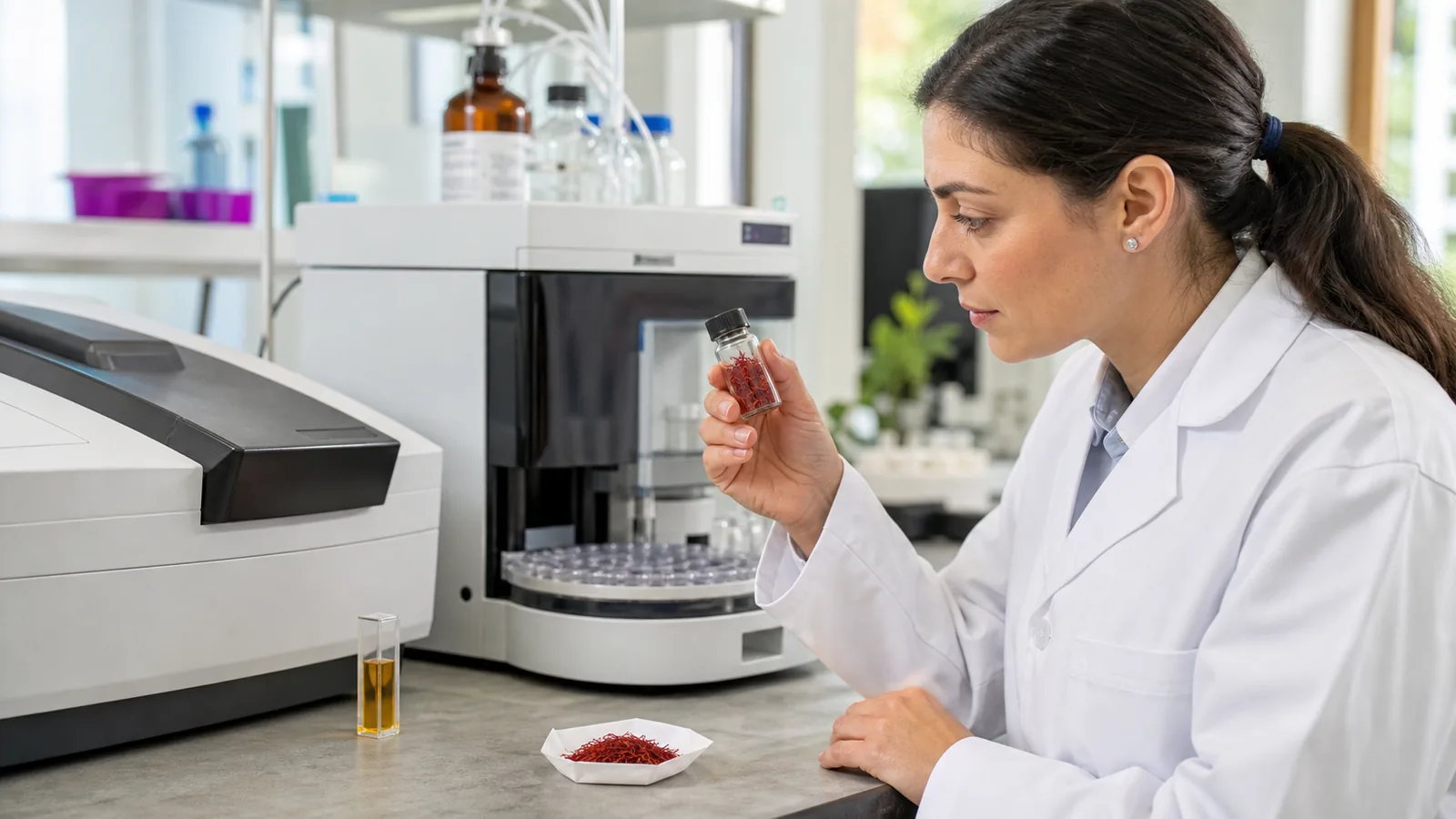
Standard Saffron is still a plant product, so it does not have one fixed chemical formula. A sound standard defines what the product is, the condition it must meet and how a laboratory should test it. The chemistry then helps explain the three qualities people notice in the kitchen: saffron’s yellow colour, its distinctive bitterness and its aroma.
The short version is that crocins provide most of the colouring strength, picrocrocin contributes the characteristic bitter taste, and safranal is an important part of the aroma. Harvesting, drying and storage affect that balance. A certificate should therefore identify the lot and test method rather than simply call the material “premium” or quote an unexplained grade.
What does “standard saffron” mean?
In formal trade, a standard Saffron specification begins with dried material from the pistils of Crocus sativus L. It can be sold as filaments, cut filaments or powder. The current ISO specification is ISO 3632-1:2025; the ISO catalogue lists ISO 3632-2:2010 as the current test-method document, confirmed in 2022. Codex CXS 351-2022 provides an international food standard for dried saffron as well.
These documents do more than name the main aroma and colour compounds. They address physical condition, moisture and volatile matter, extraneous material and other quality measurements. Exact contract requirements may differ by market, product form and intended use. Our practical guide to Iranian saffron standards explains how those requirements are read on a specification sheet.
The phrase saffron chemical sometimes appears in searches, but saffron is not a single chemical. It is dried floral tissue containing many natural compounds. The three marker families below are especially useful because they connect laboratory measurements with familiar sensory properties.
Saffron chemical composition: the three familiar markers
Crocins and crocetin: colour
Crocetin is a carotenoid framework. When sugars are attached to it, the resulting glycosyl esters are known collectively as crocins. Their polar sugar groups help make the colour disperse in water, which is why a small quantity of saffron can turn an infusion yellow-gold.
The old version of this page called crocetin the main pigment, then described a garbled “crocetin ments of Genetic Astrdy.” The useful meaning behind that sentence was crocetin glycosyl esters: crocins. A laboratory can assess the colouring characteristic spectrophotometrically, while chromatographic methods can separate individual crocin compounds for a more detailed profile.
Picrocrocin: bitter taste
Picrocrocin is a monoterpene glycoside associated with saffron’s bitter flavour. An earlier translation on this page called it “Esherishia,” which is not the accepted name of a saffron quality compound. Picrocrocin is also relevant to aroma development because it can break down during processing and storage, contributing to the formation of safranal.
Safranal and other volatiles: aroma
Safranal is a volatile aldehyde strongly associated with dried saffron’s aroma. It is not a pigment, and it should not be described as the source of saffron’s colour. Fresh stigmas and finished spice do not have identical volatile profiles: biochemical changes during drying help develop the aroma people recognise.
The former article said safranal, together with “about 9 other compounds,” caused the aroma. That number is too narrow to use as a general rule. Researchers have identified a much broader volatile mixture, and its proportions vary with origin, handling and analytical technique. Safranal remains a useful marker, but the smell of a lot cannot be reduced to one fixed recipe.
The ordinary components still matter
Dried stigmas also contain the common components the original article mentioned: water, carbohydrates, protein, fat, minerals and vitamins. Their presence does not by itself establish a commercial grade. The old page said this mixture determined saffron’s “quality and price”; composition matters, but market price also reflects form, supply, origin, contract terms and current demand. Moisture is particularly important because excess water adds weight and can shorten storage life. Ash-related measurements can help a laboratory evaluate mineral residue and possible contamination, depending on the method and specification being applied.
Colouring strength is likewise only one part of quality. A vivid extract does not answer every authenticity question, and a high result in one measurement cannot excuse foreign material, poor hygiene or an unsuitable moisture level. Product form matters too. Powder is harder to examine visually than intact filaments, so traceability and an appropriate test plan become more valuable.
How processing changes the finished spice
Separation and cleaning
After the flowers are picked, the red stigma branches are separated from petals and stamens. The chosen commercial form determines how much pale style remains and whether the red material is kept long or cut. Cleaning removes floral waste and visible foreign matter before drying or during subsequent sorting.
Drying
Drying reduces moisture and stabilises the delicate tissue. The method, temperature, airflow and duration influence the final balance of colour, taste and aroma. Too little drying leaves an unstable, heavy product; harsh or prolonged treatment can damage desirable compounds. There is no honest universal time-and-temperature instruction for every dryer and batch, because layer depth, starting moisture and equipment differ.
This stage also explains the old page’s partly correct statement that a compound changes into safranal while saffron is kept dry. Safranal can develop from picrocrocin-related pathways during drying and storage. That does not mean that more heat or a longer wait always creates better aroma. Process control matters.
Conditioning, packing and storage
Once dry, saffron is allowed to reach a stable condition, then graded and packed. Moisture, oxygen, light and heat can change the product over time. A barrier container stored in a cool, dry, dark place is preferable to a clear open vessel beside a hot cooking area. Strong neighbouring odours are also unwelcome because saffron is sold for its own aroma.
How laboratories measure colour, taste and aroma
The original page correctly named spectrophotometry and high performance liquid chromatography, although it did not explain their different jobs.
- UV-visible spectrophotometry measures how a prepared saffron extract absorbs light at specified wavelengths. Standardised procedures use these readings to assess characteristic strength. Sample preparation, instrument settings and the stated method are essential; a bare number without them is difficult to compare.
- High-performance liquid chromatography (HPLC) separates compounds before detection. Researchers and specialist laboratories use it to examine individual crocins, picrocrocin, safranal and other constituents in more detail.
- Gas chromatography, often coupled with mass spectrometry, is useful for profiling volatile aroma compounds.
- Microscopy and complementary spectroscopic methods can support identity and adulteration work, especially when the question extends beyond the three headline markers.
A result is only as reliable as the sample and procedure. The test portion must represent the lot, equipment must be suitable, and the report should identify the method. Our separate review of Iranian saffron compositional analysis looks more closely at how analytical profiles are interpreted.
What a useful certificate should show
For a wholesale purchase, ask for a certificate of analysis tied to the actual batch. It should state the product form, lot number, sampling or test date, laboratory or responsible party, method references, results, units and acceptance limits. Relevant tests depend on the contract, but a practical review commonly includes:
- moisture and volatile matter;
- extraneous material and floral waste where applicable;
- ash-related measures;
- the standard’s colour, taste and aroma characteristics;
- microbiological, residue or contaminant tests required by the destination market;
- an authenticity plan when substitution or adulteration is a material risk.
Do not compare two certificates until you have checked that they use the same method, units and basis. A marketing label such as “superior” is not a substitute for that information. Nor should a laboratory result be stretched into a medical claim; composition and culinary quality tests do not prove that a product treats disease.
Reading the chemistry without oversimplifying it
A good lot brings the three sensory strands together: crocins support colouring, picrocrocin contributes bitterness, and safranal participates in aroma. Their measured values are shaped by the crop and everything that happens after harvest. Variety labels, origin stories and thread appearance may add context, yet none replaces a lot-specific result when a contract depends on defined limits.
That is the useful meaning of processing and chemical composition in standard Saffron. Start with correctly identified Crocus sativus, control separation and drying, protect the finished spice, then test it with a named method. The result is evidence a buyer can compare, rather than a claim resting on colour or scent alone.
Sources and review note
This article was reviewed on 28 August 2026 against the official ISO 3632-1:2025 specification record, the current ISO 3632-2:2010 test-method record, the FAO/WHO Codex CXS 351-2022 saffron standard, and an open-access peer-reviewed review of analytical methods for saffron quality assessment. The article explains principles rather than reproducing proprietary test procedures or setting a buyer’s legal specification.