Saffron flower drying methods begin well before the dryer is switched on. Flowers have to be picked cleanly, moved without crushing, opened promptly and separated on a sanitary surface. Drying then removes enough moisture to stabilise the red stigmas while developing the colour, bitterness and aroma expected from finished saffron.
For anyone asking how to dry saffron, the safest general answer is: work with a small, identified lot; spread the stigmas in a thin, even layer; use clean equipment and controlled heat or airflow; check the material frequently; and stop when the target dryness is reached. A temperature copied from another farm is not a complete process. Load depth, airflow, starting moisture and equipment behaviour all affect the result.
From the field to the drying room
Flower emergence and harvest planning
Saffron flowers commonly begin to appear about two to three weeks after the first autumn irrigation, although temperature, soil moisture and local conditions shift the timing. In Khorasan, flowering can run from late October into late November. Cooler areas may flower earlier after irrigation than warmer ones, and very cold irrigation water or a warm autumn can change the interval.
That old observation remains useful for planning labour and dryer capacity. A field can produce a concentrated flush of flowers, and a processor who cannot separate and dry them promptly may lose quality before the equipment becomes the limiting step.
Pick clean, dry flowers
Harvest is usually scheduled for the early morning, preferably after dew has lifted and while many flowers are still opening or in bud. The compact form is easier to handle, reduces mechanical damage and protects the stigma better than a fully spread flower. Do not collect visibly mouldy flowers or blooms contaminated with soil.
Use clean, ventilated containers and keep the layer shallow. A deep sack or tightly packed basket traps heat, compresses the flowers and encourages condensation. Keep harvested flowers shaded from sun and protected from dust, rain, animals and strong odours during transport.
Separate the stigmas promptly
Open the flowers and remove the stigma within a few hours when possible. University of Vermont Extension advises refrigeration if immediate separation is impossible, while still aiming to finish within 24 hours. Refrigeration buys time; it does not repair flowers already crushed or warmed in a heap.
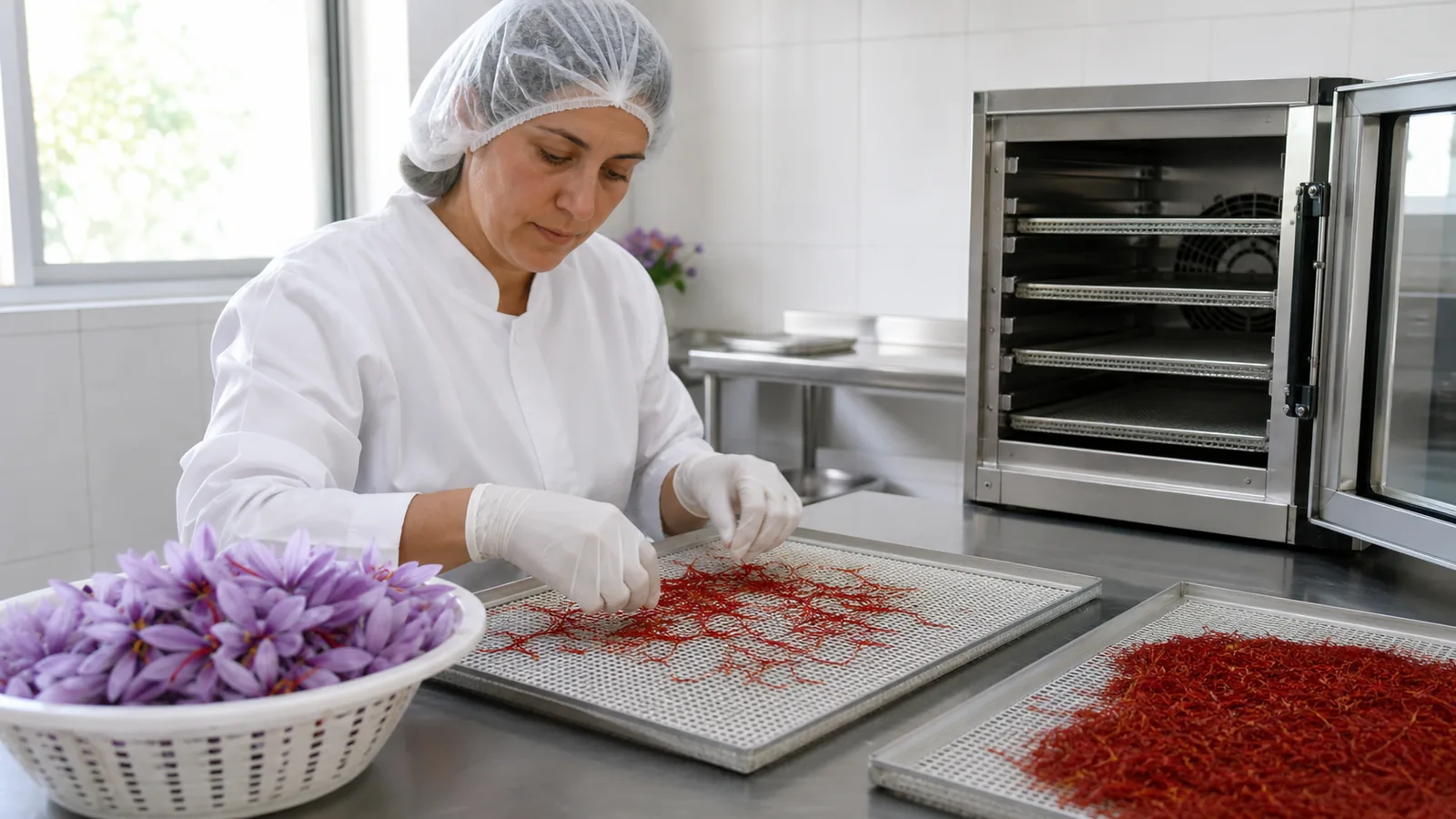
Set aside a washable work area for this task. Hands, trays, tools and contact surfaces should be clean before each lot. Maintain the field and harvest identity as flowers move through separation, drying and storage. That basic traceability matters more than a decorative grade name.
What is separated from the saffron flower?
Each Saffron flower has three red stigma branches joined to a pale style. The cut made during separation determines the commercial form that will be dried.
- Dasteh, Dokhtarpich or Bunch: the three branches remain connected with a substantial pale style and may be arranged together before drying. The earlier page referred to this as farmer “categories.”
- Sargol or all-red cut: the red stigma is separated at or near the junction with the pale style. The old translation called this “saffron flower heads.”
- Pushal: the red stigma keeps a small portion of yellow or pale style. The former phrase “straw saffron” was a mistranslation of this red-and-style form.
Keep a consistent cut within a lot. Mixing forms after drying makes the specification harder to explain and can create an uneven drying load because thick junctions and fine tips do not always lose moisture at the same rate. Our guide to types of saffron compares these names in more detail.
How to dry saffron with controlled warm air
A food dehydrator or controlled convection dryer is the most practical method for repeatable small and medium batches. The process should be validated on the actual machine rather than managed by the dial alone.
- Prepare the dryer. Clean food-contact surfaces, verify that the chamber is free of odours and, where possible, check air temperature with an independent instrument.
- Load one thin layer. Spread fresh stigmas on food-grade mesh or parchment-lined trays. Avoid clumps and overlapping piles. Record the wet weight and lot number.
- Use steady airflow and controlled heat. Research has produced good results across different temperature-and-time combinations, including moderate drying near 50–70°C and shorter high-temperature processes in specific equipment. These are study conditions, not interchangeable recipes.
- Rotate or assess trays. Household and farm dryers often have warmer shelves and cooler corners. Move trays only when the process calls for it, and keep the lot protected during inspection.
- Check the endpoint. UVM’s post-harvest guidance uses a water content below 12% and notes that adequately dried stigmas snap when broken. Commercial lots should use an appropriate moisture method rather than touch alone.
- Cool before packing. Move the tray to a clean, low-humidity area, allow the saffron to cool fully, then weigh and seal it promptly.
Do not increase temperature simply to finish sooner. Drying transforms picrocrocin-related precursors and helps build safranal, but excessive heat or time can alter aroma and degrade sensitive colour compounds. The correct endpoint is a stable product with the intended analytical and sensory profile, not the darkest thread or strongest toasted smell.
The Spanish or heated-sieve method
The original article described a Spanish method that was replacing slow traditional drying in parts of Iran. It used a silk mesh sieve about 30 cm in diameter, a layer approximately 2 to 3 cm deep and a heater to shorten drying and reduce microbial growth.
The principle is still recognisable: put a controlled, even layer on a mesh and apply indirect heat uniformly. This can provide more rapid drying than an ambient shade method, with less time for microbial growth when hygiene and temperature are controlled. The historical dimensions should not be copied as a universal specification. A 2–3 cm layer can behave very differently depending on thread density, airflow and the heat source. Modern food-grade mesh, a measured chamber temperature, defined batch mass and an endpoint check produce a more transferable method.
Keep the saffron away from direct flame, combustion fumes and hot metal. If one side of the sieve receives most of the heat, the batch will dry unevenly. Any “Spanish” label describes a tradition, not proof that the process is hygienic or that the finished saffron meets a standard.
Traditional shade or room-air drying
Traditional saffron drying may involve laying separated stigmas on clean paper, cloth, glass or a tray in the shade. It needs little equipment, but it is slow and highly dependent on ambient humidity, air movement and sanitation. That is the disadvantage the old page tried to express: when drying takes too long, the material remains in a condition where microorganisms and quality loss are harder to control.
Room-air drying is a poor choice in humid weather or a dusty, busy room. If it is used in a reliably dry climate, protect the single layer from insects, splash, wind and contact, and measure the endpoint rather than assuming that elapsed time is enough. Direct sun is not a shortcut; light and uncontrolled heat can damage desirable compounds.
Microwave, vacuum and freeze drying
Researchers have tested microwave, vacuum-oven, freeze-drying and infrared systems. Each can change the drying curve and the balance of crocins, picrocrocin and volatile compounds. Microwave work, for example, shows that power and time interact: a high setting applied blindly can overheat a small load before moisture leaves evenly.
These methods belong in a validated process with equipment-specific settings. A published trial does not justify putting an unmeasured handful of stigma into a domestic microwave. Vacuum and freeze-drying can offer control but add cost, and their output should still be checked against the intended specification.
Why drying changes saffron quality
Fresh stigma is not simply wet finished spice. Drying creates the shelf-stable product and changes its chemistry. Crocins are closely associated with colouring strength, picrocrocin with bitter taste and safranal with aroma. Temperature, duration, oxygen exposure and the moisture-removal rate influence all three.
That is why studies can report different “best” treatments. Cultivar, growing conditions, initial moisture, batch size, dryer design and the quality measurement chosen are not identical. A method optimised for one Chinese laboratory sample, for example, should not automatically become the standard for a commercial Iranian dryer.
For sale or export, saffron drying should be part of a written standard operating procedure. Record the harvest date, lot, separation form, wet mass, dryer, loading depth, actual temperature, time, endpoint result, dry mass and person responsible. Test representative lots under the applicable saffron specification rather than relying on colour by eye.
Cooling, storage and reabsorption
Freshly dried saffron can reabsorb moisture from humid air. Let it cool in a clean protected place, then place it in an airtight food-grade container and store it in the dark. Do not seal a warm product if condensation could form, and do not leave the cooled tray exposed for hours while paperwork catches up.
Keep each storage container tied to its lot number. Check for unexpected softening, clumping, condensation, off-odours, insects or visible mould. Suspect material should be isolated and evaluated, not blended into a sound batch.
Common drying failures
- Flowers wait in a heap: heat and condensation build before separation.
- The stigma layer is too thick: the surface dries while the centre stays moist.
- Heat is uneven or unmeasured: one tray scorches while another remains flexible.
- Dryness is judged only by time: changes in load and ambient humidity are ignored.
- The product cools in open air: it picks up moisture or contamination again.
- Lots lose their identity: a result can no longer be traced back to its harvest and process.
A good method is the one a processor can repeat and verify. Prompt separation, a clean thin layer, controlled drying, a defined endpoint and protected storage form one continuous system. If any link is missing, a faster heater will not rescue the batch.
Sources and review note
This article was reviewed on 28 August 2026 against the current official record for ISO 21983:2019, confirmed in 2025; the University of Vermont Extension Saffron Post-Harvest Handling Best Practice Recommendations; a peer-reviewed study of electric, vacuum and microwave drying; and a peer-reviewed review of saffron compounds and commercial quality. Individual processors should validate time, temperature and endpoint for their equipment and applicable food standard.