


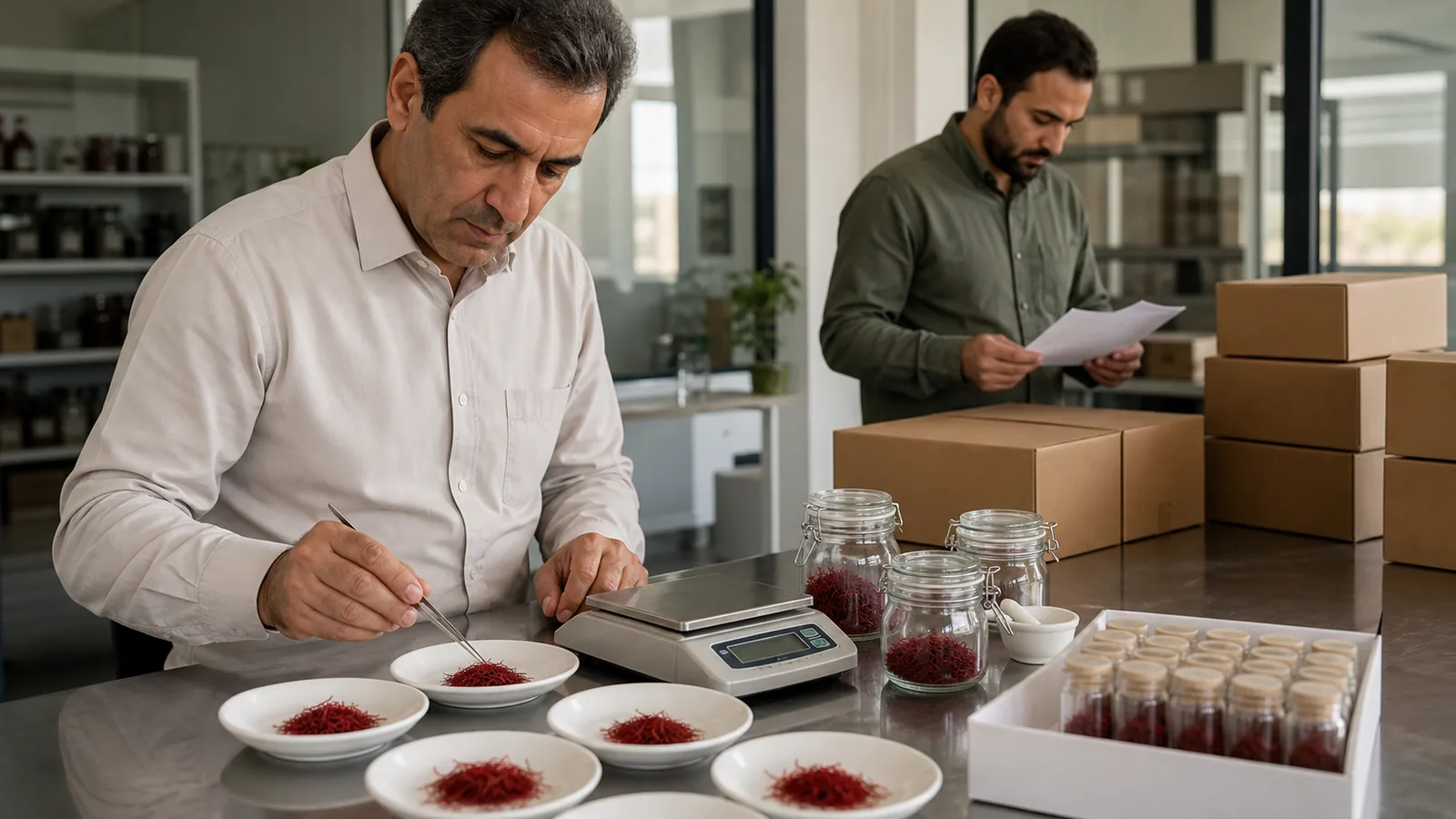
The economic importance of wholesale saffron begins well before a buyer asks for a price per kilogram. A commercial lot carries the work of growers, flower pickers, stigma separators, dryers, graders, laboratory staff, packers and freight teams. Its value depends on whether that chain can deliver the promised quality, in the promised form, with records that a buyer can verify.
Iran remains the centre of this trade. The Food and Agriculture Organization of the United Nations (FAO) currently describes the country as producing about 85–90% of the world’s saffron and says the crop supports hundreds of thousands of smallholders. The economic importance of saffron is clearest at that scale: wholesale trade affects rural incomes as well as exporters and food businesses.
Why saffron has unusual economic value
Saffron is valuable partly because the saleable product is such a small part of the flower. Each Crocus sativus flower supplies three red stigmas, which are normally separated by hand and carefully dried. A grower therefore needs a large flowering area, dependable seasonal labour and close control of drying to produce a modest weight of marketable spice.
The crop also follows a distinctive calendar. It flowers in autumn, when many fields are otherwise quiet, and most vegetative growth occurs through the cooler months. Its water demand can be lower than that of many irrigated alternatives, but “low water” does not mean no management. The timing of irrigation, soil condition, corm health, temperature and labour availability all influence yield and quality.
These features give saffron a useful place in dry regions. It can generate considerable value from a small physical volume, while harvesting and processing create concentrated periods of employment. FAO’s work in Iran links saffron with climate-resilient agriculture, rural development and the livelihoods of small-scale producers.
What the wholesale chain actually adds
A wholesale transaction is not merely a larger retail order. The product usually has to move through several controlled steps before it is suitable for a manufacturer, distributor or private-label customer:
- Lot formation: compatible material is assembled without losing farm, harvest or processing records.
- Grading and inspection: the physical form, colour, aroma, moisture condition and visible foreign matter are checked against the agreed specification.
- Testing: representative samples may be analysed for identity, quality characteristics, contaminants and any buyer-specific requirement.
- Packing: food-contact packaging protects the threads from moisture, light, crushing and cross-contamination.
- Documentation and delivery: batch references, certificates, invoices, customs documents and transport conditions must agree with the actual shipment.
Each step costs money, but each can also protect value. Poor drying can damage an otherwise good harvest. Weak lot control can make a laboratory result meaningless. A late or incorrectly documented shipment can be costly even when the saffron itself is sound.
Production leadership is not the whole trade story
Older descriptions often say that Iran produces “more than 90%” of the world’s saffron. That figure changes with the year and the method used to estimate informal and formal production. The more cautious current FAO range of 85–90% still identifies Iran as the leading producer without turning one historical estimate into a permanent number.
Production volume is also different from export value. Some saffron leaves the producing country in bulk and is then sorted, packaged, branded or distributed elsewhere. The businesses that control quality assurance, customer relationships and final presentation can retain part of the value that does not appear at the farm gate. A strong Iranian value chain therefore depends not only on growing more, but on selling verifiable quality in forms that end users need.
For a saffron wholesale buyer, the useful questions are practical: Which harvest and lot is being offered? Is the grade a clearly defined specification or only a trade name? What test methods were used? Does the certificate match the packed lot? What are the incoterm, payment, lead-time and minimum-order conditions? A low headline price cannot compensate for an unsuitable specification or an unreliable delivery.
Labour and rural income
The original version of this article recorded an estimate of 270 workdays per hectare across 47,208 hectares—about 12.7 million person-days. It also noted production of 160 tonnes in Iranian year 1380 (2001–2002), much of it intended for export. These are historical figures, not current benchmarks, but they show why saffron was already economically significant when the earlier material was assembled.
Employment is distributed unevenly through the season. Flower collection happens in a short window and is followed quickly by separation and drying. Families, seasonal workers, cooperatives, processors and traders may all participate. Later stages create different work in testing, packaging, design, sales, compliance and logistics.
That breadth matters. If a region sells only an undifferentiated raw commodity, its earnings are exposed to harvest swings and bargaining pressure. Better post-harvest practice, transparent grades and dependable market access give producers and processors more ways to compete than price alone.
Why production changes from one year to another
The former article attributed large fluctuations mainly to rainfall. Rain and irrigation matter, but they are only part of the explanation. The planted area, age and density of corms, summer heat, timing of the first irrigation, flowering weather, pests and disease, labour supply and harvesting speed can all affect the quantity that reaches the dryer. Drying losses, quality rejection and the way production is reported can change the commercial total again.
Wholesale planning therefore needs more than a national production headline. A serious wholesaler of saffron should monitor the condition of the relevant growing areas, obtain samples from the offered lots and allow for variation between harvests. Forward promises made before quality is known create risk for both supplier and buyer.
Food, fragrance and other end uses
Food remains saffron’s best-established market. It is used in rice, bakery and confectionery products, dairy foods, sauces and beverages for its colour, aroma and characteristic flavour. Different customers may prefer whole threads, cut material or powder, but powder requires especially strong identity and traceability controls because the buyer cannot examine the original thread structure.
Saffron and its constituents are also studied for non-food applications. Research interest should not be confused with permission to market a medical treatment. Health products, cosmetics, colour preparations and extracts are governed by the rules of the destination market and may require evidence or controls beyond those used for a culinary spice.
Can the rest of the flower create value?
The red stigmas are only a small fraction of the harvested flower. Petals and other floral material make up most of the remaining mass and are commonly discarded. Peer-reviewed research has identified anthocyanins and other compounds in these by-products, which explains interest in recovering colourants or useful extracts instead of treating every petal as waste.
The earlier article called the petal pigment “Antoine Sanyn”; the intended term was anthocyanin. Correcting the word does not make every petal preparation ready for food use. A proposed ingredient still needs suitable processing, composition and safety evidence, along with compliance in the market where it will be sold.
Leaves, spent flowers and undersized corms have likewise been investigated for feed, starch or other products. These are possible value streams, not automatic recommendations. Plant material intended for animals, food or extraction must be evaluated for contamination, residues, storage condition and legal suitability. Diseased corms should never be moved into another field or supply chain simply because they have little planting value.
A short history, with room for uncertainty
Saffron cultivation has a history measured in millennia. The older text presented both a Greek or eastern Mediterranean origin and an alternative association with the foothills of Iran’s Zagros Mountains. Research on the domestication and early movement of Crocus sativus continues, so neither a corrupted place name nor a confident single-sentence origin story should be treated as settled proof.
What is clear is that saffron became deeply established in Iranian agriculture and trade. Important producing areas have included South Khorasan and Razavi Khorasan, with cultivation also found in provinces such as Fars, Kerman, Yazd and parts of central Iran. Conditions and commercial scale differ by district, which is why origin information should be attached to a traceable lot rather than used as a vague quality claim.
How wholesale saffron can retain more value
The economic opportunity is strongest when the physical product and the commercial promise match. Growers need clean planting stock and sound harvest practice. Processors need controlled drying and lot separation. Exporters need accurate documents, suitable packaging and realistic delivery commitments. Buyers need a specification that reflects the product’s intended use.
Long-term relationships are built by recording problems as carefully as successes. If a test result, delay or packing defect is hidden, one shipment can damage confidence in an entire supply chain. If it is traced and corrected, the same event can improve the next harvest and contract.
That is the wider economic importance of wholesale saffron. The spice may travel in small cartons, but the value behind it is shared across fields, households, laboratories, packing rooms and international markets. The strongest trade is not simply the trade that moves the greatest weight; it is the one that preserves identity, quality and trust from the flower to the customer.
Sources and review note
This article was reviewed on 28 August 2026 against current FAO material on Iran’s saffron value chain, production share and smallholder livelihoods, the FAO description of the Qanat-based saffron farming system in Gonabad, the official FAO/WHO Codex standard for saffron, and a peer-reviewed review of saffron-flower by-products. Historical labour, acreage and 1380 production figures are retained as dated records from the earlier article, not presented as current statistics.

![Exporting Saffron to Turkey + Price Guide [Complete 0 to 100]](https://img.rowhanisaffron.com/20260827003933/saffron-export-turkey-quality-inspection.webp)



