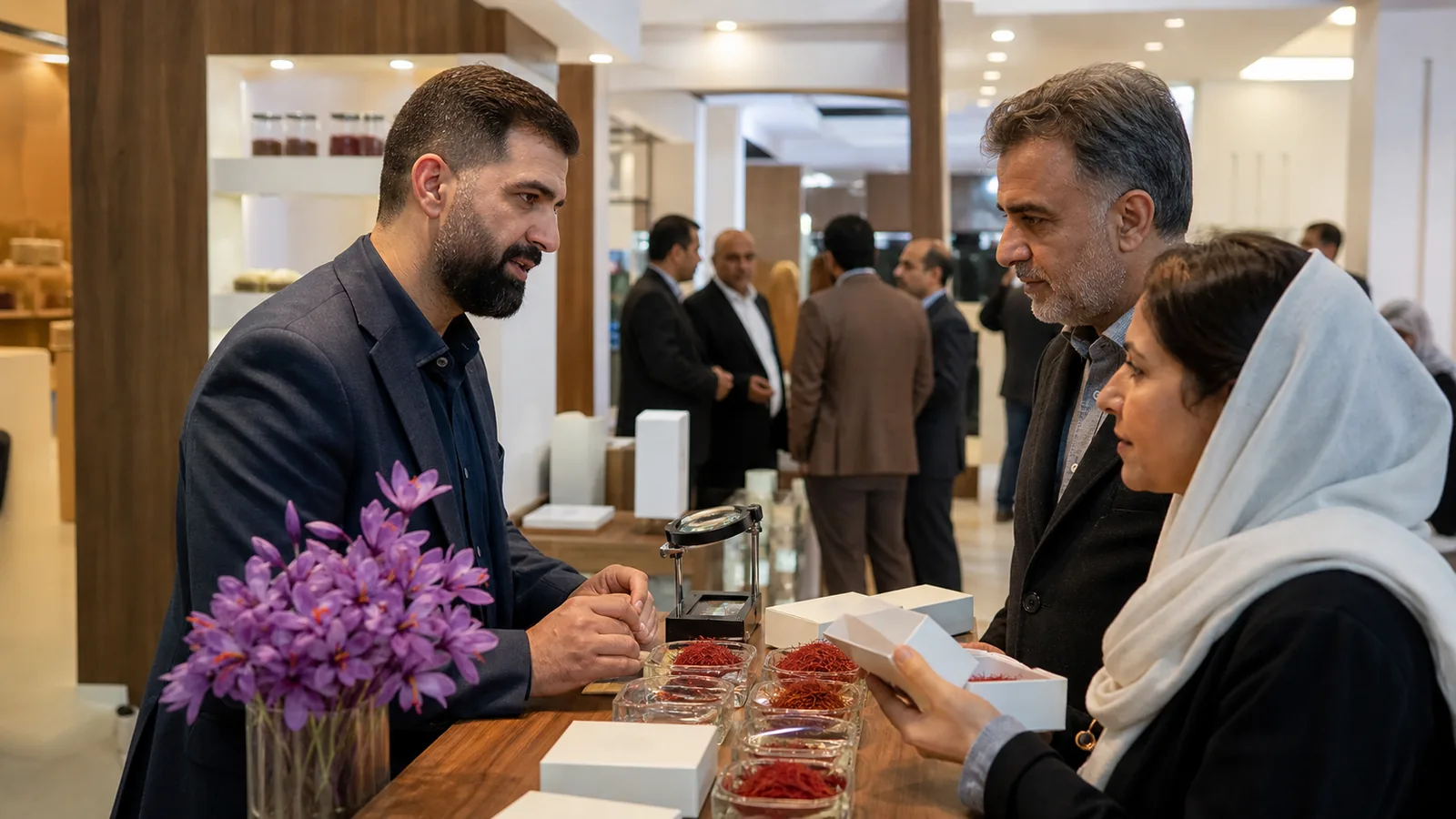
Iranian saffron is grown largely by families working small or fragmented plots. That pattern protects local knowledge and rural livelihoods, but it can leave each farmer buying inputs, finding workers, testing a tiny lot and negotiating a price alone. Small-scale ownership is not the problem by itself. The dilemma is how independent farms can keep their land and identity while gaining the coordination that larger buyers and export markets require.

What small-scale ownership means for Iranian saffron
A saffron holding may consist of a modest field or several separated parcels. Inheritance can divide land further between generations. Every owner then makes decisions about corms, soil preparation, irrigation, labour and the moment of sale, often with limited cash and limited access to current market information.
That structure has strengths. Families know their soil and water closely, harvesting creates seasonal work, and saffron can add value in dry areas where crop choices are constrained. It also makes coordination difficult. A processor or exporter may need a consistent lot that is larger than one farm’s output, supported by representative tests and traceable records. Combining anonymous bags after purchase creates volume, but not necessarily consistency or traceability.
A 2019 study indexed by FAO AGRIS examined saffron farms in Gonabad and found relatively strong technical efficiency alongside much weaker allocative and economic efficiency. The finding does not describe every Iranian farm, but it illustrates the central issue: growers may understand how to produce saffron while still facing costly input choices and a weak route to market.
Why production cost and bargaining power become connected
Each hectare needs healthy corms, suitable soil preparation, well-timed water, weed and pest management, and an intense burst of labour for picking and stigma separation. Small farms cannot always spread equipment, testing, transport or professional advice across enough output to lower the cost per kilogram.
Harvest pressure narrows the seller’s options. Flowers cannot wait long for separation, while dried saffron may be sold quickly if a household needs cash. A trader able to assemble, grade and store product has more time and information than an individual farmer. That imbalance is often described simply as “middlemen taking the value,” yet traders also perform real functions. The practical goal is to make their services transparent and competitive, or enable farmers to perform some of them together.
The old account behind this article criticised high production costs and low government purchase prices. That should not be read as a permanent national price rule: support programmes, procurement terms and market prices change by season. The lasting concern is whether growers can compare a public offer, a private offer and the cost of holding stock before they sell.
What FAO recognition actually covers
Saffron is rightly associated with Iranian agricultural knowledge, but the recognition is specific. The FAO Globally Important Agricultural Heritage Systems programme designated the qanat-based saffron farming system of Gonabad in 2018. It recognised an integrated local system of water management, biodiversity, livelihoods and inherited knowledge—not every saffron field in Iran and not a commercial quality certificate.
FAO also describes Iran as the world’s largest saffron producer. A later FAO value-chain programme placed Iran’s share at roughly 85 to 90 percent of global production and focused on production practice, post-harvest management, food safety, traceability and marketing. Production leadership therefore creates responsibility as well as brand potential.
Production figures need a year and a label
The earlier version quoted more than 123,000 hectares and said annual production could reach 400 to 500 tonnes under favourable conditions. These figures came from a period when industry representatives were forecasting a rebound; they were not a timeless annual total. In the same discussion, the 2023 crop was reported at about 150 tonnes after drought, compared with roughly 230 tonnes in 2022.
Area, forecast production and final harvest are three different measures. A large planted area may yield poorly after adverse weather, while a favourable year can lift output without any change in hectares. Anyone researching Iran saffron export and production should attach a crop year and source to every number rather than combining figures from different seasons.
Reports of production difficulties in North Khorasan belong in that local and seasonal context too. A national cultivation forecast does not cancel a poor outcome in one province or district.
How a cooperative can help without taking the land
Cooperation does not require farmers to surrender ownership or merge every field. It can begin with a few services that work better at shared scale.
- Input purchasing: members define specifications for corms, compost, approved crop inputs and packaging, then buy with clearer quality control.
- Harvest coordination: local teams, collection points and schedules reduce the risk that flowers wait too long for separation.
- Shared processing: hygienic separation areas and controlled drying can serve several farms while keeping lots identifiable.
- Testing and grading: representative sampling and laboratory work become more affordable when planned across pooled volumes.
- Storage and finance: secure, insured storage and documented inventory can give members more choice over when to sell.
- Market access: the cooperative can present a consistent specification, negotiate fees and record what each buyer paid.
The related discussion of the commodity exchange and small saffron farms shows another possible route to transparent grading and sale. Neither an exchange nor a cooperative is automatically fair; the rules and access costs determine who benefits.
Good cooperative governance is part of product quality
A poorly governed cooperative can reproduce the same imbalance it was meant to solve. Members need to know how grades are assigned, which lot was sold, what deductions were made and when payment will arrive. Independent testing, written fee schedules and regular reporting reduce room for favouritism.
Lots also need to remain traceable after pooling. If saffron from several farms is blended, the cooperative should have a documented rule for acceptance, sampling and composition. If farms remain separate, each batch needs its own identity. A collective brand cannot be stronger than the records behind it.
Performance should be measured in practical terms: member participation, payment time, test consistency, rejection rate, processing loss, repeat orders and the share of sale value returned to growers. A membership total on its own says little about whether the organisation is working.
Why foreign branding is a value-chain issue
Iranian saffron has long been shipped to European and regional buyers, including firms that clean, pack or market it under their own brands. Spain is often singled out in this discussion. The accurate concern is not that all Iranian saffron in Spain loses its origin or is falsely labelled; it is that bulk, weakly traceable trade can leave the producer invisible while more value is created later through quality assurance, packaging and customer relationships.
Our review of Iranian saffron and Spanish branding separates documented trade from the sweeping version of that claim. Origin rules still apply, and a packer’s brand is not automatically a claim that the crop was grown in that country.
Cooperatives can strengthen Iranian identity by documenting farm origin, harvest period and lot history, then supplying a product that meets a buyer’s specification repeatedly. A flag or an ornate box cannot substitute for that work.
Knowledge-based uses require specialist partners
The old article proposed pharmaceuticals, cosmetics and health products as new markets. Those sectors may use saffron or its compounds, but they require different evidence, extraction controls, safety assessment, manufacturing standards and regulatory approval from culinary spice trade. A farming cooperative should not imply medical efficacy or begin processing for those markets without qualified scientific and regulatory partners.
A sensible first step is to define the material a potential customer needs: whole stigmas, powder, extract, petals or another by-product; the required composition; contaminant limits; and the records expected. Only then can the cooperative judge whether investment is realistic.
A practical route out of the dilemma
There is no need to choose between scattered, isolated farms and complete consolidation of ownership. Farmers can retain their land while coordinating the parts of the chain where scale matters most.
- Map members, field area, expected volume and existing processing capacity.
- Choose one shared problem—such as testing, drying or sales transparency—rather than promising to solve the whole market at once.
- Write acceptance, grading, fee and payment rules before product is collected.
- Pilot the service with traceable lots and publish the result to members.
- Expand only when the records show lower costs, better quality or stronger returns.
A member of parliament quoted in the original report called for saffron to be treated as a strategic commodity and warned that foreign branding weakens recognition of Iranian origin. The useful response is not a title alone. It is reliable data, fair dealing, enforceable standards and institutions that farmers can actually use.
Protecting the farmer and the Iranian saffron name
Iranian saffron does not lose its value because it comes from a small field. It loses bargaining power when the farmer must sell alone, the lot has no documented identity, or quality work cannot be demonstrated to the next buyer.
Well-run cooperatives can close those gaps while preserving local ownership and knowledge. They can also fail if management is opaque or services cost more than they return. The right test is simple: can members see that coordination produced a cleaner lot, a lower cost, a faster payment or a better customer relationship? When the answer is documented, small-scale ownership stops being a trap and becomes a network capable of carrying the Iranian saffron name to market.

![Exporting Saffron to Turkey + Price Guide [Complete 0 to 100]](https://img.rowhanisaffron.com/20260827003933/saffron-export-turkey-quality-inspection.webp)