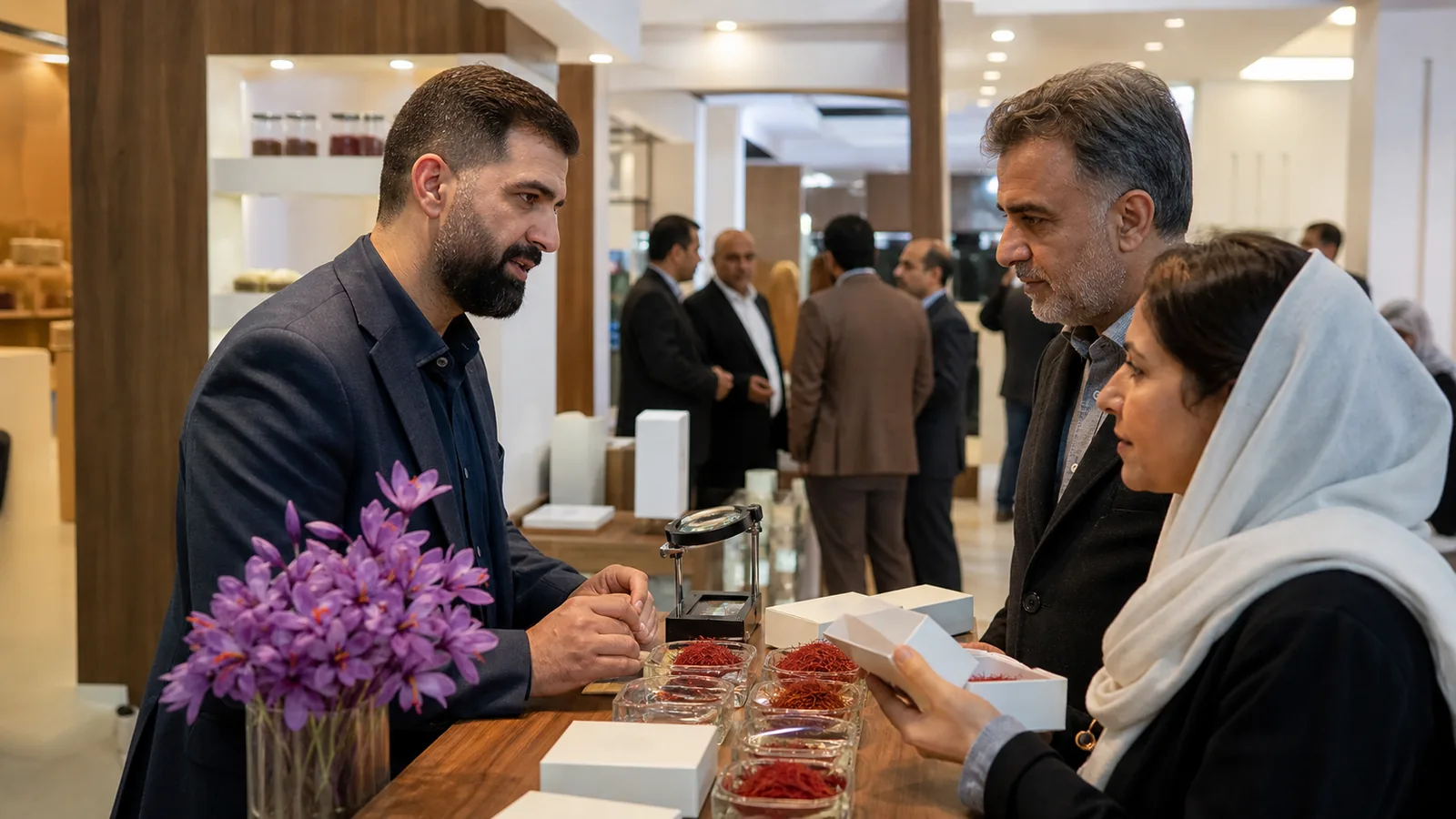
Saffron market in Khorasan was the focus of a harvest-season proposal from growers and exporters in Khorasan Razavi: organise purchasing through rural cooperatives, announce clear terms early and give farmers a credible alternative to selling under pressure. The idea has merit, but a cooperative purchase only protects growers when grades, prices, payment dates and resale costs are transparent.

Why Khorasan Razavi matters to the saffron market
Khorasan Razavi is the centre of Iran’s saffron trade. Its farms, collection points, processing rooms and exporters connect thousands of small producers with domestic and overseas buyers. In the seasonal report behind this article, the province was described as producing about 85% of the country’s saffron. That percentage belongs to the period being discussed, not to every harvest year.
As the early crop began after favourable rainfall, the same report referred to roughly 96,000 hectares under saffron: about 92,000 hectares of established fields and another 4,000 hectares of young fields that had not yet reached normal production. The original English text accidentally reduced 96,000 hectares to 96 hectares. The corrected figure also explains why the report could discuss a provincial forecast of around 300 tonnes in a favourable season.
Area is not the same as output. Young fields, weather, corm condition, irrigation, crop management and the speed of flower processing all affect the amount and grade finally obtained. A 300-tonne figure should therefore be read as a pre-harvest forecast, not a confirmed total. Recent research indexed by FAO AGRIS on saffron farms in the three Khorasan provinces likewise treats farm conditions and management as important variables rather than assuming a uniform yield.
What farmers asked cooperatives to do
Gholamreza Miri, speaking as an industry representative in the original report, called for a continuing purchase arrangement in which the Rural Cooperatives Organization would buy directly from producers and make the saffron available to exporters at a stated margin. The request followed an earlier support-purchase programme and reflected a familiar harvest problem: flowers arrive within a short window, labour and processing costs are immediate, and some growers need cash before they have time to compare offers.
The proposal was not simply for government to buy an unlimited crop. It was for an organised buyer to publish terms before peak supply, maintain a route to market through the season and reduce the advantage held by buyers with more storage, cash and price information.
Iran has used this kind of intervention before. A report on the 2019 support-buying programme recorded more than 68 tonnes purchased in Khorasan Razavi, with smaller quantities in South and North Khorasan. That history shows that cooperative procurement can operate at scale. It also exposes the difficult part: farmers need prompt payment, safe storage and a clear plan for selling the stock afterwards.
The 90 million toman figure needs a date
The earlier article presented a proposed fair purchase price of 90 million toman per kilogram. It was a seasonal proposal, not a current quotation and not a permanent measure of what saffron is worth. Saffron grades differ, and prices change with harvest size, exchange conditions, export demand, storage and the exact commercial specification.
A useful procurement notice must say more than one headline number. It should identify the crop year, grade, moisture and foreign-matter limits, sampling method, delivery point, deductions, payment schedule and whether the amount is a guaranteed floor or a negotiated purchase price. Without those details, two lots that look similar in a news report may not be commercially comparable.
Buyers and growers looking for a current figure should use a dated quote for a defined grade. The 90 million toman proposal remains relevant as a record of what farmers were asking for during that harvest, not as today’s saffron purchase agreement or market price.
How cooperative purchasing can reduce harvest pressure
A well-run cooperative creates another option at the farm gate. It does not need to remove every private trader. Intermediaries often perform necessary work: assembling small lots, financing purchases, arranging tests, storing product and finding buyers. The problem comes when those services and margins are invisible, or when a farmer has only one immediate offer.
For cooperative purchasing to improve the saffron market in Khorasan, the process should be easy for a grower to audit:
- Terms published before collection: eligible growers, grades, delivery locations and the purchase window are stated in advance.
- Representative sampling: the sample is taken, sealed and linked to the farmer’s lot in a way both sides can verify.
- Consistent grading: colour, aroma, moisture, foreign matter and other agreed requirements are assessed by the same documented method.
- A written receipt: weight, provisional grade, deductions and the expected payment date are recorded at delivery.
- Traceable storage: accepted lots remain identifiable, whether sold separately or blended to an agreed specification.
- Visible costs: testing, storage, finance and the cooperative’s profit margin are disclosed to members.
This is where the cooperative model and the development of a more transparent saffron market meet. A price floor can prevent a distressed sale, while grading and traceability help the stored product retain value. One without the other is incomplete.
What exporters need from the arrangement
The original proposal argued that a more stable market would let exporters concentrate on finding customers instead of watching abrupt price movements. Stability can help, but an administratively announced price does not remove commercial risk. If the purchase price is detached from grade or demand, stock can accumulate and working capital can become trapped.
Exporters need lots that match the customer’s specification, records that establish origin and handling, reliable delivery dates and a price they can quote for a reasonable period. Farmers need a return that covers production and harvest costs. A cooperative can connect those needs by collecting advance buyer specifications, grading against them and publishing its margin rather than purchasing first and searching for a market later.
That approach fits the direction of the FAO and Iran saffron value-chain programme, which brings farmers, processors, cooperatives, traders and specialists together around post-harvest handling, safety, traceability and modern marketing. The programme also describes Khorasan Razavi and South Khorasan as important livelihood centres for hundreds of thousands of smallholders.
Employment claims should be handled carefully
Saffron unquestionably creates seasonal work. Flowers are picked early, then stigmas must be separated and dried promptly. Processing, testing, packaging, transport and export add work beyond the field. The crop also brings value to arid communities where water limits other agricultural choices; FAO’s Gonabad qanat-based saffron system documents that connection between saffron, water management and rural livelihoods.
The old article went further, saying that 700,000 households directly depend on saffron in Khorasan Razavi and South Khorasan, and that cleaning every three kilograms of flowers creates one temporary job—therefore 100 kilograms creates work for 34 people. Those statements were presented without a defined year, study area, shift length or method. Similar reports sometimes count people, growers, households, seasonal workers or person-days as though they were the same unit. They are not.
It is safer to retain the underlying point without manufacturing precision: saffron supports a large network of farm families and creates concentrated seasonal labour, especially during flower picking and stigma separation. A current employment total should only be used when its source defines who was counted and for how long.
Saffron creates value beyond the raw crop
The earlier account described saffron as a product that does not require foreign currency. Taken literally, that is too broad: farms and processors may use imported equipment, packaging inputs or services affected by exchange rates. The useful point is that the crop itself is grown locally and can earn export revenue with a high value relative to its weight.
More value added can remain in the producing region when cleaning, controlled drying, laboratory testing, packaging and customer documentation are done well. Printing a colourful box is not enough. The package must protect the saffron, the label must be accurate, and the lot behind it must meet the promised specification.
A practical test for any new purchase plan
Before growers deliver saffron, they should be able to answer a few plain questions: Who grades the lot? Can the result be challenged? When is payment due? Who carries storage loss? How much does the cooperative add before resale? What happens if exporters do not buy the stock?
Officials and cooperative managers should publish the same answers, then report the quantity received, average payment time, stock sold and costs incurred after the season. Success is not measured by announcing a high price. It is measured by whether eligible farmers were paid as promised and whether the product moved through a traceable, financially sustainable chain.
The call from saffron farmers in Khorasan Razavi was therefore about more than removing intermediaries. It was a request for market organization: an early, credible offer; a buyer present during the harvest; transparent quality rules; and a route from small farms to serious exporters. Cooperatives can provide that structure, but only when their own decisions are as clear as the market they are meant to improve.

![Exporting Saffron to Turkey + Price Guide [Complete 0 to 100]](https://img.rowhanisaffron.com/20260827003933/saffron-export-turkey-quality-inspection.webp)