


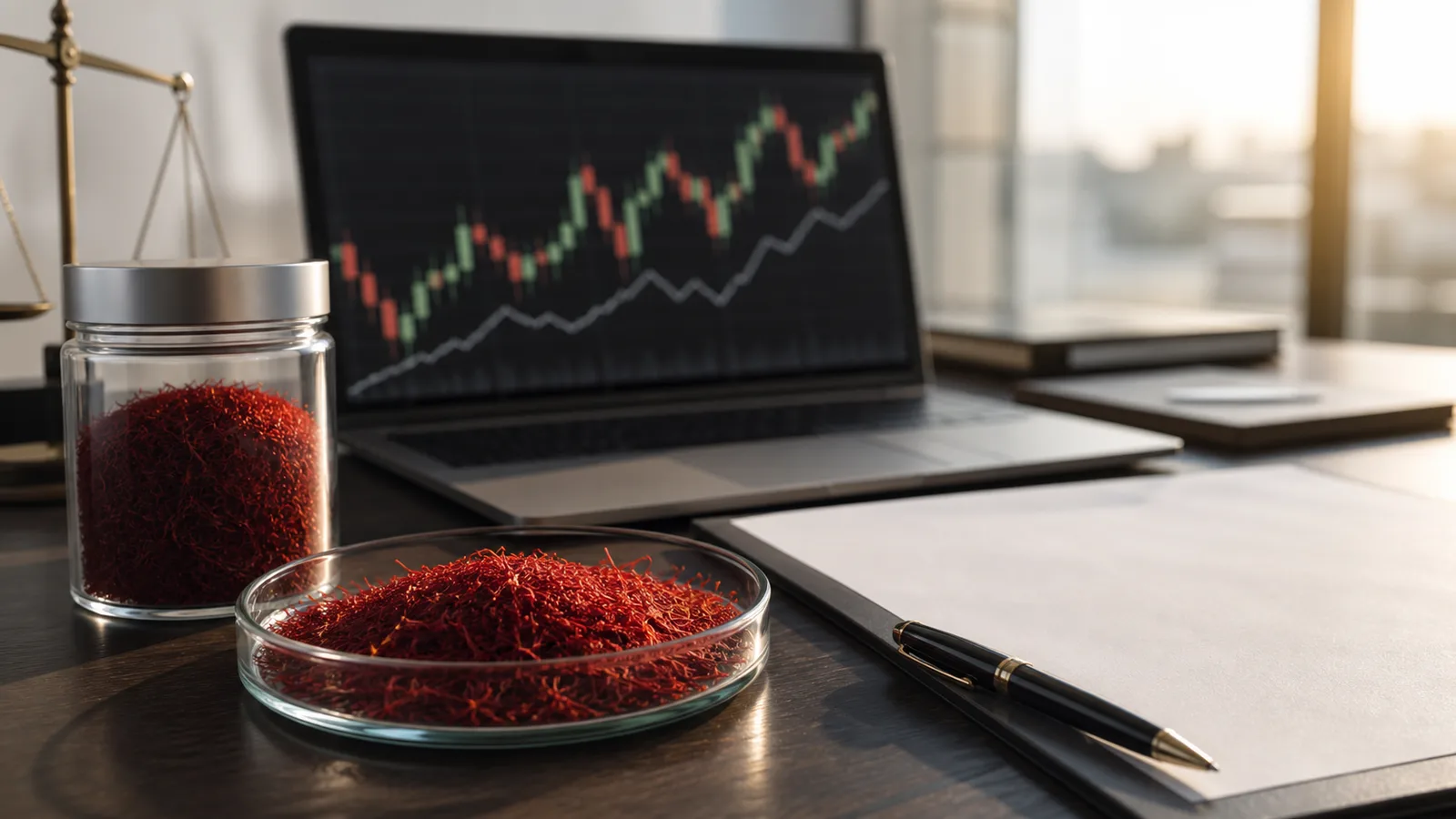
Launching a new agreement on Saffron described the opening procedure for a new Iranian saffron futures contract. In this context, “agreement” meant a standardised exchange contract, not a private supply agreement between two saffron companies. The important part of the announcement was the sequence: a 30-minute pre-opening period, a single-price auction, then normal continuous trading under the contract’s daily price limit.
What the historical launch notice said
On the contract’s first trading day, the exchange was to hold a pre-opening period for 30 minutes without the normal daily fluctuation limit. Orders could be entered during that stage, but ordinary continuous trading had not yet begun.
The notice then called for a single-price auction at 10:30. The English source rendered the time as “10:30 pm,” which is inconsistent with its description of the start of a trading session and may be a translation error. The source is preserved, but the hour should not be treated as a current timetable without checking the relevant exchange notice.
Once the auction produced a trade, the discovered price became the base price for the contract. Continuous trading could then begin, with price movement governed by the stated daily limit. If the opening auction produced no trade, the notice said the new futures contract would remain stopped and the same process would be attempted on the next business day.
Why the first auction matters
A newly listed contract does not have a previous settlement price of its own. The opening auction brings buy and sell orders together to establish a reference price before continuous trading. That first price is not an official statement of what saffron is “really worth.” It is the price at which compatible orders met under the exchange’s rules at that moment.
Opening without the usual fluctuation band can help the market find a workable starting point, while applying a limit afterward controls how far the contract may move during the rest of the session. Neither step removes market risk. Thin order books can produce a weak price signal, and a daily limit can delay rather than eliminate a large adjustment.
The 100-gram Negin contract described in the article
The earlier saffron futures contract used 100 grams of premium cut saffron, commonly called Negin, as its underlying quantity. That detail matters: one contract represented a defined amount and grade, not any saffron offered by any seller.
The historical terms also set a daily movement limit of plus or minus 3 percent from the previous day’s settlement price. Both the 100-gram size and the ±3 percent band belong to the contract described at that time. Exchanges can revise specifications, approved grades, delivery months, margin and price limits, so a trader must read the live contract notice rather than copy old numbers from this article.
From pre-opening to continuous trading
The old procedure can be read as four steps:
- Pre-opening: participants place or adjust orders during the announced 30-minute window.
- Single-price auction: the exchange seeks one clearing price that matches eligible demand and supply.
- Base-price creation: a successful auction establishes the reference for that contract’s first session.
- Continuous auction: trading continues within the stated daily fluctuation margin.
If step two does not produce a trade, there is no valid discovered price for the planned continuation. That is why the source described stopping the contract and repeating the launch procedure on the following business day.
What “saffron futures” actually means
A futures contract creates an obligation under exchange rules for a specified future month. Market participants may use it to manage price exposure or to take a view on future prices, but the contract is leveraged and can generate losses as well as gains. It should not be confused with a guaranteed price for a farmer or a promise that the cash market will move in the same direction.
The standard terms normally define the contract quantity, acceptable quality, delivery process, trading calendar, settlement, margin and position rules. Warehouse receipts and approved delivery arrangements connect the financial contract to physical saffron. For a broader account of that early market structure, see our article on the latest coordinates of saffron futures on commodity exchanges.
The May 2018 milestone
The source said Iran’s first saffron futures contract had launched in May 2018 and referred separately to a June development in the same period. Its English chronology is awkward, but the useful historical point is clear: saffron futures were already trading, and the exchange was opening another contract under a defined first-day price-discovery procedure.
This was a development in Iran’s commodity market, not the first time anyone had agreed to buy saffron for later delivery. The innovation was a standardised, centrally traded contract with published rules, margining and an exchange-supervised delivery framework.
What the announcement did not establish
The launch notice did not show how liquid the new delivery month became, how many contracts traded, who used it for hedging, or how closely the futures price tracked physical Negin saffron. It also did not establish today’s contract size, price limit, session time or approved delivery standard.
Those questions require dated exchange data. A useful review would compare volume, open interest, bid–ask depth, warehouse stocks, cash prices and the final settlement or delivery outcome. Without them, the launch mechanics can be explained, but the contract’s later performance cannot be inferred.
How to read the old figures safely
The 30-minute pre-opening, 10:30 auction, 100-gram Negin size and ±3 percent daily range are preserved because they are the substance of the original article and may explain the page’s search visibility and external link. They are historical specifications, not instructions for placing a trade today.
Anyone considering a current position should use the Iranian exchange’s live contract specification, circular and trading calendar, and should understand margin calls, price-limit rules and delivery obligations. This article is an explanation of a past market launch, not investment advice.
Sources and risk note
The opening-auction sequence and historical contract figures come from the exchange notice preserved in the original article. General explanations of price discovery, hedging, margin and futures-market risk follow the US Commodity Futures Trading Commission’s official Futures Market Basics and economic-purpose guide. Those sources explain futures mechanics; they do not set Iranian contract terms.

![Exporting Saffron to Turkey + Price Guide [Complete 0 to 100]](https://img.rowhanisaffron.com/20260827003933/saffron-export-turkey-quality-inspection.webp)



