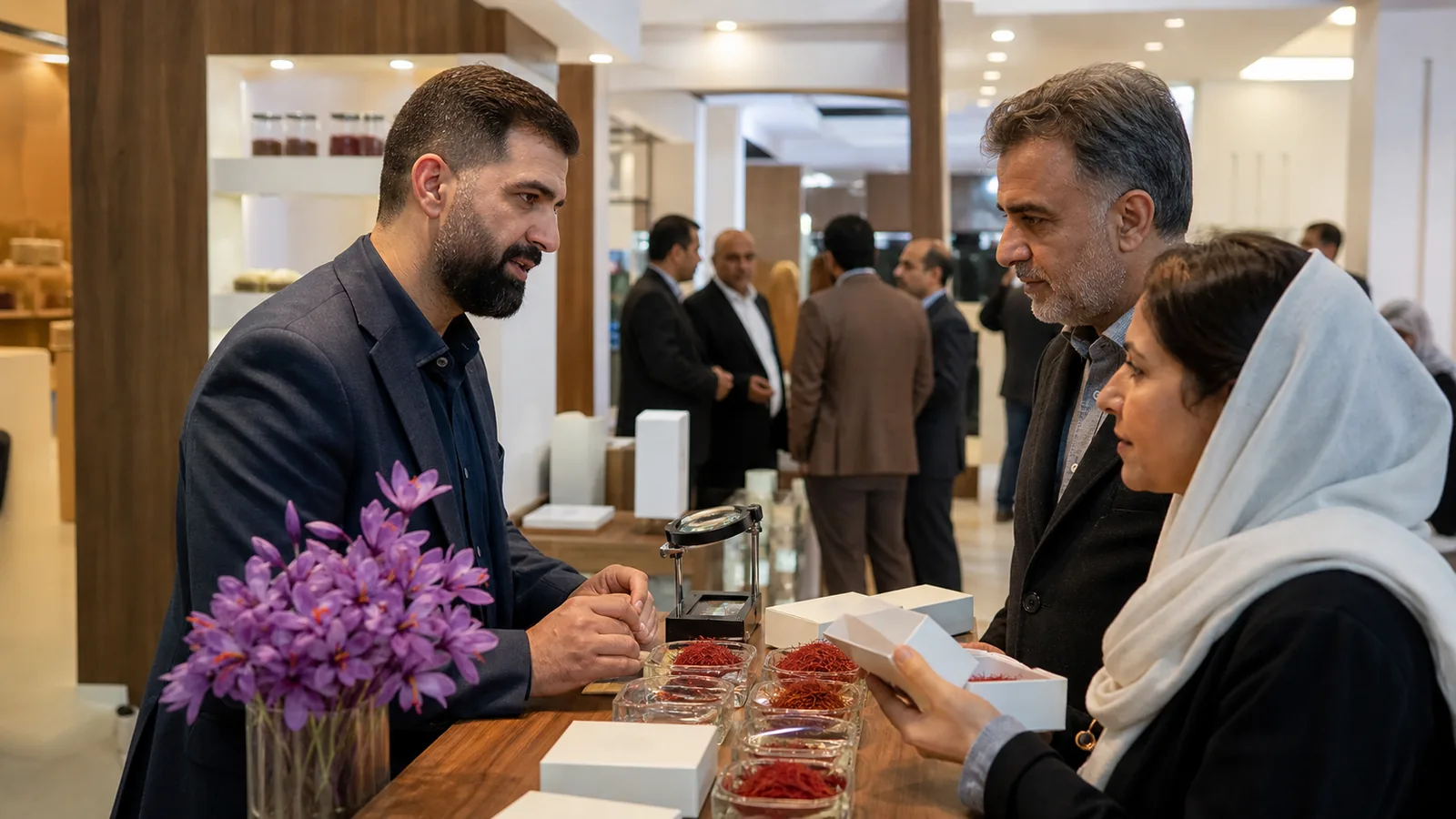
Organic saffron production in Vamnān is often used to describe the mountain village’s growing reputation, but the harvest story is also about labour, processing and keeping value close to the farm. A late-October 2024 report from Vamnān recorded the first flowers reaching market, a sharp early price change and a four-tonne production forecast from 1,100 hectares. Those figures make more sense when read as a dated new-crop snapshot rather than a promise about every season.

New saffron harvest from Golestan reaches the market
Vamnān is a mountainous village in Azadshahr County, in Iran’s Golestan Province. While Khorasan is better known internationally for saffron, cultivation in Golestan has developed into an important source of farm income. Vamnān is one of the province’s recognised production centres.
An IRNA report reproduced in contemporary Golestan news coverage said the season’s first saffron flowers sold for 11 million Iranian rials per kilogram on the first day and 9.5 million rials on the second. In toman, the commonly used everyday unit, those figures are 1.1 million and 950,000 toman respectively.
These were prices for a kilogram of freshly picked flowers, not a kilogram of dried saffron threads. The distinction is essential: most of each flower is not part of the final spice, and the stigmas still have to be separated and dried. Early flower prices can also move quickly because only small quantities are available before the main flush.
Why the harvest began later but flowered well
Zabihollah Adeli, identified in the report as manager of the Vamnān Saffron Growers Cooperative, said the harvest was running about ten days later than the previous agricultural year. The report attributed the delay to changing weather conditions. At the same time, Adeli described flowering as better than the year before and expected the main harvest to begin the following week as conditions improved.
Those observations are not contradictory. Timing and flower abundance respond to more than one condition, including temperature, the first irrigation, soil moisture, corm health and the weather during emergence. “Climate change” is too broad to explain a single field by itself, so the ten-day delay should be read as the cooperative’s local, year-specific observation rather than a universal rule for Golestan.
The expected output was four tonnes of dried saffron from about 1,100 hectares. If both estimates proved accurate, that would average roughly 3.6 kilograms per hectare. It was a forecast made near the start of harvest, not a recorded final yield. Our separate review of Golestan saffron production provides more regional context without treating one season’s estimate as permanent.
The labour problem behind the flower price
Saffron flowers need attention soon after picking. Leaving them in warm, compressed piles can make separation harder and compromise the material before drying. That creates an intense need for trained hands during a short harvest window.
The Vamnān report said nearly five tonnes of flowers were sold to buyers in Khorasan because the village lacked enough workers and local processing capacity. It quoted separation costs of one million rials per kilogram of flowers in Vamnān, compared with about 500,000 rials in Khorasan. In everyday currency, that was roughly 100,000 versus 50,000 toman.
The gap explains why flowers could leave the province even when farmers would prefer to retain more local value. A buyer with labour, space and drying equipment can process them more economically. For Vamnān, the missed opportunity was not only the separation fee. Once flowers leave, later grading, packing and some of the product identity may leave with them.
Processing capacity has to match the harvest window
A permanent facility alone does not solve the problem. It needs enough trained people, clean work surfaces, suitable drying control, batch records and a plan for peak days. Equipment that sits unused for most of the year may be expensive, while capacity that is too small creates the same bottleneck at harvest.
Practical options can include coordinated collection points, staggered first irrigation where agronomically appropriate, seasonal worker training, shared drying facilities and clear agreements between growers and processors. The best model depends on local volume and transport time; it should be costed rather than assumed.
What “organic saffron from Vamnān” should mean
Vamnān saffron is frequently described locally as organic, and that identity is part of the village’s market story. A farming method that limits synthetic inputs may be valuable, but it does not by itself prove that every lot is certified organic for every export market.
For example, the USDA rules for organic imports and labelling require production and handling under the applicable organic regulations and certification programme. The certifier, audit trail, lot identity and handling after harvest matter alongside what happened in the field. Other destination markets have their own rules.
A buyer asking about organic saffron production in Vamnān should therefore request:
- the certificate and the authorised certifying body;
- the farms, crop year and lots covered by that certificate;
- records for inputs, harvest, storage and processing;
- proof that certified and non-certified saffron stayed separated; and
- labelling that complies with the destination market.
Where those records are not available, the honest description is Vamnān-grown saffron produced under stated farming practices, not a blanket certified-organic claim. Our guide to what organic saffron certification actually requires goes further into this distinction.
The cooperative’s role in keeping value local
The historical report described the Vamnān Saffron Growers Cooperative as having around 1,000 members. It also referred to two direct-sales shops in Gorgan and Azadshahr. Those details belong to that reporting period and should be confirmed with the cooperative before a current visit or purchase.
A cooperative can give small farms a more workable route to market by combining volumes, organising collection and presenting consistent product information. Direct sales may shorten the chain, but fair prices for producers and consumers are not automatic. Transparent weighing, documented grades, published fees and traceable lots are stronger evidence than the word “direct” alone.
Collective action can also make local processing more realistic. When members know the likely flower volume and timing, they can plan workers and drying capacity around the peak instead of negotiating under pressure after flowers have already been picked.
How quality is protected from flower to dried saffron
The finished quality depends on decisions made within hours of harvest. Flowers should be picked cleanly, kept cool and airy, and delivered for separation without unnecessary delay. Workers need hygienic surfaces and containers. The red stigmas then require controlled drying and protection from moisture, heat, light and contamination.
Quality claims should be tied to the particular lot. Thread appearance is useful, but colour, aroma, flavour strength, moisture and foreign matter are better assessed through representative sampling and suitable laboratory tests. Mountain origin or an organic reputation cannot replace those checks.
What the early price drop did and did not show
A fall from 11 million to 9.5 million rials per kilogram of flowers in two days sounds dramatic, but it was an early-market observation. It did not establish the season’s average price, the eventual price of dried saffron or the income of every grower. A larger flow of flowers, differences in freshness and immediate processing demand can all move the daily flower market.
Anyone comparing the report with a current quotation should confirm the year, currency unit, product form, weight, grade and place of sale. A dried Negin price cannot be compared directly with a fresh-flower price, and a retail pack cannot be compared with a farm-gate kilogram.
A stronger future for Vamnān saffron
Vamnān’s opportunity is real, but it is more specific than saying the village will inevitably become a leader in the global saffron market. The community already has cultivation experience, a large cooperative base and a recognisable origin. The immediate weakness identified by growers was the narrow post-harvest window: too few workers and too little local processing when flowers were ready.
Solving that bottleneck could keep more grading, drying and packaging work in Golestan. Credible organic certification, where farms choose that route, could open another market position. Neither step guarantees international demand; both make the product easier for serious buyers to evaluate.
The new saffron harvest from Golestan is therefore best understood as a chain of decisions, not a single headline. The 2024 figures captured one early week in Vamnān: flowers at 11 million and then 9.5 million rials per kilogram, a ten-day delay, nearly five tonnes moving to Khorasan, and a four-tonne dried-saffron forecast from 1,100 hectares. Preserving those facts while keeping them dated gives farmers, processors and buyers a useful record—and a clearer view of what has to improve next.

![Exporting Saffron to Turkey + Price Guide [Complete 0 to 100]](https://img.rowhanisaffron.com/20260827003933/saffron-export-turkey-quality-inspection.webp)