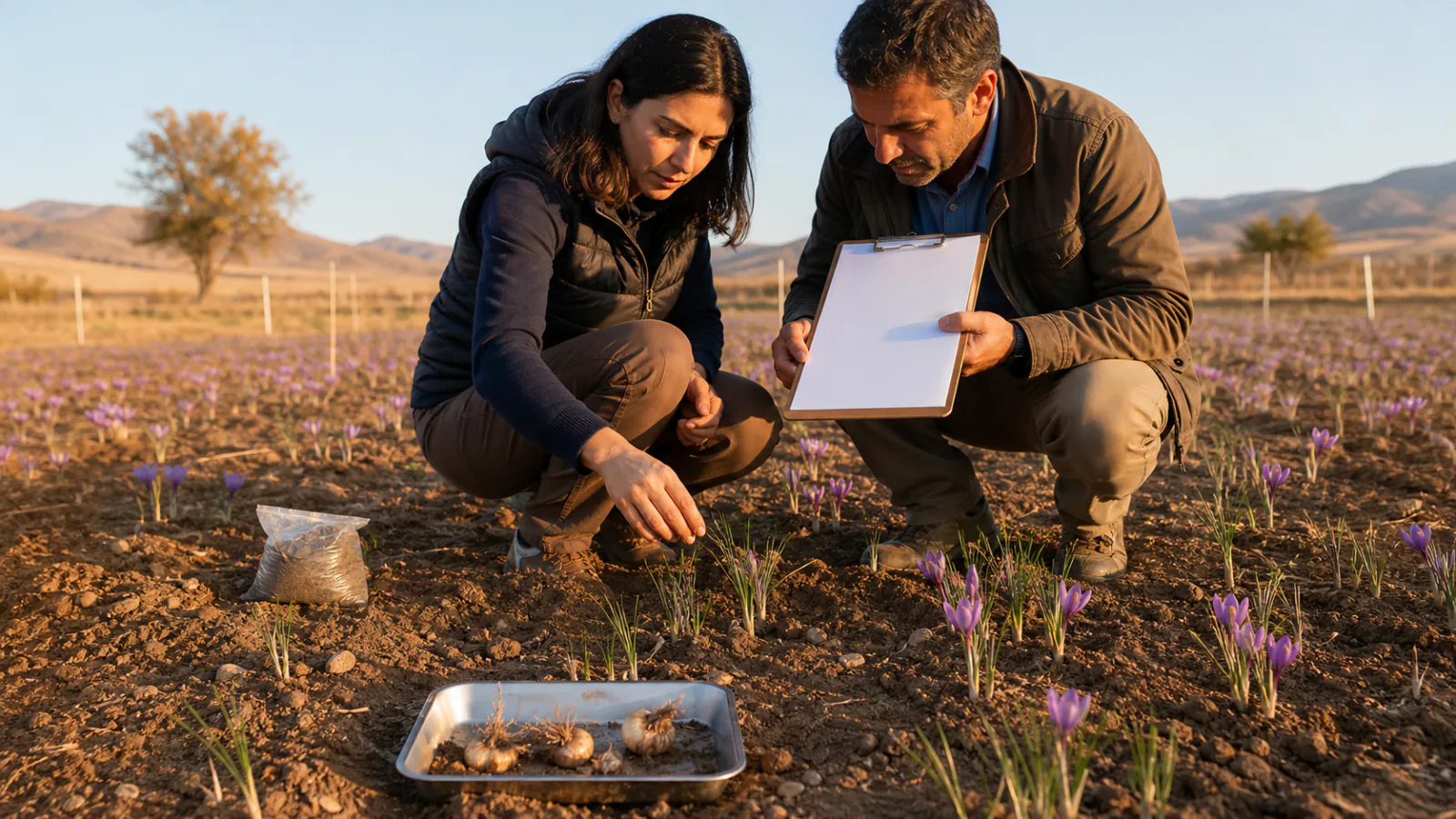
Organic saffron production means more than growing the crop without spraying conventional pesticides. A certified farm must follow a recognised organic standard, document its land and inputs, prevent contamination, maintain records and pass inspection. “Clean,” “natural” or “chemical-free” are not substitutes for certification.
The original news story on this page reported a four-year Kermanshah research project that began around the Iranian year 1391. Its researchers said they produced saffron without conventional pesticide or chemical-fertiliser use after a three-year land period. That is a historical project report, not proof that the same field or product is certified and on sale today.
Organic Saffron Production: What Certification Really Requires
Organic is a verified production claim
An organic rule defines what a farm may use and how compliance is checked. The precise requirements depend on the destination market and certifier. For example, the USDA organic crop standards require that prohibited substances have not been applied to land for at least three years before an organic harvest. EU rules likewise require certification, annual inspection and a conversion period whose length depends on crop type.
A field being untreated for three years is only one part. The operator needs an organic management plan, farm maps, input and harvest records, traceability, cleaning procedures, defined boundaries and controls against drift or mixing with conventional material.
What the Kermanshah project claimed
The translated report attributed the work to a researcher named Mohammadi at a science and technology park centre in Kermanshah. It said the team began cultivation in 1391, worked for four years and used micronutrient sprays and other inputs described as organic.
Those details establish the project’s stated aim, but important verification is missing: the exact institute, field location, certifier, applicable standard, approved-input list, inspection record, yield and certificate number. A research plot can follow organic methods without its harvest being legally marketable under an organic label.
“No chemicals” is the wrong test
Everything in farming is made of chemicals, including water, manure and plant tissue. Organic systems restrict or allow substances according to rules; they do not eliminate chemistry. Some natural substances can be harmful, and some synthetic materials are allowed for narrow uses under particular standards.
The correct questions are:
- Was each seed, corm treatment, fertiliser, soil amendment and crop-protection product approved?
- Does the record show when, where, why and how much was applied?
- Were preventive practices used before an intervention?
- Could prohibited spray drift, irrigation water or shared equipment contaminate the field or lot?
- Can harvested saffron remain segregated and traceable through drying, storage and packing?
Soil fertility without prohibited fertilisers
Saffron draws on the soil for several years. Organic management therefore starts with soil testing, suitable corm density, crop history, organic matter, drainage and a nutrient plan. Compost or manure may be useful, but it must be mature, hygienically managed and permitted under the chosen standard. Uncomposted material can introduce weed seed, pathogens or excess salts.
The old article referred to a sand-and-soil combination that supposedly fed corms and improved resistance, but the translation did not preserve a usable recipe. Soil texture cannot replace nutrients or disease management. Saffron needs a well-drained rooting environment, yet the right amendment depends on laboratory results and local soil.
Managing weeds, pests and disease
Organic farming does not mean leaving problems untreated. It prioritises prevention: clean planting material, suitable rotation, field sanitation, balanced nutrition, drainage, cultivation, mulching where appropriate, and monitoring. Approved physical, biological or material controls may be used when the standard and certifier permit them.
Corm rot, rodents, mites and weeds can still reduce an organic crop. Bringing infected corms into a certified field creates a problem that a label cannot solve. Records should connect each corm source and intervention to the field.
Climate and site suitability
The Kermanshah report described saffron as suited to mild winters and hot, dry summers, while also noting cold tolerance and growth through autumn, winter and early spring. The apparent contradiction reflects the plant’s cycle: corms are dormant through summer, flowers emerge in autumn, leaves grow through cooler months, and foliage senesces in spring.
Summer dormancy does not mean every rainfall or irrigation is harmful. Waterlogged soil during dormancy can encourage rot, but absolute advice must account for soil drainage and weather. The old article said cultivation was unsuitable in humid Gilan and very hot southern regions; commercial suitability needs local trials rather than a province-wide rule.
Harvest and post-harvest controls remain organic
Certification does not end when the flowers are picked. The operation must stop organic saffron from being mixed with non-organic lots during transport, stigma separation, drying, storage and packing. Food-safety and quality controls remain necessary.
Useful records include harvest date and field, flower or stigma quantity, work area, dryer or tray identification, cleaning, final lot weight, packaging and stock movement. A mass-balance review should show that organic sales do not exceed documented organic production.
Organic does not prove superior flavour, safety or medical effect
An organic certificate verifies compliance with a production standard. It does not automatically prove that one saffron lot has stronger colour, aroma or flavour, no contamination, or better nutritional value. Those are separate questions requiring representative sampling and appropriate tests.
The old report claimed saffron improves digestion and circulation and treats kidney, bladder and liver problems. Organic status does not make those medical claims true. Farming method and clinical efficacy are different evidence domains; a spice must not be promoted as disease treatment without reliable human evidence.
Does organic certification affect saffron price in Italy?
The price of saffron in Italy cannot be inferred from the word organic alone. The retail price may reflect origin, grade, package size, brand, certification cost, importer margin, tax and the date of sale. A tiny branded packet and a wholesale kilogram are not comparable.
EU organic labelling requires an operator within the control system and compliance with applicable import and traceability rules. During conversion, a farm bears added cost but may not yet sell the crop as fully organic. Certification can support a premium only when buyers value it and the claimed lot is verifiable.
What to verify on organic saffron
- Identify the certifier or control body and the certified operator.
- Check that certificate scope includes the relevant crop, activity and current period.
- Match the package lot and responsible business to traceability records.
- Distinguish certified organic from in-conversion, pesticide-tested or merely “natural.”
- Request separate quality or contaminant evidence when those characteristics matter.
- Check import and label requirements in the market where the product will be sold.
The Kermanshah project was useful because it framed organic saffron as a multi-year production challenge. The enduring lesson is stricter: methods must be documented, audited and maintained from the field through the final package. A claim becomes trustworthy when a buyer can trace it to evidence.