


A saffron price in the EU cannot be read from one production forecast. The amount harvested in Iran matters, but so do grade, laboratory results, thread condition, pack size, transport, importer costs and the point in the supply chain at which a price is quoted. A bulk offer at origin and a one-gram retail jar in Europe describe different transactions.
This article brings together two archived reports about Iranian production and exports. Their figures are useful as a record of what the National Saffron Council expected at the time. They are not current price quotations, and they should not be used as if they describe today’s crop.
What the earlier export report recorded
In an interview reported in 2016, National Saffron Council secretary Farshid Manouchehri said Iran had exported 126 tonnes and 121 kilograms of saffron during the preceding 12 months. The stated export value was $384.312 million. He expected official export volume to rise by about 15% to roughly 140 tonnes in the following year.
The same report placed expected production at 240–250 tonnes, with the possibility of reaching 280 tonnes if favourable weather continued through the end of the season. It attributed the better outlook to rainfall in the Khorasan provinces and contrasted it with a previous season in which flowering was said to have fallen by 25%.
Those numbers were forecasts, not final harvest or customs totals. A forecast made before flowering and harvest can change quickly when autumn temperature, irrigation timing or labour availability changes.
A later forecast pointed to greater supply
A second report from the following period described a larger cultivation base. Manouchehri said saffron area in the two Khorasan provinces had reached about 90,000 hectares, compared with 83,000 hectares the previous year. On the back of favourable spring rainfall, he forecast national production of 340–350 tonnes.
The earlier report had described cultivated area rising from about 72,000 to 80,000 hectares. Read together, the reports show the direction of expansion, but not a single settled figure. They were published at different points in the crop cycle and referred to estimates available at those moments.
Expansion also raised a policy concern. The council secretary argued that scattering saffron cultivation into unsuitable areas could displace other crops without necessarily improving efficiency. He put typical yield in Khorasan at roughly 3–3.5 kilograms per hectare and argued that better management could lift yield on suitable land. That is an industry view from the archived reports, not a promise that every field can produce the higher figures he proposed.
Why Iranian production affects, but does not set, the EU price
A larger crop can ease pressure at the farm and wholesale levels, while a weather loss can tighten supply. The effect is not automatic. Export demand, exchange rates, stocks held from earlier crops and the share of saffron that meets a buyer’s specification all influence the final transaction.
Quality is especially important because saffron is sold in several forms and grades. The current ISO 3632-1:2025 specification covers dried saffron as filaments, cut filaments and powder. A buyer should therefore compare products on a like-for-like basis rather than treating every kilogram as interchangeable.
Authenticity testing has a commercial value too. In the European Commission’s coordinated control of herbs and spices, 11% of the saffron samples assessed were considered at risk of adulteration. The Commission’s published results explain that the survey used analytical techniques and relevant ISO provisions to assess authenticity and purity. A traceable lot with credible test documentation should not be compared only by headline price with an unidentified powder.
What an EU saffron quotation should state
Before comparing offers, identify exactly what each price includes:
- Form and cut: whole threads, cut threads or powder, and the proportion of yellow style material.
- Quality evidence: the applicable test report, batch number and date of testing.
- Quantity and packaging: bulk weight, food-service packs or consumer-ready jars. Small packs carry much higher packaging and handling costs per gram.
- Delivery basis: whether freight, insurance, customs clearance, local delivery and taxes are included.
- Origin and traceability: where the saffron was harvested, processed and packed, supported by documents rather than packaging language alone.
- Quote date and validity: harvest markets and exchange rates move, so an undated price has little practical value.
For trade analysis, Eurostat’s international trade in goods documentation is the official harmonised source for EU import values and quantities. It also explains that detailed data are revised as national authorities provide validated updates. Dividing customs value by quantity can provide a trade unit value, but it is not the same as a retail shelf price or a supplier’s live quote.
How to compare price without sacrificing quality
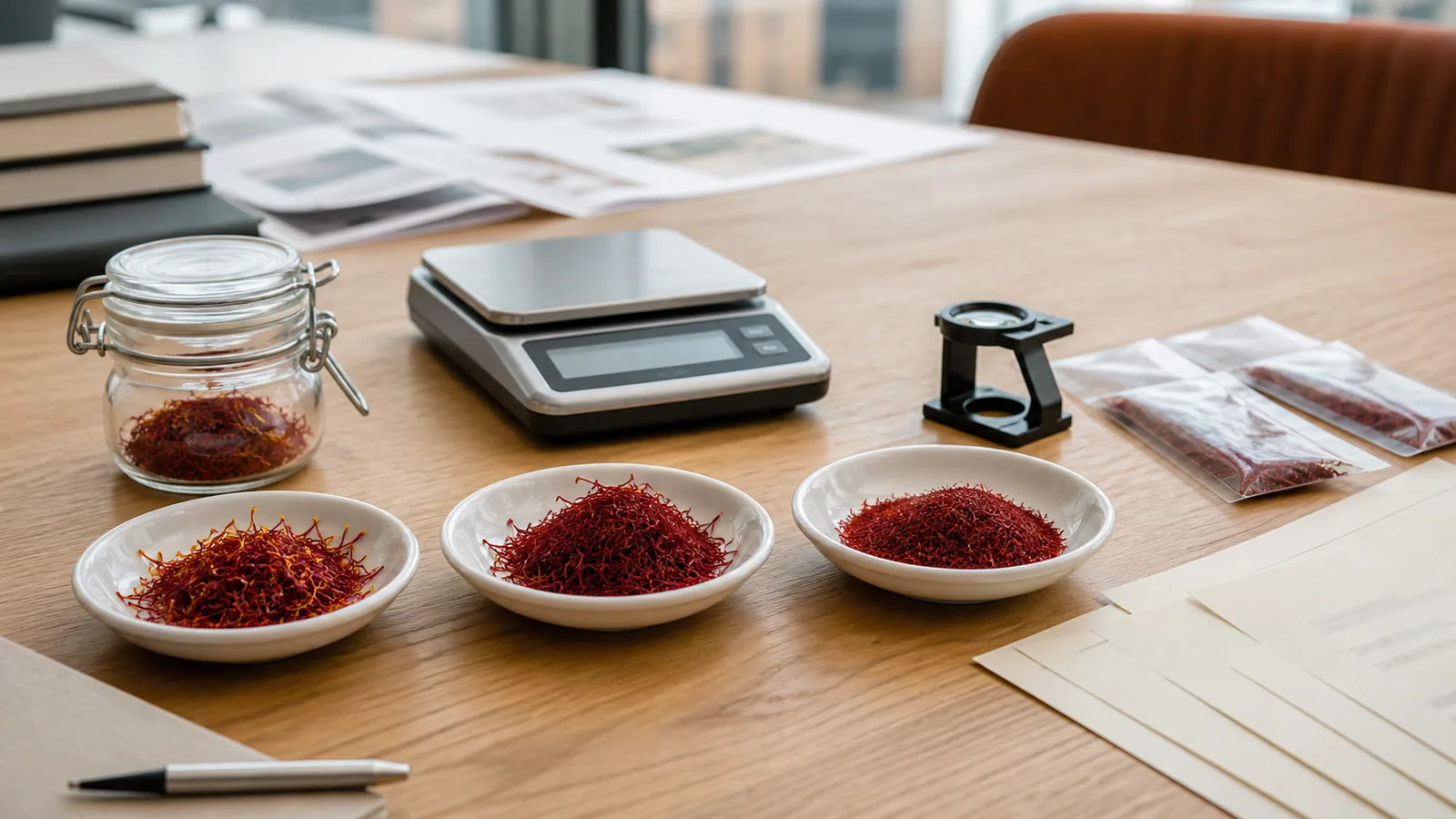
Begin with the intended use. A restaurant may value consistent aroma and colour release in a larger pack, while a retailer also needs compliant consumer labelling and reliable presentation. Request samples from the same lots covered by the documents, inspect the threads, and bloom a measured amount under the same conditions.
Then normalise every offer to the same weight and delivery basis. If one quote is ex-works and another is delivered with customs and tax paid, the visible per-kilogram numbers are not directly comparable. Include testing, repacking, rejected material and storage losses in the landed cost.
Once the saffron arrives, protect the quality paid for. Keep it airtight, dry and away from heat and light; our saffron storage guide explains the practical options for threads and opened packs.
Reading the historical numbers responsibly
The combined record is straightforward: one season’s report expected 240–250 tonnes of production and about 140 tonnes of official exports after a 126.121-tonne baseline; a later report expected 340–350 tonnes as cultivated area expanded. Both statements came from the same council official, but they described different forecast moments.
They help explain why Iranian crop size is watched by European buyers. They do not establish a current saffron price in the EU. For a decision today, use a dated, specification-based quotation and current official trade data, then compare the landed cost of equivalent, tested product.

![Exporting Saffron to Turkey + Price Guide [Complete 0 to 100]](https://img.rowhanisaffron.com/20260827003933/saffron-export-turkey-quality-inspection.webp)



