


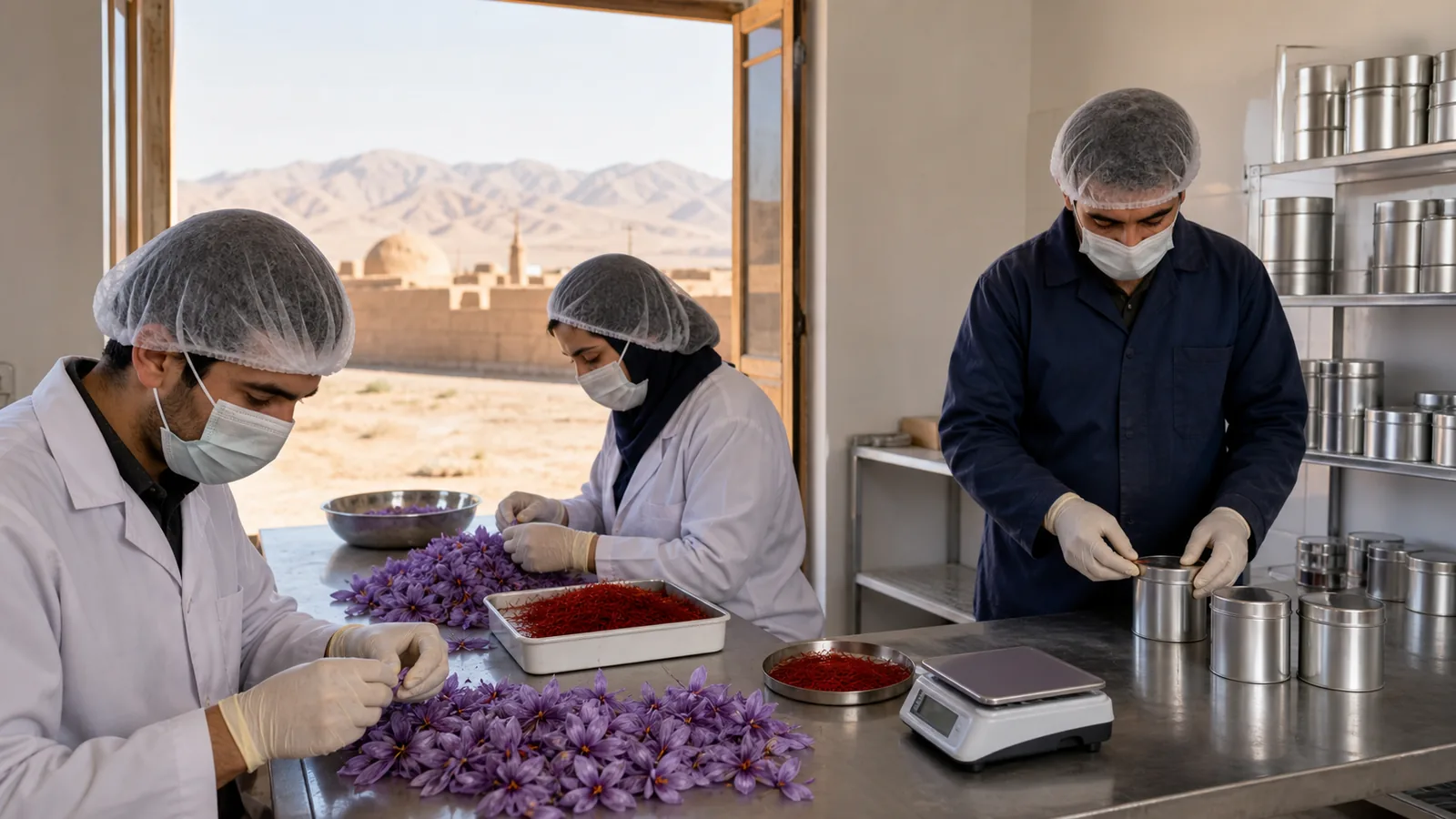
Yazd’s saffron sector was producing a valuable crop, but much of it left the province in bulk for processing or sale elsewhere. That was the concern raised at a 2016 meeting between provincial agricultural officials and a Spanish delegation. The discussion covered acreage, yield, early-morning harvesting, mechanisation, local packing and the possibility of building a stronger saffron industry inside Yazd.
The figures in this article belong to that crop year. They remain a useful account of the province’s development plans, but they are not current production statistics or a present-day export offer.
Yazd’s reported saffron area and yield
Jamal Sajadi Pour, then head of Yazd Province’s Agricultural Jihad Organization, reported approximately 421 hectares of saffron in the 1394 Iranian crop year. The stated average yield was 4.5 kilograms of dry saffron per hectare.
Bahabad was the province’s leading producing county, with about 270 hectares. The translated source recorded the next area at 48 hectares but damaged the county name; rather than guess, it is left unidentified here. Mehriz ranked third with 33 hectares.
The development programme cited two future acreage figures—700 and 1,120 hectares—within a ten-year planning horizon. The old translation does not make the staging sufficiently clear to present either as a confirmed outcome. Both are best understood as policy targets discussed at the meeting.
Why Bahabad saffron attracted attention
The report singled out saffron grown in Yazd, especially Bahabad. Flowers were said to be collected before sunrise, a practical detail that helps avoid midday heat and allows the stigmas to be separated and dried promptly. Officials associated this handling with good aroma and quality.
Harvest time alone does not prove a grade. Final quality also depends on botanical purity, separation, drying temperature, moisture, storage and protection from foreign material. A buyer should verify a lot through sampling and laboratory analysis rather than relying on a regional reputation.
The problem with exporting value in bulk
Provincial officials said Yazd saffron was being sent in bulk to Khorasan and Kerman. Bulk movement is not inherently bad: processors and packers often need larger lots. The economic concern was that Yazd could lose the identity, processing work and brand value associated with its own crop.
A traceable supply chain can preserve both efficiency and origin. Grower or collection-point records should follow each lot through drying, sorting, testing and packing. If material from several farms is blended, the receiving records need to show exactly which lots entered the blend. That makes a claim such as “Yazd saffron” auditable rather than decorative.
Mechanisation and the proposed Yazd facility
A representative of a Spanish company explained planting and harvesting methods during the meeting. The report also discussed establishing a factory in Yazd that could serve as a centre for saffron mechanisation and supply equipment or services to other provinces and export markets.
Mechanisation can help with field preparation, planting, cleaning, controlled drying and packing. The flower itself still demands careful handling, and delicate stigma separation is difficult to automate without losses. Any investment should therefore begin with the actual bottleneck: labour availability, inconsistent drying, limited testing, weak storage or inefficient packaging.
A facility adds value only when it can operate hygienically, keep lots separate, document temperatures and weights, and sell enough product to cover its fixed costs. Equipment without trained operators, maintenance and buyer specifications does not solve the marketing problem.
Saffron as a lower-water crop option
Yazd’s policy promoted saffron partly as an alternative to crops with greater irrigation demand. That does not make saffron water-free or suitable for every field. Corm health, drainage, soil texture, salinity, irrigation timing and local winter and spring conditions still determine whether a site can support a productive planting.
Farmers also need to account for establishment costs and the short, labour-intensive harvest. The selling price, saleable yield and access to a trustworthy buyer matter more than the headline value of the spice. Our saffron cultivation guide covers the practical checks before planting.
What German buyers should ask for
The legacy address refers to Persian saffron in Germany. The original Yazd report did not quote a German price or identify German sellers. It does show why a German importer should ask where the saffron was grown and where it was processed, particularly when a crop may pass through another province before export.
A commercial specification should state origin, harvest period, lot number, cut, moisture limits, packaging and storage. ISO 3632 laboratory results can describe colouring strength, aroma and bitterness, while food-safety checks should match current EU requirements and the buyer’s intended use. Labels and traceability records must agree.
Price comparisons should use the same grade, net weight and delivery basis. Freight, insurance, customs, testing, repacking and payment costs can materially change a low bulk quote. See our wholesale saffron guide for a practical buying framework.
Keeping more value in Yazd
The meeting’s ambition was larger than expanding acreage. Officials wanted a provincial saffron association, better packaging and enough processing capacity for Yazd to become a recognised production centre. Those goals depend on each other. More hectares without quality control and customers can increase price pressure; attractive packaging without traceable lots cannot create durable trust.
The stronger model begins in the field and continues through the finished pack: appropriate sites, careful early harvest, controlled drying, lot records, independent testing and truthful origin. That is how bulk export can support Yazd growers without making the crop anonymous.
Sources and context
- The 421ha, 4.5kg/ha, 270ha, 48ha, 33ha, 700/1,120ha, bulk-shipment and Spanish-mechanisation details preserve the original ISNA/Yazd meeting report and are clearly treated as historical.
- ISO 3632-1:2011 and ISO 3632-2:2010 cover saffron specifications and testing.
- European Commission food-safety information provides current EU context; importers should verify the requirements applicable to their lot and intended use.

![Exporting Saffron to Turkey + Price Guide [Complete 0 to 100]](https://img.rowhanisaffron.com/20260827003933/saffron-export-turkey-quality-inspection.webp)



