


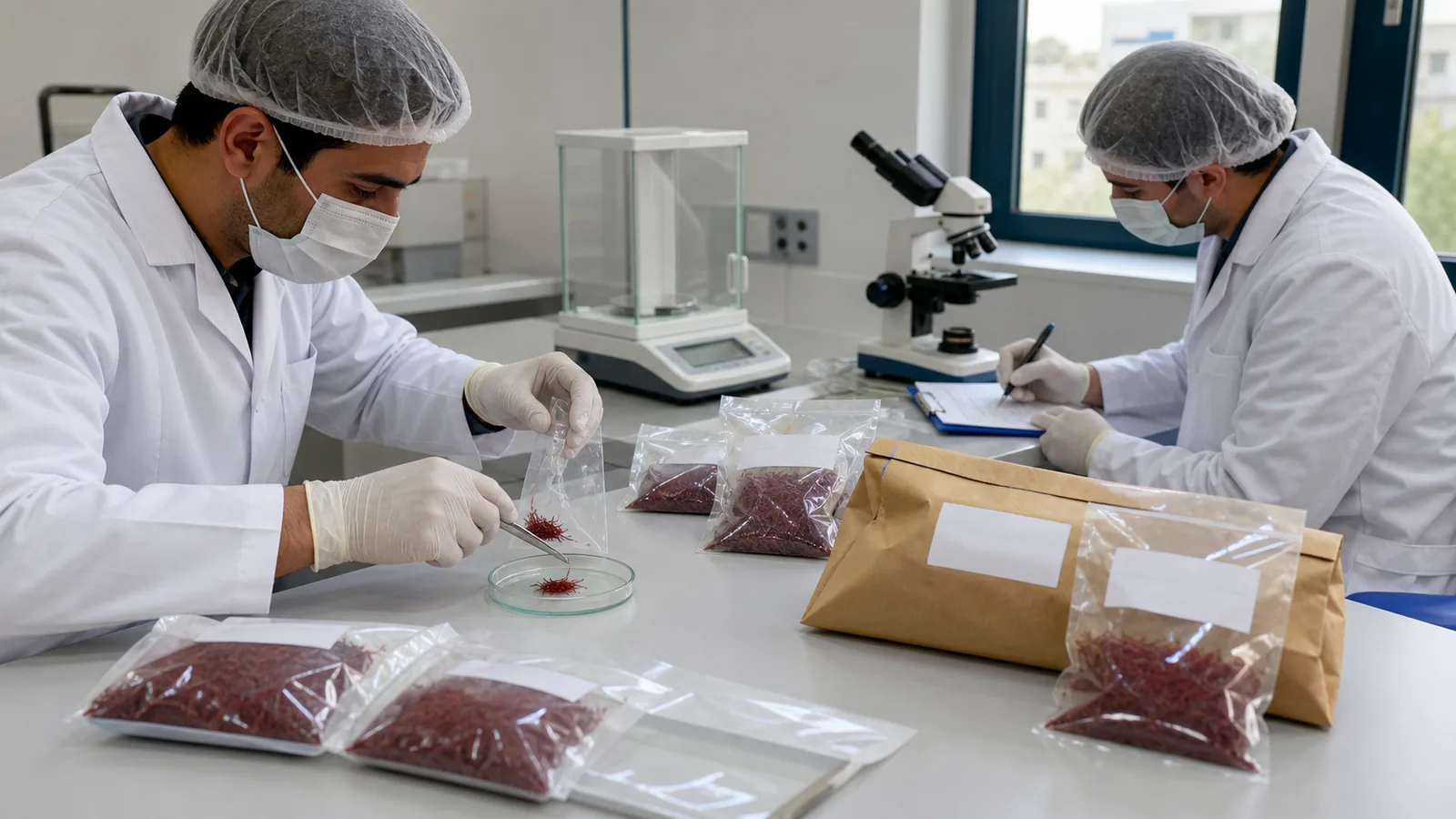
Inspectors in Kermanshah seized more than nine kilograms of suspected counterfeit saffron from a private house and sent a sample for laboratory testing. The 2016 report described an enforcement action, not a published laboratory verdict. Calling the material “fake saffron” reflects the allegation in the original account; its precise composition was not stated.
The case is a useful reminder that colour alone cannot authenticate saffron. Buyers need traceable lots, intact packaging and appropriate tests—especially when a product is offered outside a normal food supply chain.
What happened in the Kermanshah case
According to ISNA’s Kermanshah report, the local Food and Drug Administration received information about unauthorised packs of suspected counterfeit saffron stored in a house. Food-control inspectors acted with industry, trade and security officials after obtaining instructions from the deputy prosecutor.
The inspection recovered and seized more than nine kilograms of material. Officials said one kilogram was forwarded to a food-and-drug control laboratory and that the file was referred to the judicial authorities. The source did not publish the test result or the eventual court decision, so neither should be inferred.
The earlier English version repeated the seizure and sample statements. Those duplicates have been removed here; the facts themselves remain.
What “counterfeit saffron” can mean
The term can cover several different problems. A pack may contain another plant, dyed fibres, exhausted saffron, excess yellow style material, undeclared fillers or genuine saffron sold with false origin or grade information. It may also be underweight or carry a copied brand label.
These are not interchangeable. Botanical substitution is an identity problem; added colour is adulteration; false origin is a traceability and labelling problem. A proper investigation identifies the material and the breached rule rather than relying on a single broad description.
Why visual checks are not enough
Experienced buyers can notice warning signs such as unusually uniform fibres, surface dye, excessive yellow material, dust or an aroma that seems flat or artificial. None of these observations proves authenticity. Sophisticated adulteration can look convincing, while genuine saffron varies naturally by cut and handling.
Internet “tests” using an open flame, chemicals or tasting large amounts are unreliable and may be unsafe. A water observation can reveal rapidly bleeding dye or fibres that immediately lose all colour, but it is only a screening clue. It cannot replace a laboratory result or prove origin.
Evidence a buyer should request
For retail or commercial saffron, the evidence should connect the physical pack to a defined lot. Useful checks include:
- a lot code, harvest or packing date and net weight;
- the producer, processor or importer responsible for the pack;
- declared botanical identity and country of origin;
- an invoice and traceability record through each supplier;
- ISO 3632 results for colouring strength, aroma, bitterness and moisture;
- food-safety and adulteration tests appropriate to the market and risk; and
- a retained reference sample for larger orders.
The certificate should identify the tested lot, laboratory and date. A generic report or a certificate issued for another batch does not verify the saffron being sold.
How laboratories assess saffron
ISO 3632 methods measure chemical characteristics associated with saffron’s colour, aroma and bitterness. They help classify a sample and can expose some forms of poor-quality or altered material. Laboratories may add microscopy, chromatography, DNA-based methods or targeted tests when substitution or undeclared colouring is suspected.
No single number proves every claim. Origin, for example, relies on chain-of-custody evidence as well as analytical work. The testing plan should match the question being asked: identity, grade, contaminants, microbiology, added colour or geographical claim.
Buying saffron in Germany
The legacy address refers to a saffron shop in Germany, although the enforcement case occurred in Iran and did not identify a German seller. A German customer should buy from a food business that provides the mandatory label information, an identifiable responsible operator, lot traceability and a clear route for complaints.
For a commercial purchase, ask the importer how the lot was sampled and which tests were performed. Compare offers by net weight and verified grade rather than dramatic words such as “super premium.” Extremely low pricing, anonymous loose material and pressure to pay outside normal business channels deserve extra scrutiny.
Our guide to identifying real saffron explains practical observations without treating a home test as proof. Businesses sourcing larger quantities can use the checklist in our wholesale saffron guide.
What to do when a product seems suspicious
Keep the pack, receipt, lot number and any correspondence. Do not mix the product with other stock, repackage it or sell it onward. A consumer can contact the retailer or the relevant food-control authority; a business should follow its hold-and-investigate procedure and preserve representative samples.
An allegation should be documented carefully. The Kermanshah report shows the proper sequence: secure the material, preserve the legal chain, test a sample and refer the evidence to the competent authorities. Public certainty should come after the result, not before it.
Sources and context
- The more-than-9kg seizure, private-house inspection, participating authorities, one-kilogram laboratory sample and judicial referral preserve the original 2016 ISNA Kermanshah report; no unpublished test result is asserted.
- ISO 3632-1:2011 and ISO 3632-2:2010 cover saffron specifications and test methods.
- European Commission Food Fraud Network explains official cooperation on suspected intentional food-chain violations.

![Exporting Saffron to Turkey + Price Guide [Complete 0 to 100]](https://img.rowhanisaffron.com/20260827003933/saffron-export-turkey-quality-inspection.webp)



