


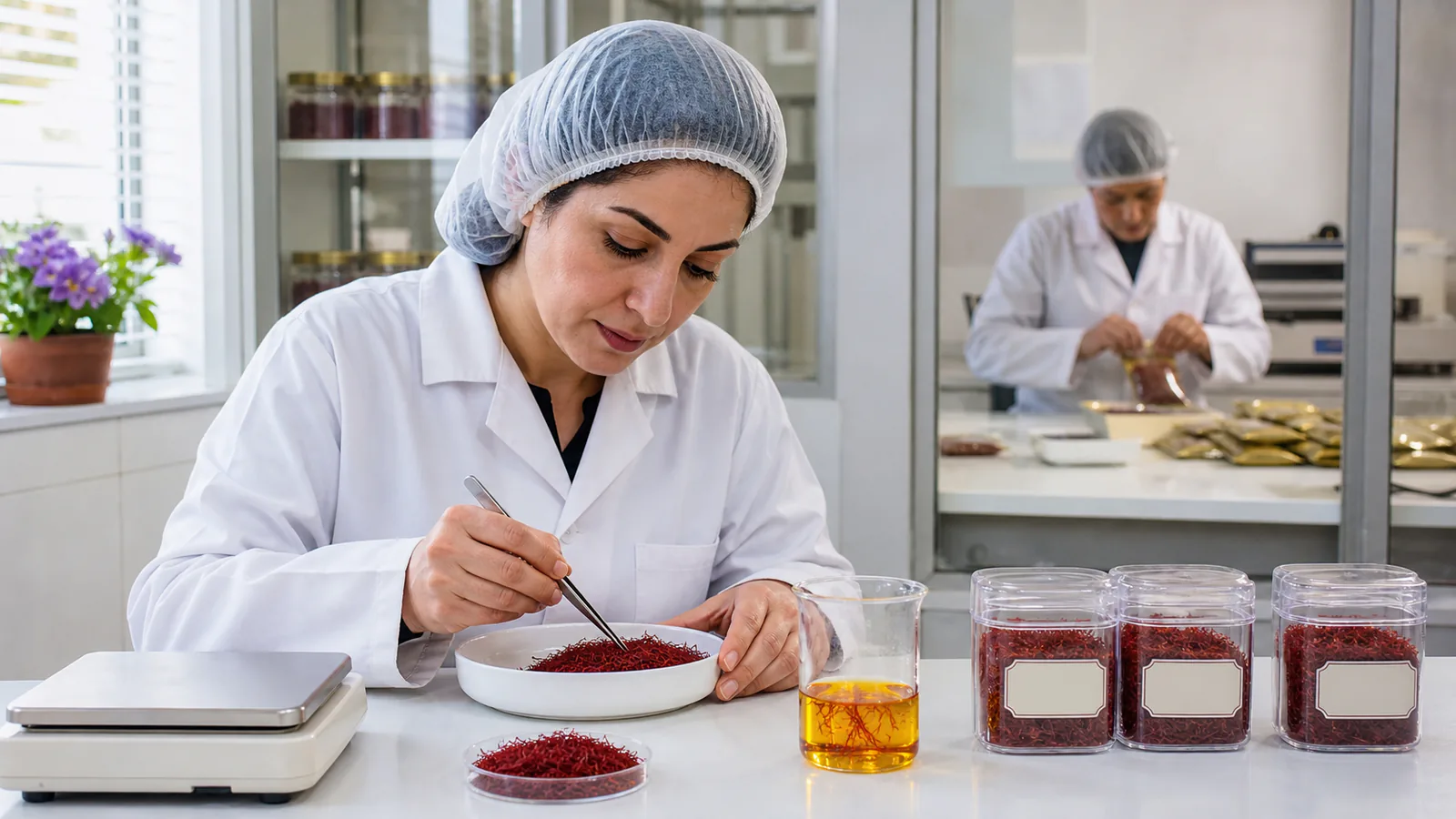
To identify pure saffron with confidence, look at the thread structure and package traceability first, then rely on a competent laboratory for a defensible purity or grade decision. Water, taste and visual checks can expose an obvious problem, but no single home test can certify a batch.
That distinction is especially important for wholesale saffron buyers. A sample can look convincing while containing extra floral material, added weight or dye; a genuine sample can also be poorly dried or mishandled. Authenticity, grade and condition overlap, but they are not the same question.
What genuine saffron threads look like
Saffron is the dried stigma, sometimes with part of the style, from Crocus sativus. The official Codex standard CXS 351-2022 for dried saffron describes a stigma that widens into a trumpet-like, serrated or indented top and narrows toward the style.
Open a small amount on a white surface under neutral light. Real filaments should not be a collection of perfectly identical straight fibres. Look for the characteristic widened end, variation expected from a flower, and a red body that may carry a limited paler style portion depending on the labelled style or grade.
Visible petals, stamens, unrelated plant strips, thread, stones, sand, metal, packaging fibre, insects or mould are warning signs. They can indicate extraneous saffron-flower material, foreign matter, contamination or poor sorting. Appearance alone still cannot reveal dissolved sugar, excessive moisture or a well-made botanical substitute.
The water test is only a screening check
Place a few threads in clear room-temperature or warm water and watch them over several minutes. Genuine saffron releases yellow-to-golden colour while the filaments remain recognisable. An immediate cloud of intense red dye, colour bleeding from a cut edge, or material that rapidly loses all surface colour deserves investigation.
This is not a pass-or-fail authenticity test. Genuine saffron releases colour at different rates depending on grind, temperature, age and handling, while a sophisticated adulterant can be designed to behave plausibly in water. The result can tell you to stop and obtain a proper analysis; it cannot justify a purity certificate.
Taste and aroma can reveal obvious additions, not prove purity
Saffron is characteristically bitter and aromatic rather than sugary or salty. A distinctly sweet or saline taste may suggest added sugar or salt, both historically used to increase sale weight. Yet sensory perception varies, and a small addition can escape notice.
Do not taste a sample that smells musty, looks mouldy or contains unknown material. For an apparently clean food sample, taste is still only a clue. It cannot quantify moisture, ash, dye, botanical substitution or microbial condition.
Documented dyes and look-alike material
Older saffron reports named synthetic colours such as tartrazine, Orange II, amaranth, sunset yellow and Ponceau 4R. The damaged term “Yellowstone Kynvlyyn” most likely combined yellow-colour names; it is not a usable chemical identity and should not be repeated as one.
A peer-reviewed review of saffron quality control and adulteration documents dyes including tartrazine, sunset yellow, quinoline yellow, amaranth and Ponceau 4R, as well as additions such as safflower, calendula, turmeric and other plant material. Sugar, salt, extra moisture and non-stigma flower parts can increase mass without needing to imitate every feature of a genuine thread.
A list of possible adulterants does not identify what is in a particular package. That requires an appropriate analytical method and a representative sample.
What ISO and Codex standards actually do
ISO 3632-1:2025 specifies requirements for dried saffron in filament, cut-filament and powder forms. Standardised test methods allow laboratories to examine identity, foreign material, moisture and the characteristics associated with taste, aroma and colour rather than relying on a photo or marketing phrase.
The amended Codex saffron standard provides public composition and physical criteria. Across its extra, I, II and III classes, it sets a maximum 12% moisture, 10% total ash and 8% acid-insoluble ash, plus limits for foreign and extraneous matter. It uses picrocrocin, safranal and crocin measures for taste, aroma and colouring strength, with class-specific values. Unclassified saffron must meet the grade III minimum under that standard.
These numbers are batch criteria, not claims a shopper can validate in a kitchen. A seller stating an ISO or Codex class should be able to connect the package lot to a report from a capable laboratory, including the method, result, date and sample identity.
Why powder needs extra care
Grinding removes the thread shape that helps a buyer inspect saffron visually. ISO’s own guidance on recognising quality saffron notes that fraud occurs more readily with powder because inexpensive material is easier to conceal. Powder can still be genuine and useful, but the buyer depends more heavily on the producer, lot controls and analysis.
For a large or repeat order, compare a retained reference sample with the delivered lot and request documentation that matches the form purchased. A filament result should not be assumed to certify an unrelated powder lot.
What a useful saffron label should tell you
A polished package is not evidence of purity by itself. Look for information that lets a buyer trace and question the product:
- the product name and form, such as filaments, cut filaments or powder;
- net weight;
- producer or responsible business and contact details;
- lot, batch or serial identifier;
- packing or production date and an applicable best-before or expiry statement;
- storage instructions;
- declared grade or class only when supported; and
- licence or health identifiers required in the market where it is sold.
A standard logo, licence number or health code should be checked with the issuing authority when the purchase is material. A logo can help trace responsibility; it does not replace lot-specific testing, and requirements differ between jurisdictions.
How a controlled packaging process begins
Good packaging starts before anyone fills a jar. Incoming saffron and packaging materials should be logged, sampled and checked against specifications. The older packaging workflow listed colour strength, aroma-related compounds, moisture, total ash, acid-insoluble ash, cold-water-soluble extract, pigment, foreign matter and flower remains. It also mentioned total nitrogen and crude fibre as internal or legacy checks.
Current release decisions should follow the applicable standard, market rules and validated method rather than copying a historical test list. Results need a batch identity and record. A loose number without the sample, unit, date and method is not useful evidence.
Sorting removes visible material, not hidden adulteration
After incoming approval, trained staff can sort filaments to remove foreign particles and unwanted floral remains. Sorting improves physical cleanliness and consistency, but it cannot measure moisture, ash, crocin, picrocrocin, safranal or dissolved additives. Laboratory control and manual sorting solve different problems.
The accepted saffron then moves to calibrated weighing equipment. Scale calibration, tare control and in-process checks matter because a correct label must correspond to the actual net contents. Containers should be filled without crushing the threads or impairing quality.
Sealing, vacuum packing and coding
The historical workflow used sealed pouches or cans and vacuum packing for selected formats. Vacuum is a packaging condition, not an authenticity test: it cannot turn a contaminated or low-grade batch into pure saffron. The material, seal and fill process must be suitable for the product and intended shelf life.
After initial packing, a coding or jet-printing step can apply the declared weight, production or packing date, expiry or best-before information, product identifier, lot or serial code and format. Those fields allow a complaint, withdrawal or test result to be tied back to a defined batch.
Units may then be placed in cartons, and some formats may receive shrink wrapping for grouping or tamper evidence. Final inspection should confirm the correct product, readable code, net-content control, seal condition, package integrity and match between the physical lot and its records.
Quality control continues through the line
A robust process does not wait for the last carton to find a mistake. Incoming approval, sorting, weighing, sealing, coding, boxing and final release each need a defined check and a recorded result. Suppliers of raw saffron and packaging material should also be approved against documented requirements.
Storage after packing matters as well. Protect saffron from conditions that degrade aroma and colour, and follow the package instructions. Our guide to storing saffron explains practical household handling after opening.
A practical decision for retail and wholesale buyers
For a small retail purchase, inspect the seal, label, lot code, threads and aroma; use water only as a warning screen. If anything conflicts—such as a missing responsible business, implausible colour release or visible foreign material—do not rely on the package.
For wholesale saffron, a photograph and home test are not enough. Ask for a representative sample, lot-linked specification and certificate of analysis, then define acceptance criteria before shipment. When stakes are high, use independent testing and preserve a sealed retain sample from the received lot.
Pure saffron is a documented conclusion
The best answer to “How can I identify pure saffron?” is layered. Thread shape, aroma, taste and water behaviour can catch an obvious mismatch. A complete label and controlled package provide traceability. Standardised sampling and laboratory analysis provide the evidence needed to classify or reject a batch.
No attractive tin, bright infusion or single logo can do all three jobs. Purity becomes credible when the physical saffron, the package code and the test record point to the same product.

![Exporting Saffron to Turkey + Price Guide [Complete 0 to 100]](https://img.rowhanisaffron.com/20260827003933/saffron-export-turkey-quality-inspection.webp)



