


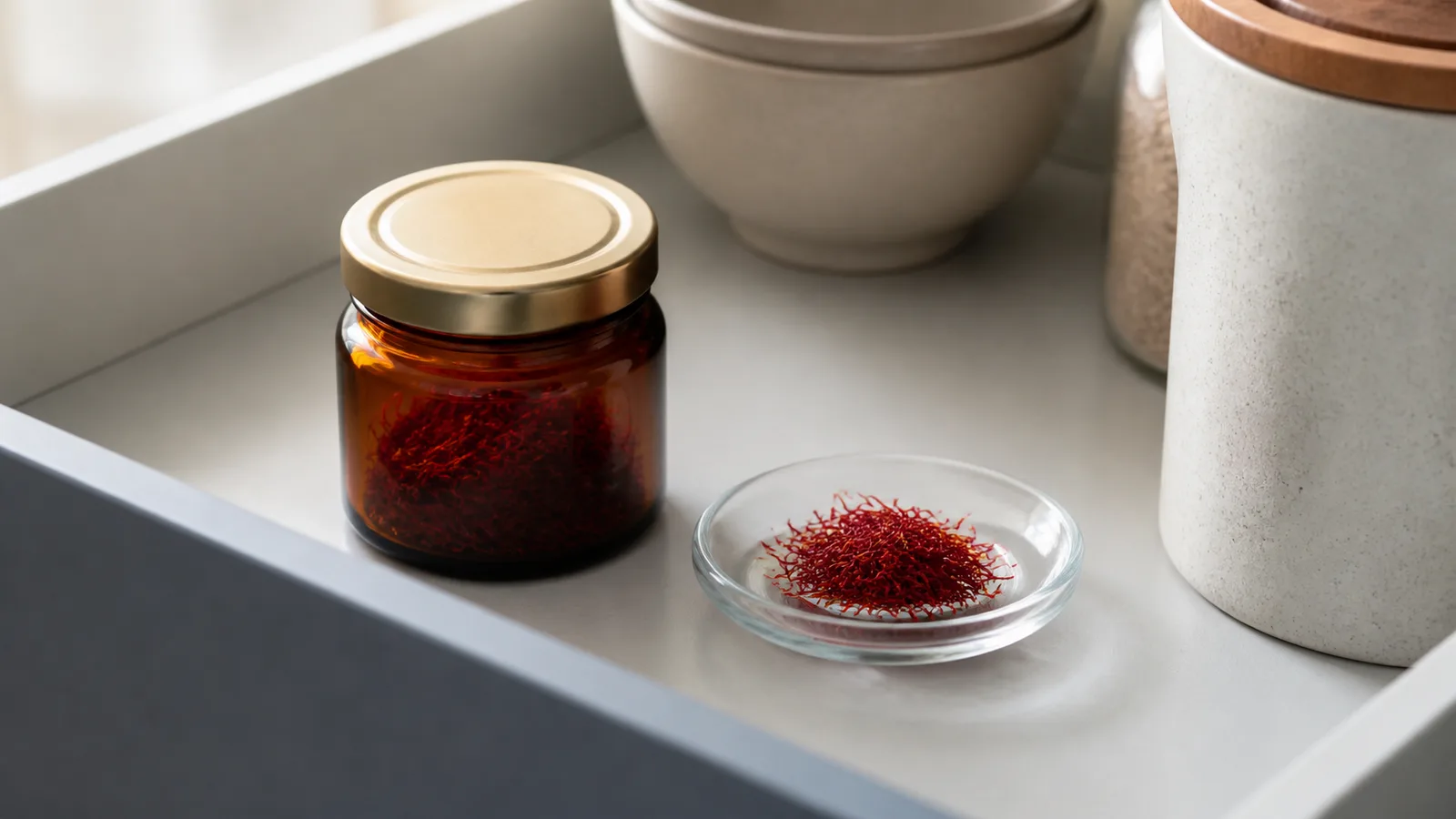
Best Ways to Store Saffron Spice and Preserve Its Qualities
The best way to store saffron is in a small airtight container, kept cool, dry and dark. A cupboard away from the cooker, sink and direct sun is usually better than an exposed spice rack. Open the container only long enough to take what you need, then close it firmly.
This simple routine protects saffron threads from their main storage enemies: light, heat, moisture, oxygen and nearby odors. If you are deciding how to keep saffron fresh at home, a stable pantry and a sound seal matter more than a complicated appliance. This approach also avoids the condensation risk that comes from repeatedly moving a cold jar into a warm kitchen.
Why saffron loses color, aroma and flavor
Saffron’s color is associated mainly with crocins, its bitter taste with picrocrocin, and much of its characteristic aroma with safranal. The old version of this article named crocetin as the main color compound and misspelled picrocrocin; crocetin is related chemistry, but crocins are the better storage-quality reference here.
These compounds do not remain fixed forever. Research shows that storage time, temperature, relative humidity, oxygen and light can change saffron’s chemical and sensory profile. Good storage slows that change. It cannot make an old or poorly dried lot fresh again.
How to store saffron threads at home
- Check that the threads are dry. Do not seal saffron that feels damp or has been exposed to steam.
- Use a clean, food-safe airtight container. Dark glass or metal blocks light. Clear glass is acceptable inside a closed cupboard.
- Choose the right size. A jar only slightly larger than the saffron leaves less air inside and needs less handling.
- Keep it cool and stable. Avoid shelves above the oven, beside a kettle or against a sunny window.
- Keep it dry. Use a clean dry spoon or tweezers rather than damp fingers.
- Protect the aroma. Do not store saffron beside loosely sealed coffee, perfume, cleaning products or strong spices.
- Mark the date and lot. Keep the original best-before information, especially if you transfer the saffron to another jar.
For a larger purchase, divide the saffron into several small containers. Keep one working jar and leave the others sealed. Repeatedly opening one bulk container exposes the entire supply to fresh air and humid kitchen conditions.
Best containers for storing saffron
A good container has a tight seal, is made for food contact and does not carry a residual smell. Amber or opaque glass offers light protection without reacting with the spice. A sound metal tin can also work, provided its interior is clean and the lid closes securely.
A decorative cork bottle is less reliable if the stopper allows air or humidity through. Thin bags are convenient for shipping but can be punctured, opened repeatedly or permit odor transfer. If saffron arrives in a resealable pouch, placing that closed pouch inside a rigid airtight container adds protection from crushing and changing humidity.
How to store ground saffron
Ground saffron has more surface area exposed to air and is harder to inspect for adulteration. Keep whole threads when possible and grind only the amount needed. If you buy ground saffron, use a very small airtight, light-blocking container and avoid opening it over steam.
Do not judge storage life by color alone. Added colorants or another dyed material can look vivid even when the product is not pure saffron. Traceability and suitable testing matter more than a home color demonstration.
Can saffron go bad, and does it expire?
Dried saffron usually loses strength gradually rather than spoiling on a single day. Under suitable processing and storage, published reviews report useful sensory quality for roughly one to four years, but that is not a promise for every package. Moisture level, seal, temperature, harvest, drying and handling all change the result. Follow the labeled best-before date and the producer’s instructions.
Discard saffron if it is visibly moldy, wet, contaminated by insects, or has an abnormal musty or chemical odor. Faded aroma or weak color release more often signals age and quality loss than a sudden safety boundary. When the history of a damp or unsealed product is uncertain, replacement is safer than trying to rescue an expensive spice.
What is saffron’s shelf life?
Saffron shelf life does not have one number that applies to every container. A date printed on a properly packed commercial product is the best starting point because it reflects that producer’s package and testing. Once opened, write the opening date on the jar and compare the aroma and culinary performance over time.
Buying more than you can use is rarely a saving. A small fresh supply replaced periodically usually performs better than a large jar opened for years.
Should saffron be refrigerated?
Refrigeration is not normally necessary for dry saffron in an ordinary home. A well-sealed jar in a cool dark cupboard avoids repeated temperature changes and the possibility of condensation. Refrigerators also contain humidity and food odors, both of which matter if the seal is imperfect.
If a very warm climate makes cold storage necessary, seal the saffron in small moisture-resistant portions. When taking out a portion, let the closed container reach room temperature before opening it. That keeps warm room air from condensing on cold threads. The old two-week refrigerator limit has no universal scientific basis and has been removed.
Can you freeze saffron?
Dry saffron can be frozen, but freezing is not automatically better than stable cool storage. The main practical hazard is moisture entering during thawing and repeated opening. For long-term bulk storage, divide completely dry saffron into airtight, moisture-resistant portions and thaw one portion while it is still sealed. Do not cycle the same jar in and out of the freezer.
For most household quantities, a dark pantry container is simpler and adequate. Freezing should solve a real heat or storage-duration problem, not add handling steps to a jar that will be used within its normal best-before period.
How to store liquid saffron
Prepared saffron water is a perishable food, not the same product as dry threads. Make only what you expect to use, prepare it with clean utensils, cover it and refrigerate it promptly. Follow the food-safety limits for the other ingredients in the mixture; dairy, stock or sweetened drinks may have a shorter safe life than plain saffron water.
For longer keeping, freeze freshly prepared saffron water in a clean covered ice tray, then transfer the cubes to a sealed freezer container. Label the date and portion size. Freezing helps with convenience, but it does not sterilize a mixture that was contaminated or left warm for too long.
Drying saffron is not the same as storing it
Fresh stigmas must be dried soon after harvest under a controlled process; that step develops aroma and brings moisture down for storage. It is not safe to “finish drying” an uncertain retail product by guessing with a hot oven. Excess heat and light can damage quality, while incomplete drying leaves too much moisture. Producers should use a validated process and measure the result against the applicable specification.
What about storing saffron bulbs?
Saffron bulbs are more accurately called corms, and they need a cultivation storage plan rather than a spice jar. Keep lifted dormant corms dry, ventilated and protected from pests at the temperature appropriate for flower-bud development and local planting time. Do not refrigerate or freeze them using the food-storage instructions above. Our saffron cultivation guide covers field and corm care.
Sources and further reading
- Saffron quality compounds and storage-related change, peer-reviewed open-access review.
- Effect of drying and one-year storage on saffron quality, Food Bioscience.
- Drying conditions, storage and saffron volatile compounds, peer-reviewed review.
- Saffron packaging and protection from humidity, oxygen, light and temperature, reference chapter.
The rule worth remembering is uncomplicated: keep dry saffron sealed, dark, dry and cool, and expose only the portion you plan to use. That protects the threads without turning storage into a laboratory exercise.

![Exporting Saffron to Turkey + Price Guide [Complete 0 to 100]](https://img.rowhanisaffron.com/20260827003933/saffron-export-turkey-quality-inspection.webp)



