


Ideal saffron cultivation is not one rigid planting recipe. It is a measured system that matches healthy corms, density, depth, soil, water, nutrition and labour to a particular farm—and checks the result over several seasons before calling the method better.
What “modern or advanced cultivation” should mean
The phrase modern or advanced cultivation is often used for denser planting, planned irrigation, systematic fertilization and greater use of tools. Those choices can improve output or reduce a specific cost, but the label itself proves nothing. A modern system is useful when it records inputs, protects soil and corm health, and produces a better return per hectare or per unit of water.
Claims of lower maintenance costs, less labour and two or three times the yield need a defined comparison. Which traditional method was used as the baseline? Were both fields the same age, planted with the same corm weight and measured as dry stigma? Did the calculation include the cost of planting stock, irrigation, machinery and replanting? Without that information, a multiplier is promotion rather than a farm budget.
Begin with a site and production baseline
Before choosing saffron cultivation techniques, record the field’s soil texture, pH, salinity, drainage, irrigation-water quality, winter and summer temperatures, previous crop, weeds and access for harvest workers. A system that performs well in dry, well-drained Khorasan conditions may not transfer unchanged to a humid or waterlogged site.
Define the farm’s aim as well. A grower selling dried saffron may prioritize stigma yield and quality. A nursery also needs large, healthy daughter corms. A short, high-density cycle can favour early output per unit area while reducing individual-corm performance or bringing forward the point at which crowding becomes expensive.
Corm quality and density come first
The number of saffron bulbs per unit area is one of the strongest management levers. Larger, healthy corms generally establish and flower more reliably than small or damaged stock. Record both corms per square metre and total planting weight per hectare; either figure alone can conceal a very different size distribution.
Closer spacing can increase flower and stigma production per square metre in early seasons. It does not automatically make harvesting faster, and it can increase competition as daughter corms multiply. Controlled research on planting density and depth found that high density raised yield per area but reduced performance per individual plant. The setting was a greenhouse, so the figures are evidence of a trade-off, not a field prescription.
A survey of farms in Gonabad found that some growers used high density for stronger early returns even though the productive cycle could shorten. The authors’ dense-planting efficiency analysis estimated a local density associated with better efficiency; it should not be exported to another soil or climate without a local trial.
Choose depth and layout as a system
Planting depth interacts with corm size, soil texture, temperature and the intended field lifespan. Rows or furrows can improve access and make irrigation behaviour easier to observe. Basin arrangements may suit other local systems. The ideal layout is the one that provides even emergence and drainage while allowing workers to weed, harvest and inspect the crop without compacting the corm zone.
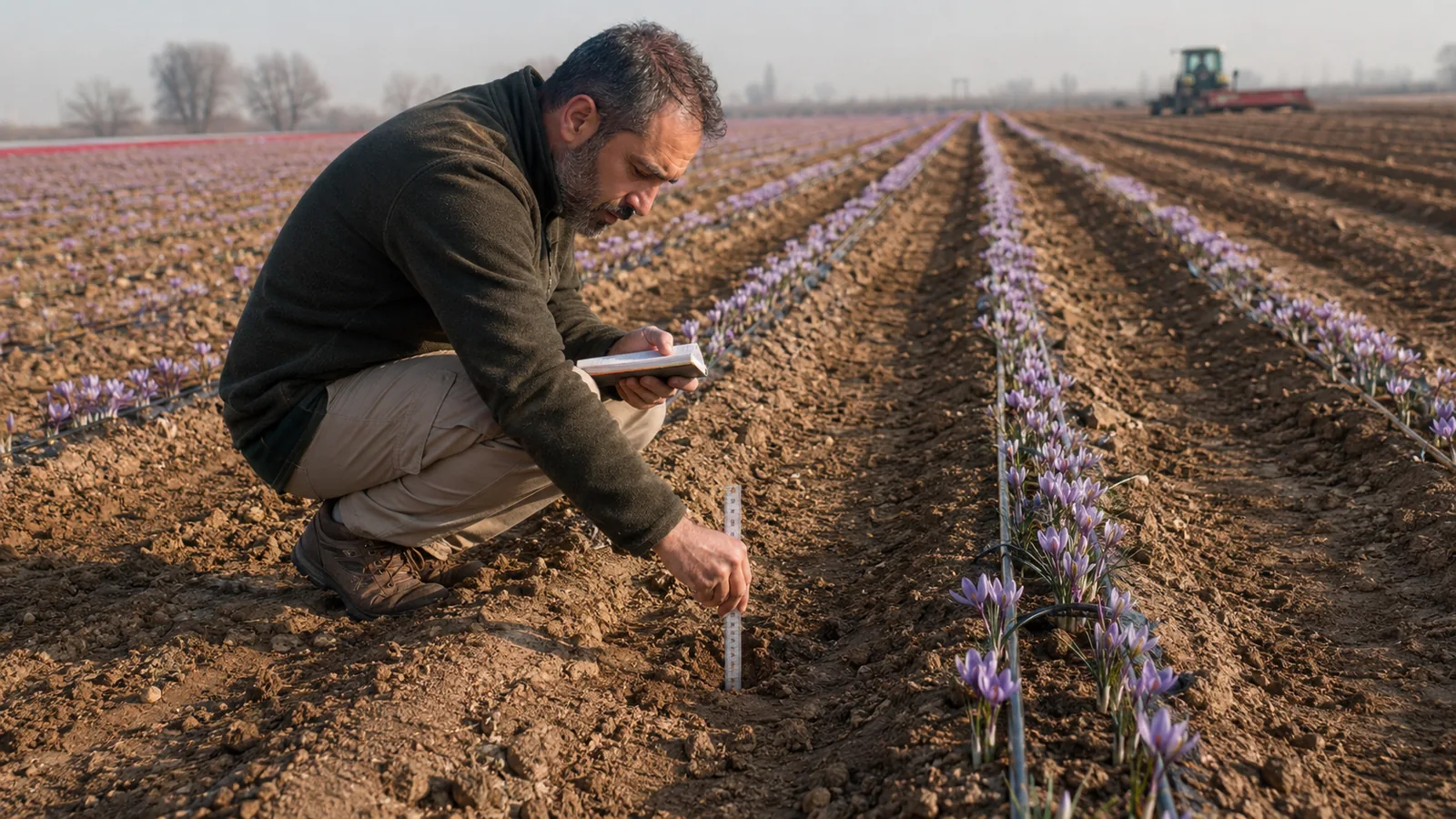
Research comparing corm size and depth has found meaningful interactions rather than one globally superior setting. Use a small field trial where local evidence is weak. Mark the depth, density and corm class in each strip and compare emergence, flower count, dry stigma, daughter-corm distribution and labour.
Fertilization: precise does not mean automatically lower
Fertilization should be systematic and tailored to the crop, but higher bulb density does not mean less fertilizer is required per hectare. More plants may remove more nutrients, while the soil may already supply part of the requirement. The correct amount begins with a representative soil test, the product analysis, organic inputs, irrigation water and the field’s measured removal and response.
“Less fertilizer” is a valid goal only when it means eliminating an unnecessary or poorly timed application without reducing soil function or crop performance. Do not cut the rate merely because the system is called ideal saffron cultivation. Likewise, more fertilizer is not insurance against low yield.
Foliar spraying can correct a diagnosed issue when the nutrient, formulation, timing and local label support it. It is not a universal route to improving next year’s saffron crops. Leaves must remain healthy long enough to support daughter-corm development, yet spray cannot repair corm injury, waterlogging, severe salinity or a poorly chosen planting depth.
Balanced nutrition may support robust corm growth, but it does not prevent mites and fungi or remove cold and temperature stress. Diagnose pests and disease; protect corms from mechanical injury; and manage temperature exposure through site, depth and soil conditions. The saffron farm nutrition plan explains the testing and record structure in more detail.
Water requirements are measured, not assumed
Saffron is often described as a low-water crop because its active season can use cool-season rainfall and its summer foliage is dormant. That does not mean every intensive system uses less irrigation. Water requirements depend on rainfall, soil storage, salinity, planting depth, rooting, system efficiency and the target yield.
Measure applied volume, not just irrigation count. Check the wetting depth and distribution, and record dry-stigma yield per cubic metre as well as yield per hectare. A recent six-season study of irrigation, salinity and planting method found that season and rainfall changed treatment outcomes; in its setting, in-furrow planting outperformed basin planting across the study period. That result illustrates interaction, not a promise for every farm.
Mechanization should solve a named bottleneck
Mechanized equipment can help with land preparation, bed formation, irrigation control, lifting or material handling. The delicate flowers still require timely collection, and machinery cannot be assumed to replace manual labour at every stage. Narrow spacing may actually make access harder if the layout was not designed for a particular machine.
Calculate labour by operation: planting, weeding, irrigation, flower picking, stigma separation, drying and lifting. A machine is worthwhile when it reduces total cost or improves timing without crushing corms, compacting wet soil, increasing contamination or lowering product quality.
What is a realistic saffron yield per hectare?
Yield figures must specify dried stigma, location and year. Official Iranian data submitted to the Codex Committee on Spices and Culinary Herbs for 2014–2015 reported provincial averages of roughly 3.1 to 6.1 kilograms per hectare. These are historical regional averages, not a ceiling, but they give context to marketing claims.
The statement that one hectare will produce 20 to 30 kilograms of saffron in the third and fourth years describes an exceptional target, not an expected result. A long-term field experiment reported average treatment yields of 9.0, 12.4, 9.8 and 0.9 kg/ha in its third through sixth seasons, showing both a strong fourth year and a steep later decline under the tested conditions.
“Traditional saffron yield per hectare” is not one global number either. Traditional fields differ in density, age, corm stock, climate and measurement quality. Compare a proposed system with the farm’s own verified dry-weight records and a suitable local benchmark. Never build a loan or investment plan around the best plot in a trial.
Profitability and risk need a full-cycle budget
Higher production does not always produce higher profit. Dense planting raises the initial corm bill and can shorten the time before lifting and replanting. Add land preparation, water, fertilizer, plant protection, labour, drying, testing, finance and marketing costs. Then model a weak, normal and strong yield year at realistic sale prices.
No cultivation method removes the risk of crop failure or creates steady, profitable returns. Weather, corm health, water quality, labour availability and market conditions remain uncertain. The useful outcome of modern records is not certainty; it is earlier detection of a problem and a clearer decision about whether to continue, adjust or replant.
Field lifespan, soil erosion and sustainability
A claim that advanced planting shortens the growing season from 9–10 years to 7 years may describe a planned high-density cycle. It is not inherently more sustainable. Lifting and replanting more often can disturb soil; leaving an overcrowded field too long can reduce corm size and yield. The correct cycle ends when field records and corm sampling show that the next season’s expected return no longer justifies maintaining the stand.
Reducing soil erosion requires its own measures: keeping runoff under control, avoiding bare vulnerable soil, aligning beds and water flow to the site, protecting structure, and keeping heavy traffic off wet ground. A seven-year calendar does not deliver those outcomes by itself.
A practical modern-cultivation plan
- Test soil and irrigation water and map field variability.
- Buy or sort healthy corms and record the full weight distribution.
- Choose density, depth and row layout from local evidence or a measured trial.
- Budget planting stock, water, labour, machinery, lifting and replanting over the whole cycle.
- Base fertilizer and foliar spraying on tests, crop stage, product labels and recorded response.
- Measure water volume, wetting depth, rainfall and yield per cubic metre.
- Track emergence, flowers, dry stigma, quality, daughter-corm classes and labour every year.
- Review the system after each harvest and change one justified variable at a time.
The future of saffron cultivation in Iran will benefit from advanced farming techniques, but “advanced” should mean transparent measurement and careful adaptation. The ideal method earns that description only when it improves the farm’s verified yield, resource use and long-term return without transferring hidden costs to soil, water or the next crop.

![Exporting Saffron to Turkey + Price Guide [Complete 0 to 100]](https://img.rowhanisaffron.com/20260827003933/saffron-export-turkey-quality-inspection.webp)



