


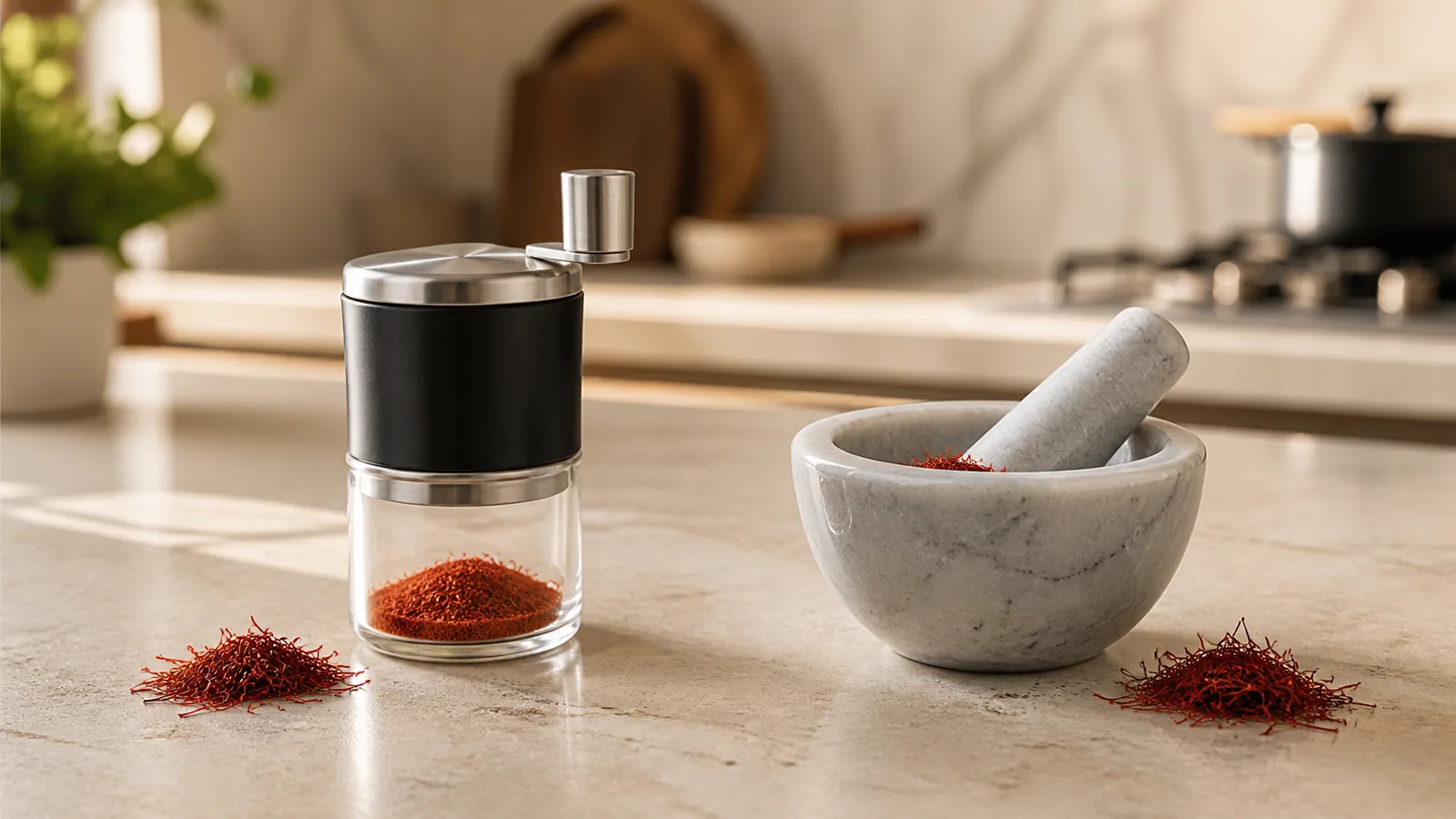
Saffron Grinder Benefits are easiest to judge beside traditional mortars: a well-made grinder is tidy and repeatable, while a mortar gives closer control over a very small quantity. Either can work well. The better choice depends on how often you grind saffron, the tool’s shape and how carefully you handle the threads.
Saffron grinder or mortar: the short answer
For an occasional pinch, a small smooth mortar is often the simplest choice among traditional tools. You can see the texture change, stop before the saffron becomes excessively fine and gather the powder with a small brush or spoon. A dedicated modern saffron grinder becomes more useful when you prepare the spice regularly, need a consistent result or find prolonged grinding uncomfortable.
An electric spice mill is rarely necessary for a household-sized portion. Its chamber is usually too large for a few threads, powder can remain around the blade, and a long run adds more heat and air exposure than the job requires. If it is the only tool available, use a clean, dry mill and very short pulses.
What grinding actually changes
Grinding does not make weak saffron stronger. It reduces particle size, increasing the surface available to water, milk, stock or fat. That normally helps the colour and flavour disperse more evenly through a dish, especially when the powder is infused before it is added.
The characteristics people value in saffron come from compounds that contribute color, taste and aroma. Tool choice cannot restore compounds lost through poor drying or storage. The current ISO 3632-1 saffron specification covers dried saffron sold as filaments, cut filaments and powder, which is a useful reminder that powder is a legitimate form but not automatically a higher grade.
Saffron Grinder Benefits in everyday use
A purpose-built manual grinder usually has a small grinding surface and an enclosed catch area. Some designs pair a glass container with a rotating handle; others use two fitted parts that crush the threads as they turn. The practical benefits may include:
- More repeatable texture: a consistent mechanism makes it easier to reproduce the same coarse or fine result.
- Less powder left on an open work surface: a catch cup can contain fine particles, though no tool is literally waste-free.
- Lower hand effort: a crank or broad turning surface may be easier to use than a narrow pestle.
- Convenient small batches: a chamber designed for saffron handles a pinch better than a full-size electric mill.
Those advantages depend on construction. Deep corners, a coarse unfinished surface or a loose-fitting chamber can trap as much powder as a mortar. A transparent container is useful for seeing the result, but do not leave saffron sitting in clear glass on a bright counter.
Where a traditional mortar is better
A mortar offers direct control. This matters when a recipe calls for only a few threads or when you want a coarse crush rather than a uniform powder. It is inexpensive, has no mechanism to jam, and can be cleaned immediately after use.
Material and shape matter more than a blanket claim that one type is always superior:
- Stone mortar: a small model with a smooth, food-safe interior gives useful grip without too many pores or crevices. A rough bowl can retain precious powder.
- Metal mortar: clean stainless steel is durable and easy to inspect. Metal does not automatically “burn” saffron through ordinary brief hand grinding; needless force or prolonged machine grinding is the more sensible heat concern.
- Wooden mortar: light and comfortable, but scratches and grain can hold saffron particles or aromas from earlier ingredients. Reserve it for compatible spices if it cannot be cleaned thoroughly.
- Ceramic mortar: a small glazed, food-safe bowl is easy to clean, provided the working area supplies enough grip and has no chips.
Why dryness matters before grinding
Properly dried saffron threads are brittle enough to break into even particles; damp, flexible threads may smear, clump or adhere to the tool. Keep a dry environment around the task, and make sure the grinder itself is completely dry.
Do not try to rescue questionable saffron by heating it aggressively in a pan or microwave. Drying is a controlled production step that shapes the spice’s chemistry; casual reheating can sacrifice aroma or colour. If stored threads have become damp, smell musty or show any sign of mould, do not grind them for food. Check the container and replace the product when safety or quality is uncertain.
How to use a manual saffron grinder
- Make sure the chamber, grinding surfaces and catch cup are clean, odour-free and dry.
- Add only the amount needed for the dish. Do not pack the chamber tightly.
- Close the tool and turn with steady, moderate pressure. Follow the maker’s direction if the mechanism is one-way.
- Stop and inspect the texture rather than continuing automatically. Fine grains are usually sufficient for infusion.
- Tap the closed tool gently so loose particles fall into the catch cup, then transfer the powder with a dry spoon or brush.
- Clean and dry every surface before storage; old spice residue can affect the next batch.
How to grind saffron in a mortar
- Place the dry threads in a small, clean mortar.
- Press and roll the pestle rather than striking hard. Begin slowly so threads do not jump out.
- Draw the saffron back toward the centre as it spreads around the bowl.
- Stop at the texture your recipe needs and collect the powder promptly.
A small pinch of sugar or salt is sometimes used as an abrasive. It can make crushing easier, but it also becomes part of the recipe, so choose it only when that ingredient and quantity already suit the dish. A dry mortar works without either.
Waste, aroma and the claim of “better flavour”
No grinder can promise zero waste. Fine saffron remains on burrs, walls, threads and seams; a mortar retains some on its bowl and pestle. A tool wastes less when its working area suits the portion, has few inaccessible corners and lets you sweep or rinse the residue directly into the recipe.
Grinding can speed extraction, but it also exposes more surface to air, light and moisture. That is why the cleanest practice is to grind a small quantity close to use. A grinder does not intensify aroma by creating more aromatic material. It helps distribute what the saffron already contains.
How to choose between them
Choose a mortar when you use saffron occasionally, work with tiny pinches, value texture control or want a tool with no moving parts. Choose a dedicated manual grinder when you prepare it often, want repeatable particles, need less hand pressure or prefer a contained catch cup.
Before buying, look at the smallest batch the tool can handle, how it opens, whether the food-contact materials are identified, and whether every surface can be reached for cleaning. A handsome grinder that traps powder below a fixed burr is less useful than a plain mortar that empties cleanly.
Store threads first and powder briefly
Whole threads are easier to inspect and leave less surface exposed during storage, so keep the main supply intact and grind what the recipe needs. A study of storage time and saffron’s chemical profile found measurable changes as samples aged. Its results do not set one universal shelf life, but they support treating storage as part of quality rather than an afterthought.
Close the container promptly and keep it away from light, humidity, heat and strong odours. If some powder remains, place it in the smallest suitable airtight, food-safe container and use it soon instead of returning it to the thread jar. The guide to storing saffron while preserving its quality covers containers and storage conditions in more detail.
Move from powder to an even infusion
Once ground, scatter the powder into the recipe’s measured liquid and give it time to disperse. The liquid, temperature and timing depend on the food; harder boiling is not a substitute for careful extraction. For a complete kitchen method, see how to prepare and grind saffron for cooking.
The practical verdict
The strongest Saffron Grinder Benefits are convenience, repeatability and containment, not guaranteed flavour or zero waste. A good grinder is worthwhile for regular use. A clean, appropriately sized mortar remains an excellent choice for occasional cooking and fine control. Whichever tool you choose, start with sound dry threads, grind only what you need and protect the result from heat, light, moisture and old spice residue.

![Exporting Saffron to Turkey + Price Guide [Complete 0 to 100]](https://img.rowhanisaffron.com/20260827003933/saffron-export-turkey-quality-inspection.webp)



