A useful Saffron Farm Nutrition Plan is not a fixed shopping list for August, September, October and December. It begins with soil and water evidence, follows the crop’s growth stages, and records the field’s response so the next decision is better than the last.
Start with the field, not a generic fertilizer calendar
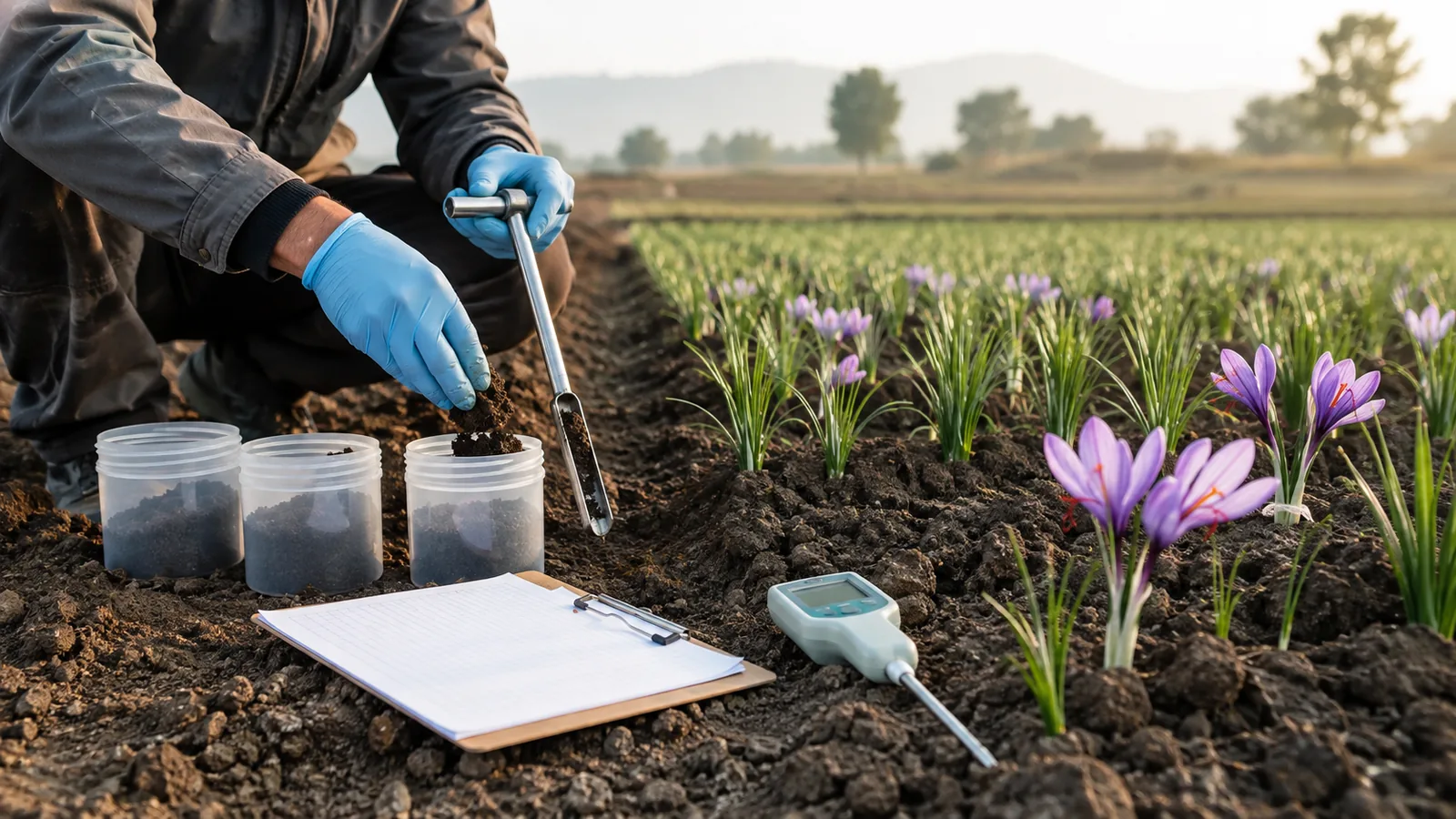
Saffron can remain in the same ground for several seasons, so a wrong nutrient decision may affect more than one harvest. Before applying fertilizer, identify the soil texture, drainage, pH, salinity, organic matter and available nutrients. Test irrigation water where salinity or bicarbonate is a concern.
The Food and Agriculture Organization’s guidance on soil and plant testing for fertilizer recommendations explains why local crop response, plant requirements, soil results and economic conditions all belong in the recommendation. A rate copied from another farm cannot account for those variables.
At minimum, give the laboratory the crop name, field history, sampling depth and recent amendments. A result without units, method or interpretation is not yet a nutrition plan. Use a local agronomist or extension adviser to translate the report into product and application rates.
Build the plan around saffron’s growth cycle
Calendar months are only shorthand. Northern Hemisphere farms often prepare during late-summer dormancy, irrigate and flower in autumn, carry green leaves through winter and spring, then return to dormancy as the leaves senesce. Climate, altitude and irrigation can move those stages.
Research on saffron corm development shows that daughter-corm growth and carbohydrate allocation change through the season. That matters because flowers, leaves and replacement corms do not all draw on the plant in the same way or at the same time.
Before planting or before the first autumn irrigation
Take representative soil samples early enough to receive results before field work. Correct drainage and compaction first; fertilizer cannot compensate for corms sitting in waterlogged soil. Our guide to choosing land for saffron cultivation covers those physical checks. If the plan calls for compost or manure, use mature material with known analysis and incorporate it according to local guidance rather than placing fresh manure against corms.
Record the amendment’s nutrient content, salt level and application area. “Organic fertilizer” may mean compost, pelletized manure or a concentrated commercial product, and equal weights do not deliver equal amounts of nitrogen, phosphorus or potassium.
Sprouting and flowering
The first irrigation is a management event, not an automatic instruction to add every available product. Check soil moisture, weather and the fertilizer plan before injecting soluble material. High concentrations around emerging roots can increase salt stress, especially where irrigation water already carries salts.
Flower number in a particular season also reflects corm size and reserves built previously. A treatment applied just before bloom should not be credited automatically for every flower that appears.
Post-flowering leaf growth
After harvest, healthy leaves carry out photosynthesis and support the development of daughter corms. This is the stage when a soil- or tissue-test recommendation may call for a split nutrient application. Split applications can be easier to match to crop uptake than one large dose, but the timing and amount still depend on the local production system.
Keep leaves intact and control weeds that compete for water and nutrients. Photograph representative areas and note leaf colour, density and damage. Pale foliage can have several causes, including nutrient shortage, root damage, water stress or disease; colour alone does not diagnose which one.
Daughter-corm development and senescence
Continue monitoring while foliage is active. Late applications made after the crop has stopped taking up nutrients may be wasted or move below the root zone. When leaves yellow naturally and dormancy begins, separate normal senescence from a sudden patch problem.
After lifting sample corms or at the next field-renewal interval, record daughter-corm number, size distribution and signs of rot. Those measurements help determine whether the plan supported future planting stock, not merely the current stigma yield.
What the main nutrients do
Nitrogen
Nitrogen supports leaf growth and plant proteins, but “more leaves” is not an adequate target by itself. Excess or badly timed nitrogen can create inefficient growth and increase cost without a proportional stigma or corm response. Base the total rate and any split on the soil’s supply, amendment analysis and locally calibrated advice.
Phosphorus
Phosphorus is associated with energy transfer, roots and developing plant tissue. Its availability changes with soil pH and existing phosphorus status. Applying it every year without testing can build an unnecessary surplus, while a genuinely low-testing field may need a planned correction.
Potassium
Potassium is involved in water regulation and many plant processes. Adequate status matters when crops face drought, but a fertilizer treatment should not be advertised as guaranteed drought protection. Potassium must come from a product that actually declares it on the label or from a measured soil reserve. Liquid sulfur is not automatically a potassium fertilizer.
Sulfur, calcium and micronutrients
Sulfur is a plant nutrient, and some sulfur materials are used to influence alkaline soil over time. The effect depends on the chemical form, soil biology, moisture and buffering capacity. A product sold as “liquid sulfur” should not be described as soil disinfection or corm-rot prevention unless its registered label and evidence support that use.
Calcium and micronutrients should also follow a demonstrated need. A foliar or liquid product’s volume says little without its concentration. Check the analysis, application method, compatibility and label limits before turning litres per hectare into a farm instruction.
Why the old monthly rates should not be copied blindly
A commonly circulated saffron plan gives four calendar entries: 600–800 kg of granular organic fertilizer in August, 2–5 litres of liquid sulfur per hectare in September, 10–15 litres of liquid humic acid per hectare in October, and 1.5–2 litres of liquid calcium per hectare in December. Those figures are not a complete recommendation.
August: 600–800 kg of granular organic fertilizer
The rate cannot be judged without knowing whether the material is compost, pelletized manure or concentrated fertilizer, what nutrients it contains, and whether “per hectare” was intended. It may supply too little organic matter to change soil structure yet too much of a particular nutrient if the product is concentrated.
September: 2–5 litres of liquid sulfur per hectare
The product name does not disclose elemental sulfur content, other nutrients or legal uses. Sulfur does not provide essential potassium unless potassium is separately present and declared. It should not be promised to disinfect soil or prevent fungal corm rot as though it were a universal fungicide.
October: 10–15 litres of liquid humic acid per hectare
Humic products vary widely in active content and source. Field research has tested humic acid within particular irrigation and nutrient treatments, but a result from one soil and climate does not validate every commercial formulation. One saffron field study, for example, evaluated nutrient and irrigation treatments together rather than establishing a universal monthly dose; see the study abstract and design.
December: 1.5–2 litres of liquid calcium per hectare
This entry lacks product concentration, soil calcium status and evidence of deficiency. In calcareous soils, total calcium may already be high even when another condition limits uptake. Diagnose the constraint before adding a product.
A practical saffron nutrition planning workflow
- Map the field. Separate areas with different soil, drainage, slope, crop history or symptoms.
- Sample correctly. Use the laboratory’s sampling instructions and keep unusual patches separate from representative samples.
- Set measurable goals. Record whether the priority is stigma yield, daughter-corm size, stand recovery or correction of a confirmed deficiency.
- Calculate nutrients, not only product volume. Convert the label analysis and application rate into kilograms of each nutrient per hectare.
- Match timing to crop stage. Use actual emergence, flowering, leaf growth and senescence rather than dates alone.
- Check compatibility. Confirm that products can be mixed and applied through the intended irrigation or spray equipment.
- Leave a comparison where practical. A small untreated or standard-practice strip can reveal whether a new input produced a useful field response.
- Review after the season. Compare yield, quality, corm measurements, soil/tissue results, labour and input cost.
Fertilizer does not replace crop protection
Corm rot, insects and poor emergence need diagnosis. Improve drainage, inspect planting material, manage irrigation and follow local crop-protection rules. Do not apply a fertilizer, sulfur input or biological product as a disease cure merely because a symptom appeared after irrigation.
Likewise, a nutrition plan cannot compensate for undersized or damaged corms, unsuitable planting depth, severe weeds or badly timed water. Record these factors beside fertilizer data so the season’s result is not attributed to nutrition alone.
Records to keep for every application
- field and treated area;
- date and saffron growth stage;
- product name, formulation and batch;
- label analysis and amount applied;
- water volume and application method;
- soil moisture and weather;
- observed crop response and any injury;
- flower, dry-stigma and daughter-corm measurements;
- input, labour and equipment cost.
The best saffron plan is therefore specific, testable and revisable. Keep the broad seasonal framework, but let soil evidence, crop stage, product analysis and measured field response decide what is applied.