


Iranian saffron is the dried red stigma of Crocus sativus, a small autumn-flowering plant in the iris family. The spice is prized because each flower produces only three usable stigmas, all of which must be separated and dried with care. Iran’s long cultivation tradition, especially in Khorasan, has made the country central to the modern saffron trade.
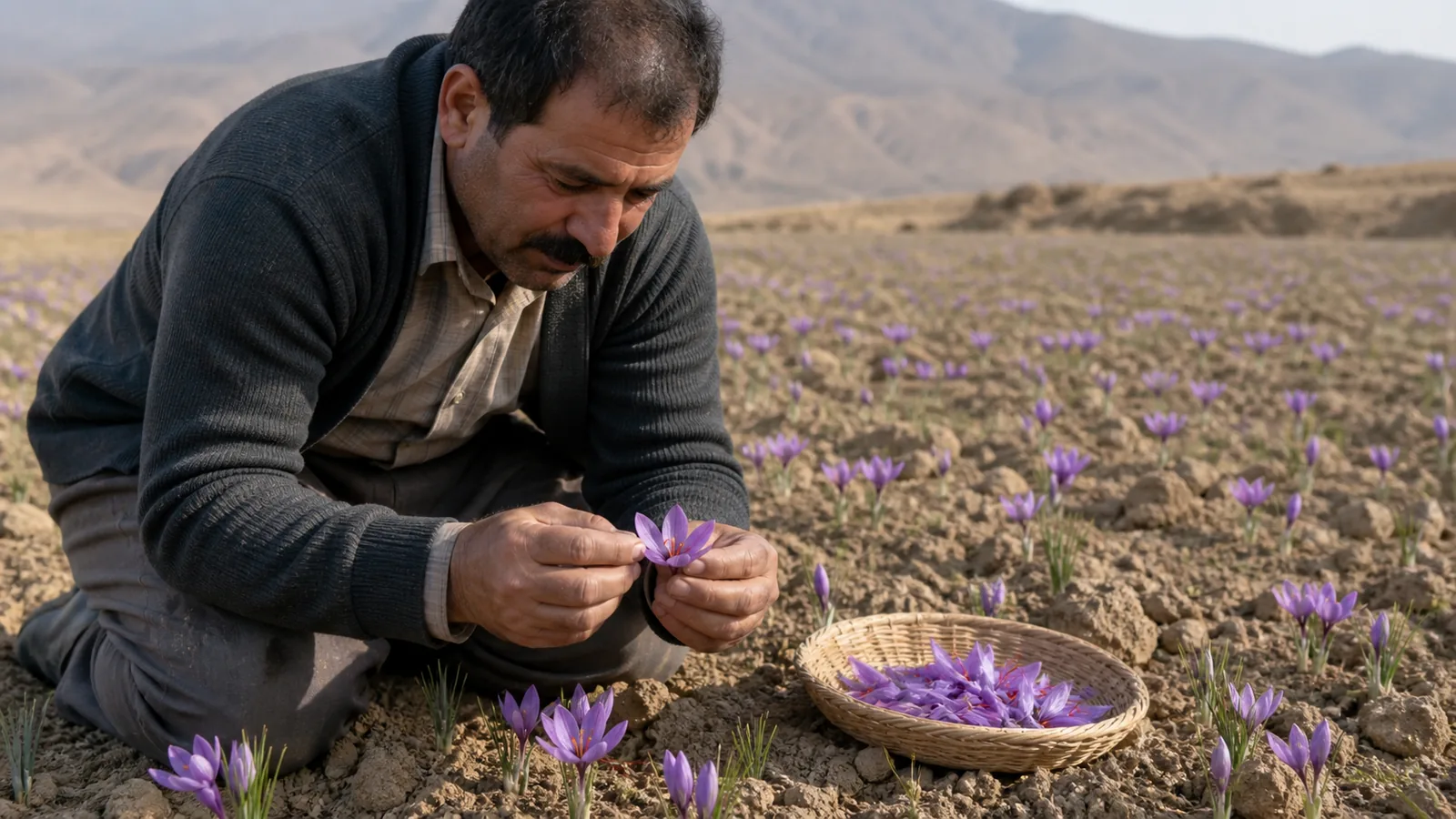
This guide brings together the plant’s botany, Iranian history, growing cycle, harvest, chemistry and safety. It also separates established facts from old claims. That distinction matters: saffron is a remarkable food ingredient, but a long list of traditional uses is not the same as proof that it treats disease.
What plant does saffron come from?
The correct scientific name is Crocus sativus L., not “Crosus sativa.” The Royal Botanic Gardens, Kew, accepts it as a species in the Iridaceae family and describes it as a tuberous geophyte. What is often called a saffron bulb is more accurately a corm: a compact underground storage stem rather than a layered onion.
The plant usually grows about 8–30 cm high. Its narrow leaves emerge around the flowering period and continue growing after the brief bloom. Each purple flower has six petal-like segments, three stamens and a style that divides into three deep-red stigmas. Those stigmas, sometimes with a small amount of the pale style attached, are harvested and dried for trade.
Saffron is sterile, so growers cannot raise a true crop from seed. New plants come from daughter corms produced around the original one. A field can therefore remain productive for several years before the corms become crowded and need to be lifted, sorted and replanted.
Iranian saffron: origin and historical tradition
Botanical origin and cultural history are related, but they are not identical. Kew currently records Crocus sativus as a cultigen from Greece and as introduced in Iran. That classification does not diminish Iran’s old cultivation knowledge or its importance to today’s supply. It does mean that “saffron is botanically native to Iran” should not be repeated as a settled fact.
Persian historical accounts connect saffron with court kitchens, fragrant preparations and coloured foods from the Achaemenid period onward. An older version of this article also referred to Xenophon and to a bronze list of court provisions. Because it did not identify the inscription, edition or translation needed to check the quantities, those details are best treated as part of a historical narrative rather than precise evidence.
What can be said with confidence is that saffron became deeply rooted in Iranian agriculture and food culture. Cultivation expanded in dry regions where farmers learned to work with the plant’s unusual rhythm: autumn flowers, winter and spring leaf growth, and summer dormancy. Khorasan remains the name most closely associated with Iranian saffron, while cultivation also occurs in other provinces.
For context on the difference between cultivation heritage and present production claims, see our explanation of Iran’s share of world saffron production.
Why does one kilogram require so many flowers?
Only three slender stigmas come from each flower, and fresh plant material loses substantial weight during drying. Estimates are therefore often expressed as flower or stigma counts rather than a fixed conversion. The retired source article quoted roughly 400,000 stigmas per kilogram. Dividing by three gives about 133,000 flowers, which is a useful illustration, not a universal production constant.
The exact number changes with stigma size, how much yellow style remains, moisture at weighing and the final grade. For the same reason, old claims that one precise weight of flowers always produces one kilogram of a particular grade should be treated cautiously. The reliable point is simpler: harvesting and separating a very large number of small flowers is skilled, time-sensitive work.
How Iranian saffron is cultivated
Saffron cultivation starts with healthy corms and a site that drains well. The University of Vermont’s saffron research program recommends light- to medium-textured soil with good drainage and useful organic matter. Standing water can rot the corms. That evidence is more transferable than the old article’s rigid “three parts clay to one part sand” recipe, which should not be treated as a universal soil formula.
Site preparation and corm selection
A grower should plan the bed as a multi-year planting, assess drainage, test the soil and incorporate mature organic material according to local agronomic advice. Healthy, firm corms without wounds, rot or obvious pest damage are preferable. Larger corms often flower more readily in the first season, but the old six-gram cutoff is not an international quality standard.
Planting depth, spacing and total corm weight depend on climate, soil, corm size and how long the field will remain in place. Published systems range widely. The Vermont guide, for example, notes regional depths of 3–12 inches and different densities for perennial and frequently replanted fields. A single prescription such as 30–40 cm furrows or 10–30 tonnes of corms per hectare cannot safely be copied to every farm.
Planting time and the annual cycle
Corms are planted while dormant, early enough to establish before the local flowering season. In Iranian production areas this is commonly a summer operation, but the right date varies with heat, soil moisture and location. Advice written for Vermont, Spain or one Iranian province should not be transferred unchanged to another climate.
Flowers usually appear in autumn and may emerge before the leaves have fully developed. The bloom is short, often concentrated over a few weeks. Leaves then support the corm through winter and spring before yellowing as summer dormancy begins. Depending on the production system, corms may stay in place for four or more years; crowding, disease pressure and falling yield determine when replanting is sensible.
Water, nutrition, weeds and pests
Irrigation must follow local rainfall, soil water and plant stage. “Water every 15–20 days” is not a safe general rule, and neither is a fixed urea schedule. Too much water can be as damaging as too little. Soil and tissue testing, field observation and locally qualified advice are a sounder basis for nutrient and irrigation decisions.
Weeds compete strongly with the narrow-leaved crop, so prevention and timely mechanical control are important. Rodents and corm diseases can also cause losses. The former source suggested blanket fungicide, herbicide, pesticide and poison-bait treatments. Those instructions have not been retained: a product may be illegal, unsuitable for a food crop or harmful to people and wildlife. Diagnose the problem first and use only locally approved controls exactly as their labels and an agricultural professional direct.
Harvesting, separating and drying saffron
Flowers are commonly collected early in the day, ideally before they are fully open and exposed to heat or dirt. During the busiest part of the bloom, a field may need more than one pass. The flowers should then move promptly to a clean separation area, where the red stigmas are removed without crushing them or mixing in unwanted plant material.
Drying is not simply a matter of leaving bunches in a cool room. Time, temperature, airflow and final moisture influence aroma, colour and storage stability. A producer needs a controlled, hygienic method suited to the volume and the applicable food rules. Once dry, saffron should be protected from light, moisture, heat and foreign odours in a clean, well-sealed food container.
What gives saffron its colour, flavour and aroma?
Three groups of natural compounds explain much of saffron’s sensory character:
- Crocin and related crocetin compounds contribute the intense golden colour released into water.
- Picrocrocin is associated with saffron’s characteristic bitter taste.
- Safranal is an important volatile component of its aroma, produced in part as the stigmas are processed and stored.
A peer-reviewed review of saffron chemistry discusses these compounds in greater detail. Their presence does not, by itself, prove a treatment effect in people. Laboratory findings about an isolated compound such as crocetin cannot be translated directly into a promise about a cup of saffron tea.
Traditional uses and what health research actually shows
Saffron has a long history of traditional use for mood, sleep, digestion and other concerns. Modern trials have investigated extracts for several outcomes, but the products, doses and participants vary. A 2021 evidence map of systematic reviews found potentially favourable results in several areas while also reporting heterogeneous evidence and a need for better-quality, larger trials.
That is why this page does not repeat the old claims that saffron tea prevents heart disease, clears cholesterol from arteries, treats cancer, removes kidney stones, cures eye disease or relieves abdominal pain. The source supplied no studies capable of supporting those statements. It also cited animal work on crocetin and an unexplained observation about heart disease in Spain; neither establishes a human preventive treatment.
Research into mood is more developed than many of the other claims, yet it still requires restraint. Some controlled trials and reviews report improvements on certain self-reported measures, but results differ across scales and studies. Saffron should not replace assessment or treatment from a qualified clinician. “Swedish bitters” is a name used for varied commercial herbal mixtures, not a standard medical form of Iranian saffron, so the old product claim has also been removed.
Safety: culinary saffron is not the same as a supplement
The small amounts used to flavour food are different from concentrated extracts or gram-level medicinal use. The World Health Organization monograph on saffron stigma describes customary food use separately from medicinal use and records adverse effects and precautions at higher exposure.
Excessive intake can cause nausea, vomiting, diarrhoea, dizziness, bleeding and other serious reactions. The retired source presented “20 grams” as a generally fatal dose. That sentence must not be used as a safety boundary: it does not mean any lower amount is safe, and it is not dosing advice. A recent systematic review of reported adverse events found that many trial events were minor, often gastrointestinal, while still calling for monitoring with higher or prolonged medicinal use.
Pregnant people, anyone with a bleeding disorder, and people taking anticoagulant, antiplatelet, blood-pressure, mood or other medicines should ask a qualified health professional before using saffron supplements. Anyone with concerning symptoms after a large exposure should seek urgent medical or poison-control advice rather than relying on an online dose estimate.
How to use Iranian saffron in food
For cooking, gently crush a small pinch of threads and steep it in a little warm or hot water until the liquid becomes fragrant and deeply coloured. Add the infusion to rice, stews, drinks or desserts. There is no need for the old article’s confusing “one part oil to twenty parts water” instruction; crocin releases readily into water.
Good saffron should look and behave like a natural agricultural product, not a uniform red powder of unknown composition. Before buying, compare the threads, aroma, colour release, packaging and traceability. Our guide to identifying real saffron explains practical checks without pretending that one home test can certify purity.
About Iranian saffron, the most useful conclusion is also the most grounded: it is a labour-intensive spice from a distinctive sterile crocus, shaped by centuries of farming knowledge. Its botanical, culinary and cultural story is strong enough without exaggerated origin stories, universal farm recipes or promises to prevent disease.

![Exporting Saffron to Turkey + Price Guide [Complete 0 to 100]](https://img.rowhanisaffron.com/20260827003933/saffron-export-turkey-quality-inspection.webp)



