


More than 90% of the world’s saffron was reported as produced in Iran in this historical industry account. The same report shows how Iran’s cultivated area and output changed between Iranian years 1380 and 1393, while a separate South Khorasan statement explains how production shifted within the country over several decades.
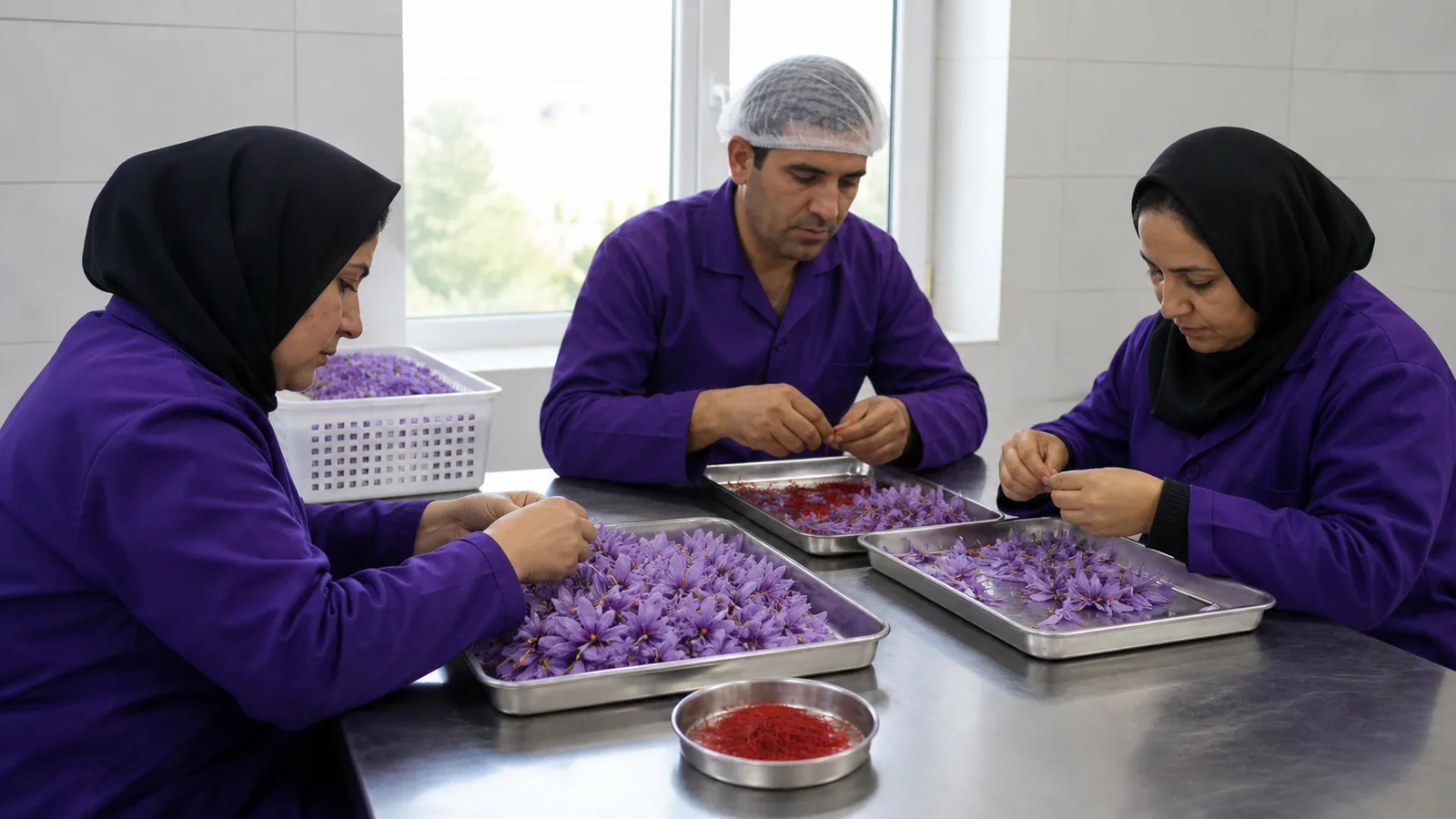
The “more than 90%” figure was attributed to Mohammad Ali Tahmasbi at the fourth National Saffron Festival in Qaen. The article does not provide the underlying global table, crop year for every producing country, or calculation method. It should be treated as an attributed historical estimate, not a precise current share.
Iran’s saffron area grew from 46,000 to 88,000 hectares
Tahmasbi reported that cultivated area increased from about 46,000 hectares in Iranian year 1380 to 88,000 hectares in 1393—approximately 2001–02 to 2014–15. The old English translation drops the word “thousand” from the second figure and says 88 hectares. That cannot be correct in a series beginning at 46,000 hectares; the intended figure is 88,000.
The change adds 42,000 hectares, an increase of about 91%. Production rose from 152 tonnes to 280 tonnes over the same period, an increase of 128 tonnes or about 84%.
Area therefore expanded slightly faster than output. The implied averages are about 3.30 kg/ha at the start and 3.18 kg/ha at the end, consistent with Tahmasbi’s statement that yield remained near 3.2 kg/ha.
More hectares did not improve average yield
The historical series is a useful warning against treating acreage as production. Iran almost doubled the area in the report, yet output per hectare remained broadly flat.
Tahmasbi linked the expansion to regional drought. Farmers were turning from more water-demanding crops toward saffron because it generally required less water under the conditions being discussed. That rationale does not mean saffron needs no water or that every conversion is profitable; field age, irrigation timing, corm health, labor, grade, and sale price still matter.
The article also mentions China, Afghanistan, and India as countries increasing saffron cultivation. It provides no comparable production totals for them, so it does not support a ranked country table beyond the attributed statement that Iran dominated production.
Export value rose from US$56 million to US$227 million
Tahmasbi reported an increase in saffron export value from roughly US$56 million to US$227 million over the period. That is a rise of US$171 million, or about 305%.
Export value grew much faster than production in the figures, but the report does not separate price changes, exchange rates, grade, shipment format, destination markets, or inflation. It is therefore unsafe to attribute the entire increase to better productivity or farmer income.
The official also criticized the continued sale of saffron in bulk and raw form. More value can be created after harvest through careful separation, controlled drying, grading, laboratory verification where required, packaging, branding, and distribution. The source does not show how the US$227 million was divided among growers, processors, exporters, and retailers.
For the related historical estimates of a 90%–94% world share, labor demand, and production targets, see the site’s analysis of Iran’s saffron production claims. That article addresses the national planning figures; this page focuses on the 1380–1393 growth series and the changing regional pattern.
South Khorasan was reported at 15% of Iranian output
Ali Hosseini, then a board member of the National Saffron Council, said at a meeting in Birjand that South Khorasan produced about 15% of Iran’s saffron. As with the national world-share figure, the report supplies no crop year, tonnage, or calculation table, so 15% remains an attributed historical estimate.
Hosseini contrasted it with the province’s position more than three decades earlier, when he said South Khorasan had produced over 90% of the country’s saffron. These are domestic shares, not percentages of world output.
The decline from more than 90% to 15% describes a redistribution of Iranian cultivation, not necessarily a collapse in South Khorasan’s absolute tonnage. Without the old and new production totals, both could be true at once: South Khorasan output could grow while its share falls because other provinces grow faster.
Why cultivation shifted toward Razavi and North Khorasan
Hosseini said South Khorasan’s cultivated area was declining or had stopped expanding in some places, while cultivation moved toward Khorasan Razavi and North Khorasan. He was concerned that saffron, long important to South Khorasan’s regional economy and identity, was being neglected.
His description of South Khorasan as saffron’s cradle should be understood as a claim about the province’s cultivation heritage, not a settled statement about the botanical origin of Crocus sativus.
Hosseini called for better planning and an expansion of South Khorasan’s saffron area. The national report, however, shows why expansion alone is not enough: hectares can rise while yield remains flat. Water capacity, final output, quality, labor, and farmer returns need to be measured alongside area.
What the combined historical record establishes
The two reports describe change at two levels. Nationally, Iran’s saffron area rose from 46,000 to 88,000 hectares and production from 152 to 280 tonnes, while average yield stayed near 3.2 kg/ha. Regionally, South Khorasan’s reported share of Iranian production fell as cultivation expanded elsewhere.
A current update would need synchronized crop-year data for every producing country and Iranian province, mature productive hectares, dried output, grade, water use, export format, and realized value. Until then, the percentages and monetary figures belong to their historical reporting context rather than the present market.

![Exporting Saffron to Turkey + Price Guide [Complete 0 to 100]](https://img.rowhanisaffron.com/20260827003933/saffron-export-turkey-quality-inspection.webp)



