


Production of saffron farms without water and soil in Bardaskan began here as a small home trial, not as proof that saffron can complete its whole growing cycle without either resource. Entrepreneur Azam Ravati used an indoor room to bring mature corms into flower, then reported what she harvested.
What the Bardaskan indoor saffron project involved
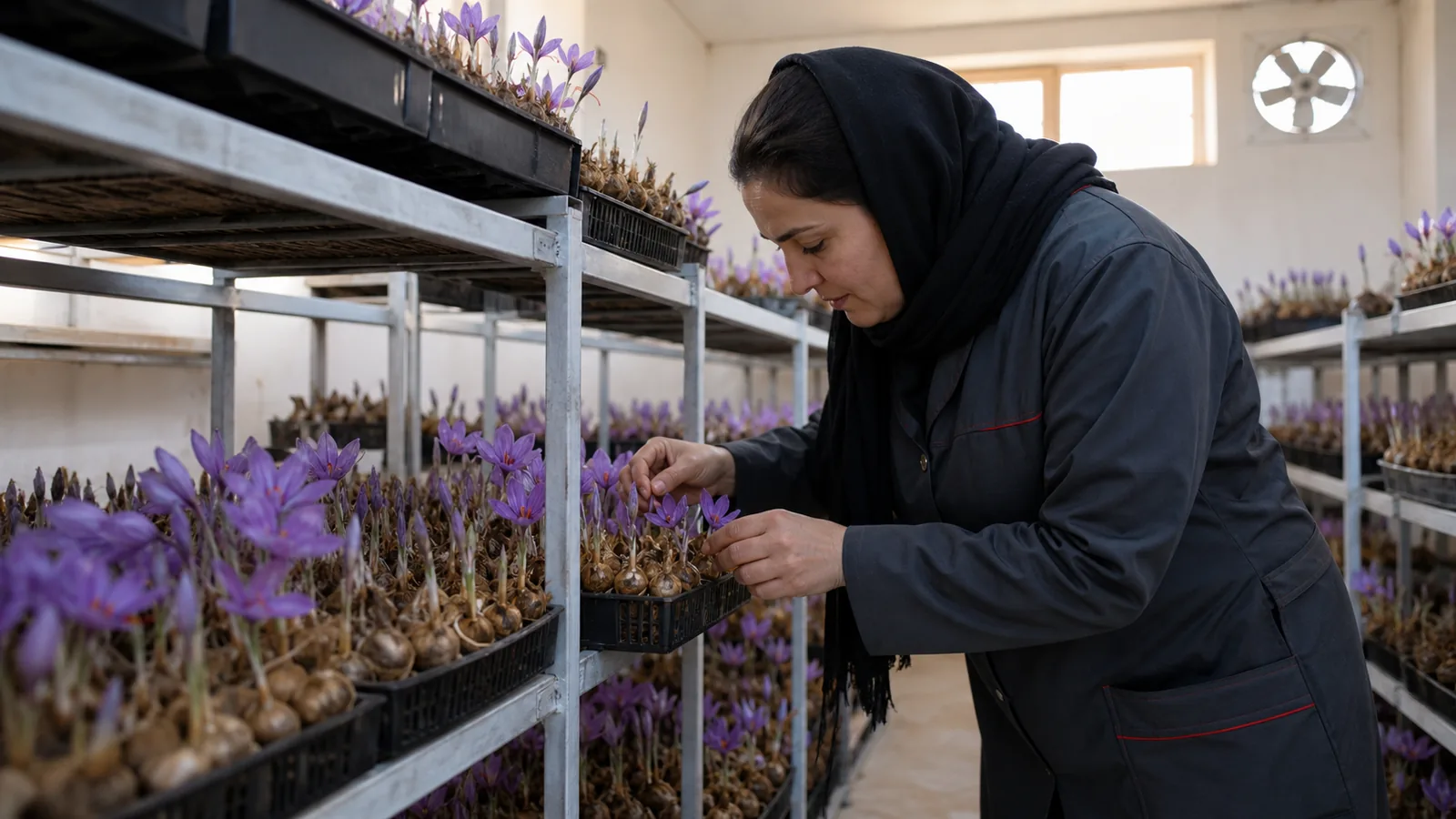
Ravati described a 30-square-metre space in her home containing 500 kilograms of saffron corms. The original English report called the arrangement “85 classes,” but that appears to mean 85 tray or rack levels rather than 85 separate rooms or crops.
That distinction matters. Stacking shallow trays can use floor area efficiently, but the report does not give the rack dimensions, spacing between corms, air exchange, temperature, humidity or the proportion of corms that flowered. Its figures describe one reported project, not a repeatable production plan.
“Without water and soil” describes the flowering stage
A mature saffron corm already contains the developing flower and stored reserves. Under controlled temperature and humidity, it can flower indoors while sitting on a tray rather than growing in field soil. This is better described as indoor or soil-free forcing than as a complete water-free farming system.
A peer-reviewed comparison of field and indoor saffron cultivation explains the two-stage method clearly: corms can be kept on indoor pallets without water and soil for flower production, then returned to the field so roots and leaves can support the growth of replacement corms.
In other words, the flower can emerge during a dry indoor phase, but the corm itself had to be produced somewhere. If it is to remain productive for another season, it also needs a later growth phase with water, nutrients, light and a suitable rooting environment. The Bardaskan indoor saffron trial therefore shifted part of the cycle indoors; it did not remove water and growing media from the crop’s full life cycle.
The harvest ran from mid-November to mid-December
According to Ravati, flowers were collected from the middle of November until the middle of December. That month-long window is one of the most useful details in the original account because it defines the period over which the reported harvest was gathered.
The remaining yield sentence was damaged in translation. It lists 1,170 flowers per kilogram, a separate “18 to 22 grams” measurement, 2,170 flowers, and 12 to 13 grams of dried stigmas, but it does not preserve a reliable label for every number. The clearest pairing is 2,170 flowers producing 12–13 grams of dried saffron, which works out to about 167–181 flowers per gram.
That result is plausible as an observation. A scientific review reports a broad range of about 110–300 flowers for one gram of dried saffron, depending on the crop and handling. The 1,170 and 18–22 figures should not be used to predict output until the original Persian production record and its units can be checked.
The aroma claim was a personal assessment
Ravati said the indoor product had a better aroma than field-grown saffron. The report, however, includes no blind sensory comparison and no laboratory results for safranal, crocin or picrocrocin. Her comment should be understood as the producer’s assessment of that harvest, not evidence that indoor forcing always improves aroma.
The cultivation study cited above also found that field and indoor regimes could produce different apocarotenoid patterns during stigma development. That is another reason to test a finished batch rather than predict its colour, bitterness or aroma from the growing method alone.
How the project was learned and funded
Ravati said she learned the method recently from websites and friends, then put it into practice herself. She dated the beginning of the project to the Iranian year 1393, roughly 2014–2015, and gave its initial cost as 12 million tomans.
That cost is a historical figure. It does not include enough detail to serve as a present-day budget: there is no breakdown for corms, shelves, cooling, ventilation, labour, electricity, drying or losses. Anyone assessing a similar room now would need current local prices and a complete cycle that accounts for corm renewal as well as flower harvest.
Why Bardaskan was a relevant setting
Bardaskan lies in Razavi Khorasan, within one of Iran’s established saffron-producing regions. The old report described the county as a crossroads on routes running east to west and north to south, and noted its historic connection with Kashmar and the wider Torshiz area. Bardaskan was part of Kashmar County until the Iranian year 1374, corresponding to 1995.
For additional local context, the report cited the 1390 census figure of 72,626 residents and rendered the household count as 21,201. Those population figures do not establish the economics of the indoor project, but they explain why a home-scale agricultural trial could matter in a county closely tied to farming and regional trade.
What this home trial shows
The Bardaskan project shows that mature saffron corms can be arranged in a compact indoor space and brought into flower during a defined autumn harvest window. It also records a local entrepreneur’s attempt to learn a controlled-environment method with limited space and capital.
It does not yet demonstrate a permanently water-free production system, a guaranteed yield from 500 kilograms of corms or superior aroma. Those conclusions would require a complete growing-cycle record, unambiguous weights, environmental measurements, corm survival data and laboratory quality testing. Read on those terms, the project is a useful early case study rather than a finished formula for saffron farming.

![Exporting Saffron to Turkey + Price Guide [Complete 0 to 100]](https://img.rowhanisaffron.com/20260827003933/saffron-export-turkey-quality-inspection.webp)



