


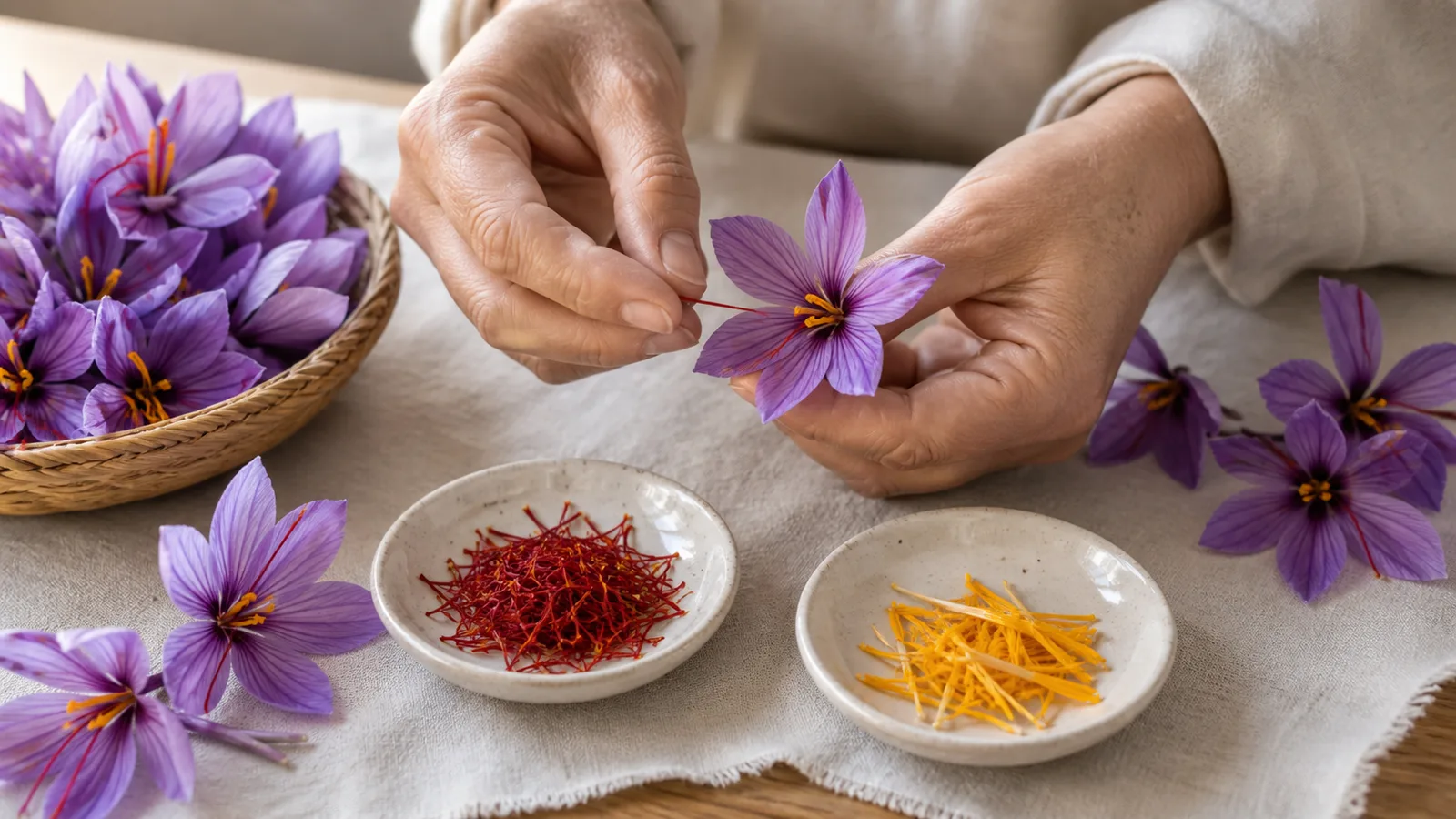
“Saffron flag” is not the standard English botanical name for a part of the flower. In this article, it refers to the saffron stamen: the yellow anther that produces pollen and the slender filament supporting it. The red stigma is a different organ, and its dried threads are the culinary spice called saffron.
This naming point matters when discussing saffron flag health benefits. Chemical studies of stamen extracts are interesting, but they do not prove that yellow stamens can treat disease, replace saffron threads in a recipe or be used safely as a home supplement.
What is the saffron flag?
A Crocus sativus flower normally has six purple tepals, three yellow stamens and a style that ends in three red stigma branches. The stigma receives pollen. A stamen makes pollen and consists of an anther plus a filament.
The word “flag” appears to be a literal translation used in some saffron markets for the stamen. “Saffron stamen” or “yellow anther” is clearer English and is the terminology used in botanical and research literature.
How to identify the stamen, stigma and petals
Yellow stamen
Each flower usually carries three yellow to orange anthers on pale filaments. The anthers hold yellow pollen and have much less of the familiar saffron aroma and colouring power than dried stigmas.
Red stigma
The stigma divides into three deep-red branches. After careful separation and drying, those branches become saffron threads. Crocins contribute their colour, picrocrocin contributes bitterness, and safranal is central to the aroma developed during drying.
Purple tepals
The six purple floral segments are tepals, although they are often called petals. They form most of the visible flower and are another distinct by-product. Our guide to saffron petals and their uses explains their pigments and practical limits.
Why are saffron stamens usually removed?
Harvesters separate the red stigmas because the spice market is based on stigma quality, colour, aroma and purity. Yellow stamens do not have the same composition or commercial grade. Leaving them mixed into a package increases non-stigma floral material and dilutes what the buyer is paying for.
Removal does not make stamens worthless. It makes them an agricultural by-product with a different identity and possible uses. A review of saffron and its by-products describes tepals, stamens and leaves as potential raw materials for research into food, cosmetic, agricultural and other applications within a circular economy.
What does research say about saffron flag health benefits?
Researchers have measured phenolic compounds, flavonoids, minerals and antioxidant activity in stamen extracts. A recent chemical study of saffron stamens identified compounds including chlorogenic acid, rutin and quercetin and found antioxidant activity in laboratory assays.
Those results describe an extract under controlled test conditions. They do not show that eating a spoonful of stamens improves memory, vision, circulation or heart health. They also do not establish a household dose.
An earlier comparison of stamen, perianth and stigma fractions reported antioxidant, antifungal and cytotoxic activity in chemical, fungal and tumour-cell models. “Cytotoxic” means an extract affected cells in an experiment; it is not evidence that a tea prevents or treats cancer in a person.
Can saffron stamens regulate blood sugar?
No reliable human clinical evidence establishes saffron stamens as a blood-sugar treatment. A cell assay, antioxidant result or study of a different saffron preparation cannot be converted into dosing advice for diabetes.
Anyone using glucose-lowering medicine needs predictable care. Do not add a concentrated stamen product in the hope of changing blood sugar without discussing it with the clinician or pharmacist responsible for that treatment.
Do they improve eyes, memory or brain health?
Claims about vision, memory and mental health are often borrowed from research on stigma-derived saffron extracts. The yellow stamen has a different chemical profile. Even promising work on the red spice cannot prove that an unstandardised stamen tea produces the same exposure or outcome.
Eye symptoms, cognitive change, depression and anxiety each need their own appropriate assessment. Saffron by-products should not delay care or replace prescribed treatment.
Can saffron flags prevent cancer or brain tumours?
No. Laboratory researchers use tumour-cell lines to explore whether an extract warrants further investigation. Cells in a dish do not capture absorption, metabolism, toxicity, tumour biology or a person’s treatment plan.
The previous article’s promise that saffron flags could prevent or treat tumours was not supported by human evidence. It has been retained here as a direct question so readers receive the correction rather than losing the topic.
Can saffron stamens be used in tea or food?
The stamen is not a direct substitute for culinary saffron. It gives less of the characteristic colour, taste and aroma, and loose harvest material may not have been dried, stored or tested as food. Do not assume that every floral by-product is edible merely because it grew beside the stigma.
A purpose-made, food-grade stamen ingredient may eventually have applications if its identity, contaminants, processing, stability and intended dose are evaluated. That is different from adding untested field residue to tea, baking or a child’s food.
What about natural dyes and cosmetics?
Stamen extracts are being investigated for pigments and functional compounds, and circular-economy research may lead to food, textile or cosmetic ingredients. A laboratory extraction process is not a home skincare recipe, however. Solvent, concentration, purity, preservation and irritation testing all matter.
Do not rub pollen-rich material around the eyes or onto broken skin. People sensitive to pollen or flowers may react, and a new rash or swelling is a reason to stop exposure.
Side effects and pregnancy
There is not enough human safety information to assign a general dose for saffron stamens. Possible concerns include allergy, contamination, interactions and the unknown concentration of a homemade extract.
The older article stated that the saffron flag causes miscarriage. Evidence for that specific claim was not supplied. The safer conclusion is narrower: pregnancy is not the time to experiment with a concentrated, poorly characterised flower by-product. Ask an obstetric clinician before using any saffron-derived supplement; ordinary spice in food is a separate exposure from an extract.
Where the saffron stamen may be genuinely valuable
The strongest case today is sustainable use of harvest material. Characterising stamens could help researchers develop tested ingredients, recover useful compounds and reduce agricultural waste. This work may create value for growers without mislabelling yellow floral material as red saffron.
That future depends on specifications: correct botanical identity, food or cosmetic safety, contaminant limits, reproducible extraction and evidence for the intended use. A long list of possible applications is a research agenda, not a finished health product.
A clear conclusion on the saffron flag
The part sometimes called a saffron flag is the yellow stamen, made of an anther and filament. It sits beside the red stigma but is not the spice itself. Stamens contain interesting compounds and show activity in laboratory extracts, which makes them a promising by-product for careful development.
There are no established human saffron flag health benefits for blood sugar, vision, memory, cancer, pain or heart health. Use genuine red stigma threads for cooking. Treat yellow stamens as a separate material whose safe, useful applications still need proper processing and evidence.

![Exporting Saffron to Turkey + Price Guide [Complete 0 to 100]](https://img.rowhanisaffron.com/20260827003933/saffron-export-turkey-quality-inspection.webp)



