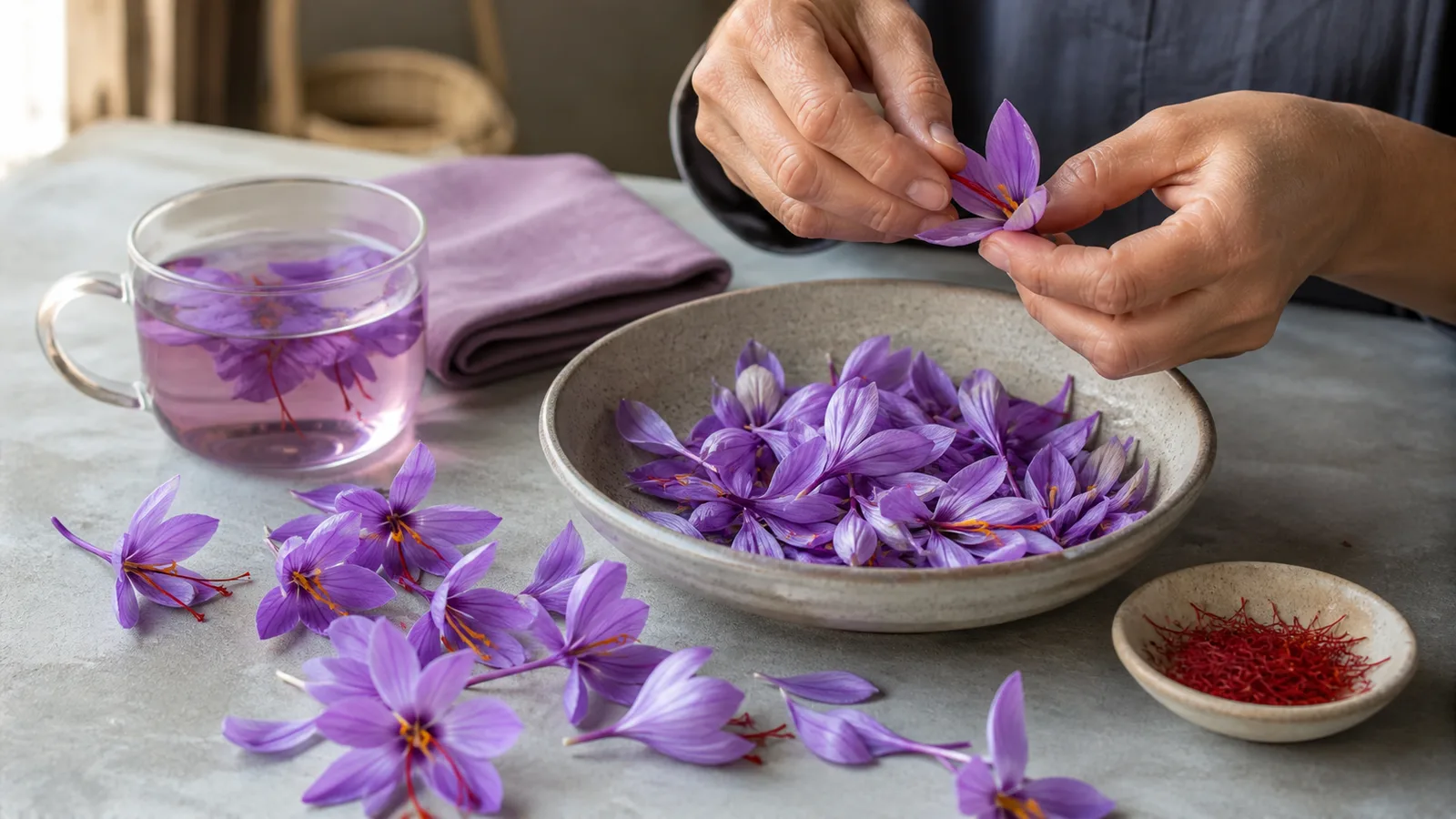
The most useful benefits of saffron petals are practical: they can become a mild flower tea, a purple natural colour, a food or cosmetic ingredient, and a valuable alternative to discarding most of the harvested flower. Petals contain anthocyanins and flavonoids, but research on their medical effects is largely laboratory or animal work. Claims proven for a standardized saffron-stigma extract cannot automatically be transferred to the petals.
This distinction is easy to miss because “saffron flower” and “saffron” are often used as if they mean the same product. The red stigma threads are the spice. The surrounding purple flower material is a separate ingredient with a different colour, aroma, composition and price.
What are saffron petals?
A Crocus sativus flower has three red stigmas, three yellow anthers and six purple segments. Botanically, those purple segments are more accurately called tepals because the flower does not have clearly differentiated petals and sepals. In everyday trade, “saffron petals” is the familiar name.
The purple colour comes mainly from water-soluble anthocyanins, including derivatives of delphinidin, petunidin and malvidin. Researchers have also identified flavonoids such as kaempferol and quercetin derivatives. A chemical-characterisation study of saffron tepals shows why the material is being investigated as more than agricultural waste.
Saffron petals and saffron threads are not interchangeable
The recent query for “saffron threads benefits” points to an important source of confusion. Threads contain the compounds used to judge spice quality: crocin contributes the familiar golden colour, picrocrocin the bitter taste, and safranal much of the characteristic aroma after drying. Petals are dominated by a different group of purple pigments and flavonoids.
Petals can add colour and a gentle floral character, but they do not reproduce the flavour, aroma or colouring strength of genuine red threads. A low-cost bag of petals should not be sold or used as a direct substitute for saffron spice. When a recipe depends on saffron’s golden infusion and distinctive aroma, use the stigma threads.
Saffron petals uses in food and drink
Saffron flower tea
Dried food-grade petals can make a light purple or mauve infusion. Place about one teaspoon in a cup, add 250 ml of hot water, cover and steep for 5–8 minutes, then strain. Start mild: growing conditions, drying and storage all change the colour and flavour. A little lemon can shift anthocyanin colour towards pink and brighten the taste.
This is a culinary drink, not the same preparation used in clinical saffron-extract trials. Do not promise menstrual, mood, blood-pressure or cancer effects from a cup. Choose petals specifically labelled for food use; flowers from a florist, garden centre or decorative display may have been treated with pesticides that are not intended for food.
Jam, baking and desserts
Saffron flower uses also include jam, syrup, jelly, biscuits and bakery products. In Hamedan, cooks have a tradition of making jam from saffron petals. The petals bring colour and a mild floral note, while sugar, acid and other aromatics shape the finished preserve.
A current review of petal-enriched bakery products describes growing interest in flour blends, extracts and powders. Results depend on particle size and concentration: too much can darken a crumb, introduce bitterness or change texture. Petals are an ingredient to formulate carefully, not a drop-in replacement for flour or saffron threads.
Natural food colour
Anthocyanins dissolve in water, which makes the petals useful as a purple-red colour source. An aqueous extraction study examined how food-grade enzymes affected pigment yield and stability. It found that extraction conditions changed both colour strength and how quickly the pigments degraded.
That instability matters in a kitchen. Heat, light, oxygen, storage time and pH can all move or fade the colour. A petal extract will not necessarily stay the same shade in a clear drink, baked cake and refrigerated jelly.
Textile and craft dyeing
Saffron petals uses extend beyond food. Their pigments can colour fibres, paper and craft materials in soft mauve, purple or pink tones. The exact result depends on the fibre, water chemistry, mordant, pH and extraction method. Test a small swatch first and document the recipe if repeatability matters.
Petal dye should not be confused with the intense yellow-gold colour produced by red saffron threads. Using the floral by-product can be more economical and avoids wasting a potentially useful material, but natural colour can vary from harvest to harvest and may fade faster than a commercial synthetic dye.
Cosmetic uses of saffron flower petals
Petal extracts appear in experimental creams, lip products, shampoos and other formulations because manufacturers are interested in their pigments and flavonoids. Laboratory antimicrobial or antioxidant activity can help with product-development questions; it does not prove that a homemade mask treats acne, reverses ageing or protects skin from disease.
A formulated cosmetic also has a controlled preservative system, pH and contamination process. Mixing damp petals into a cream at home changes its shelf life and may introduce microbes. Patch-test a properly labelled product and stop if irritation develops.
What do health studies on saffron petals show?
The honest answer is that petal-specific human evidence is thin. Most studies measure compounds, antioxidant capacity, cells, bacteria or animals. A 2024 review of saffron by-products catalogues interesting anthocyanins and flavonoids, while also showing how much of the literature is compositional or preclinical.
Heart health and blood pressure
Antioxidant activity in a test does not show that saffron petals prevent cardiovascular disease. Blood-pressure findings from trials of stigma extracts cannot be assigned to petal tea. Petals should not replace monitoring or prescribed treatment.
Mood and menstrual comfort
Saffron flower tea has traditional associations with relaxation and menstrual comfort. Human saffron trials that report mood or PMS outcomes generally use stigmas or standardized extracts, not an ordinary petal infusion. The tradition can be described as tradition, but it is not a basis for a treatment or dosing claim.
Cancer-cell research
Petal compounds have been studied in cell models, including liver-cancer cells. A response in cultured cells is not evidence that eating petals prevents or treats cancer. Petal tea and extracts should never be presented as alternatives to screening or oncology care.
How to choose and store edible saffron petals
- Buy petals identified as Crocus sativus and labelled for culinary use.
- Do not eat florist or ornamental flowers unless their food-safe growing history is known.
- Look for clean, dry purple material without dampness, insects, mould or a musty smell.
- Keep the petals airtight, cool, dry and away from direct light.
- Introduce an unfamiliar edible flower in a small amount in case of allergy or stomach upset.
These points follow the practical safeguards in Colorado State University Extension’s edible-flower guidance: correct identification, pesticide awareness and gradual introduction matter. Petals sold for dyeing, crafts or cosmetics should not be assumed edible.
The value of a saffron flower after harvest
The red stigmas make up only a small part of each bloom. Finding careful uses for the remaining flower can create food ingredients, natural pigments, cosmetics and craft materials while reducing harvest waste. That environmental and economic value is real even without a medical promise.
The strongest saffron petals benefits are therefore grounded in what the material demonstrably does: it supplies purple anthocyanin colour, can become a mild food-grade infusion, and offers a versatile floral by-product. Threads remain the premium spice; petals deserve a separate identity and honest uses of their own.