


People in Hamedan explored making jam from the purple petals left after saffron’s red stigmas were removed. The idea was part of a wider local plan for Hamedan saffron, including better standards, packaging, grower coordination and a recognizable provincial brand.
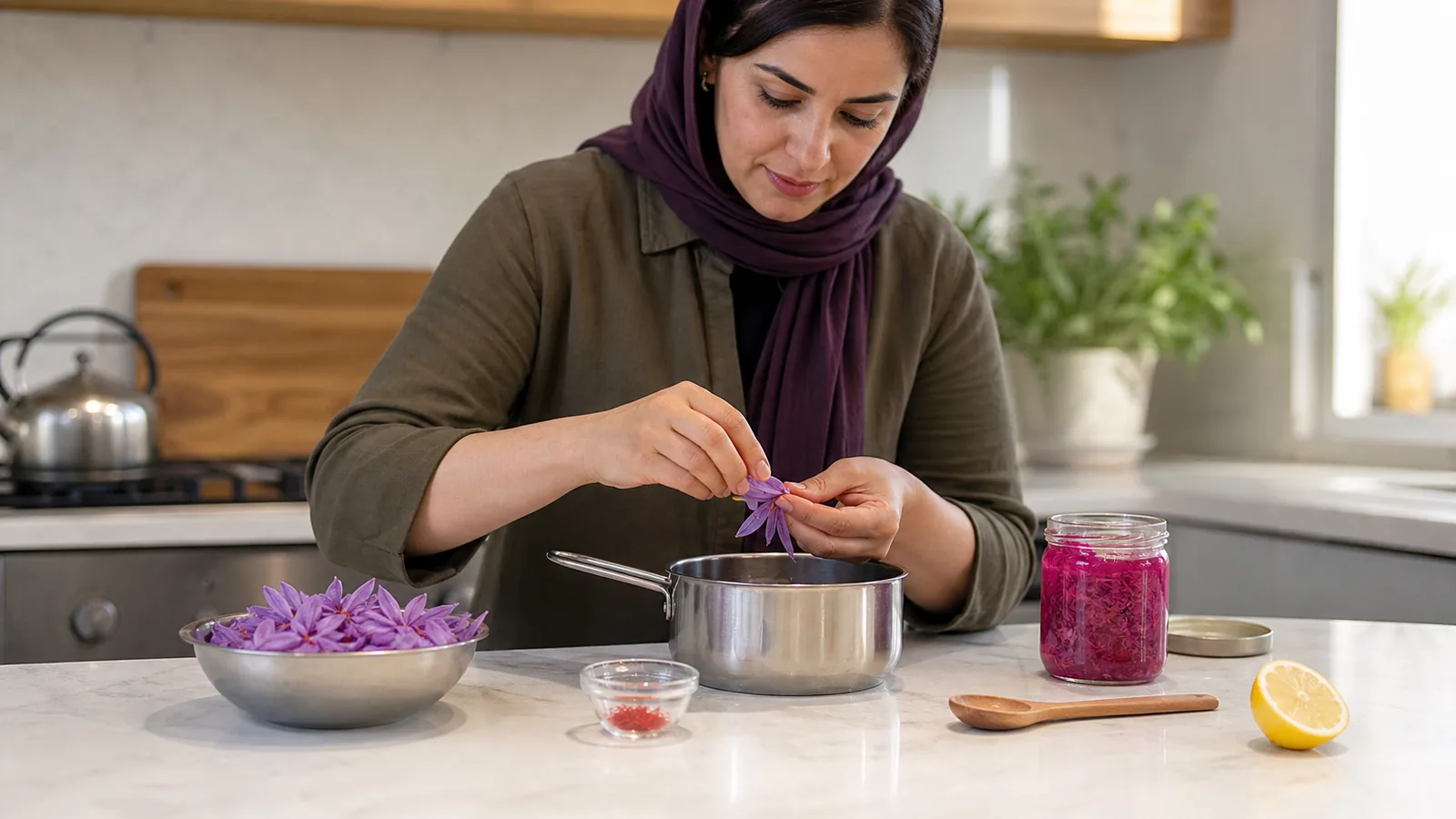
The archived report records an announcement, not a tested recipe or a current harvest bulletin. It quotes Qasem Asadian, then head of the Agricultural Research and Training Center for Agriculture and Natural Resources of Hamadan Province. Hamedan and Hamadan are English spellings of the same province.
What the Hamedan saffron petal jam announcement said
Asadian said the center intended to use saffron petals for jam for the first time in the province. That closing detail gave the original story its title, but the interview covered far more than cooking. It described a young, dispersed saffron sector trying to organize production and sales.
He said no Hamedan saffron brand had yet been registered. Before a provincial name could carry real meaning, he argued, saffron needed defined standards tested by equipped, reputable laboratories. Packaging materials and pack sizes also needed clear specifications.
The idea behind the jam fits that same effort. Instead of treating every part removed during stigma separation as valueless residue, a properly controlled food product could give one part of the flower a separate use. It would still need its own safety, quality and market checks.
Saffron petals are not the saffron spice
The saffron sold as a spice comes from the dried red stigmas of Crocus sativus. The broad purple flower parts are petals, also called tepals in botanical literature. They are different materials with different composition, flavor and commercial value.
A peer-reviewed review of saffron and its by-products describes petals, stamens and leaves as secondary materials being studied for possible uses in food and other industries. That research does not make a petal product equivalent to saffron spice, and it does not establish that eating petal jam treats a disease.
The species distinction matters too. A cook should never collect an unknown ornamental crocus because it resembles a saffron flower. Food use begins with correctly identified Crocus sativus grown and handled for that purpose.
Why petal jam interested Hamedan
Harvest crews need the red stigmas, while each flower supplies much more petal material by volume. Jam offered a familiar food format for exploring that material. It could also give visitors and local customers a product directly connected with the short autumn flowering season.
That does not make every harvested petal ready for a saucepan. Flowers collected for spice production may have touched soil, baskets, hands and field surfaces. Food-grade petals need an identified field source, appropriate crop-input records, prompt sorting and hygienic handling. Wilted, spoiled or visibly contaminated material should not enter a food product.
Fresh petals also behave differently from the dried stigmas used for aroma and color. A producer would have to develop the flavor, texture and appearance of the jam on their own terms rather than assume the petals perform like saffron threads.
Why this article does not invent a jam recipe
The Hamedan report gives no ingredient quantities, acidity measurement, cooking time, processing method or shelf-life test. Turning its final sentence into a precise recipe would create information the source never supplied.
This is especially important for a jar intended to sit at room temperature. The National Center for Home Food Preservation warns about untested jam additions: changing ingredients can make final acidity unpredictable, and sugar by itself does not guarantee a shelf-stable product. It recommends scientifically tested recipes with exact proportions and processing directions.
A commercial Hamedan saffron petal jam therefore needs a validated formulation, food-safety controls, suitable packaging and a defined storage life. A home cook should not assume that an improvised flower preserve is safe for pantry storage. The responsible choice is a recipe specifically tested for its ingredients and intended storage method.
The historical 145-hectare Hamedan snapshot
Asadian reported 145 hectares under saffron in the province. He also said cultivation and sales were scattered, which made precise local statistics difficult to assemble. In the same interview, he placed Iranian production at an average of 250 to 300 tonnes and Hamedan’s contribution at 725 kilograms.
Those numbers belong to the period of the archived interview. They should not be used as current production statistics without a newer provincial dataset. Their useful meaning is that Hamedan’s crop was relatively small and fragmented, yet large enough for local researchers to consider branding, packaging and by-product use.
Asadian described Hamedan’s elevation, rainfall, semi-steppe climate and mix of poorer and moderately fertile soils as favorable for expanding red-gold cultivation. Site suitability is never automatic. Saffron uses less water than many irrigated alternatives, but it still needs appropriate soil, healthy planting material, seasonal moisture and sound field management.
Labor is part of the petal story
The interview used an estimate of 170,000 flowers for one kilogram of saffron to illustrate the amount of hand work behind the spice. Flower counts vary with stigma size, moisture, grading and the calculation method, so that figure is best read as Asadian’s scale estimate rather than a fixed conversion for every farm.
His larger point remains clear. Flowers have to be collected during a narrow season and the stigmas separated promptly. He said the absence of specialized harvesting machinery in the province increased labor costs. Any petal product adds another handling stream, so it must be worth the time required to sort and protect it.
Branding and farmer coordination belong together
Asadian linked the absence of a growers’ union or collecting company with fraud and slow progress in cultivation and sales. Shared organization could make it easier to define planting-material sources, train growers, collect lots consistently and apply a common quality standard.
He listed several measures already associated with the provincial Agricultural Jihad organization: directing growers to approved places for buying saffron corms, offering horticultural guidance and making a relevant expert available. Those services protect the crop at its starting point. A brand applied only after harvest cannot correct unhealthy corms or weak field records.
Coordination also matters for petals. A jam maker needs to know which flowers are suitable for food use, when they were collected and how quickly they reached the processing space. A provincial name becomes more credible when those questions have consistent answers.
What the Hamedan experiment was really testing
Saffron petal jam was one possible answer to a practical question: could Hamedan create more value from its flower harvest while building a stronger identity for the province’s saffron? The announcement did not report sales, consumer testing or a finished commercial process, so it should not be presented as proof of success.
Its value is the joined-up view. Petals, stigmas, laboratories, packaging, farmers and buyers were treated as parts of the same local chain. If Hamedan develops such a jam, the product will deserve its name only when the flower source, recipe, safety controls and label are as carefully considered as the story on the jar.

![Exporting Saffron to Turkey + Price Guide [Complete 0 to 100]](https://img.rowhanisaffron.com/20260827003933/saffron-export-turkey-quality-inspection.webp)



