


Iranian saffron does have company names and retail packs. The deeper brand problem is that Iran’s origin, quality work and producer value can disappear when saffron reaches a market as an interchangeable bulk commodity. A durable brand gives the next buyer evidence they can recognize and trust.
This article revisits a specific Iranian research finding. It does not claim that one national logo would solve every export problem, or that all Iranian saffron follows the same route to market. Branding, in this context, depends on consistent product quality, traceable origin, suitable packaging and reliable commercial relationships.
What “not having a brand” meant in the research
Researchers Fatemeh Rastegaripour of Torbat-e Heydarieh University and Nariman Mohammadi studied factors affecting the foreign-exchange value of Iranian saffron. Their Delphi study covered the 2015–2016 crop year and asked specialists to consider 36 sub-criteria within three broad groups: production, export and processing.
The paper record in FAO’s AGRIS database reports that processing ranked first, followed by export and production. Within those groups, respondents identified the absence of a national brand as the leading processing concern, fraud as the leading export concern, and individual working practices among growers, including a shortage of suitable cooperatives, as the leading production concern.
Those results describe a structured expert-consensus exercise from a particular period. They are useful for showing how the weaknesses connect, but they do not prove that branding alone causes higher export revenue. Market access, exchange rates, regulation, logistics and buyer demand also shape the result.
A saffron brand begins before the package
A logo can help someone recognize a product. It cannot make an inconsistent batch dependable. The commercial promise has to begin with the crop and continue through separation, drying, testing, storage and dispatch.
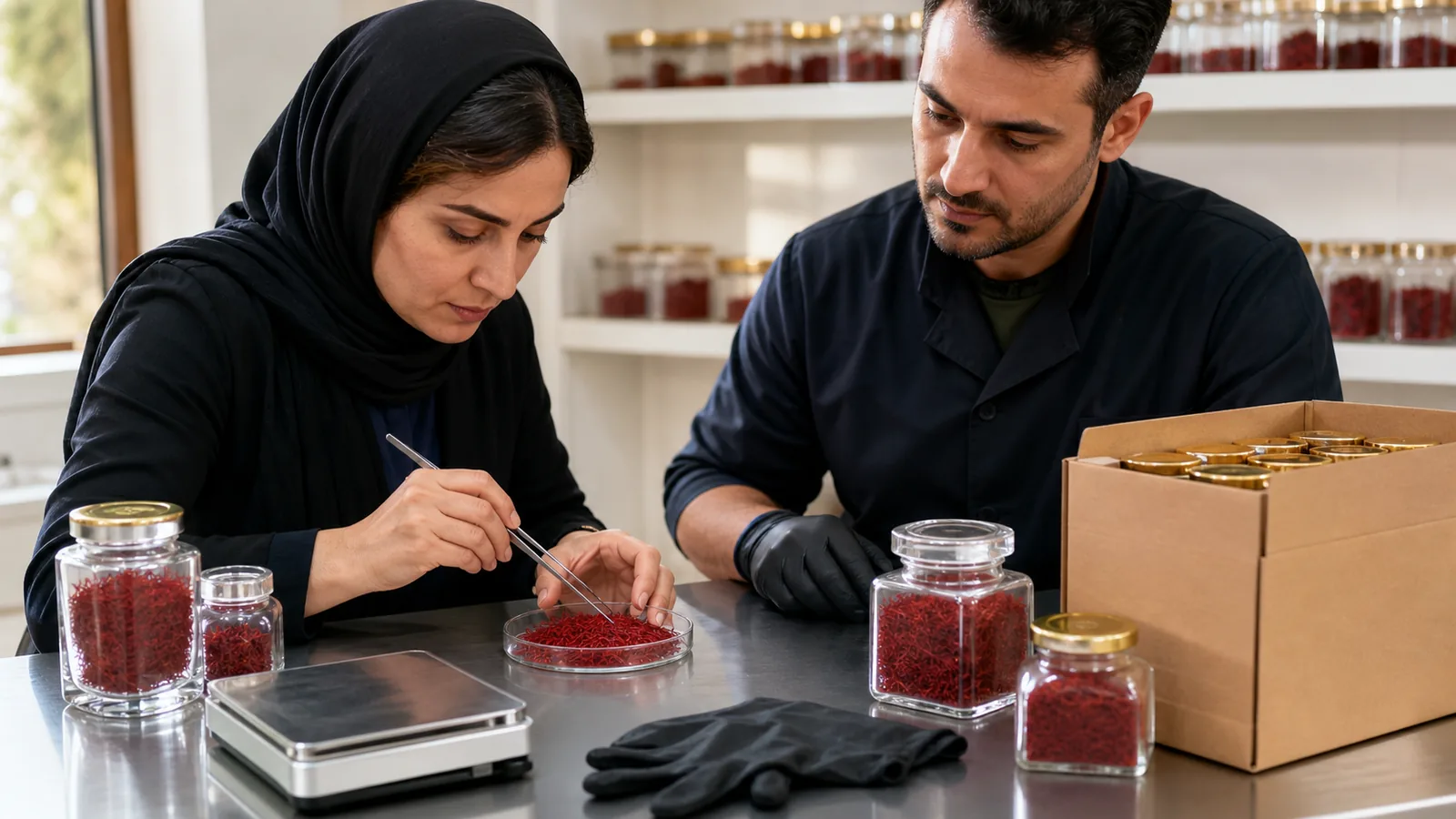
For an exporter, that usually means being able to connect a finished pack to a defined batch and supplier, state what form and specification the buyer will receive, document relevant quality checks, and handle a complaint without losing the chain of information. Repetition matters. A customer who buys again should not meet a completely different product behind familiar artwork.
This is also why country of origin and company brand are related but different. A shared Iranian origin identity may help buyers recognize the producing tradition. Each business must still earn confidence through its own controls, service and honest product description.
Packaging has a practical job
Saffron packaging is part of quality protection as well as presentation. It should be food-safe, properly closed and suitable for keeping the dried threads away from moisture, contamination and damaging storage conditions. The pack also carries the information a buyer needs to identify what was supplied.
The current ISO 3632-1:2025 saffron specification applies to dried saffron in filament, cut-filament and powder forms and includes storage and transport recommendations. The official Codex standards list includes CXS 351-2022 for dried saffron, which addresses product identity, quality, contaminants, hygiene, packaging and labelling. Exporters still have to check the law and label requirements in the destination market; an international standard is not a substitute for local compliance.
Shape and visual design matter once these basics are secure. A pack has to fit the customer, the selling channel and the quantity being offered. An expensive container that is awkward to store, difficult to open or vague about its contents is decoration, not a complete packaging strategy.
How bulk trade can weaken origin recognition
The original account described Iranian saffron moving in bulk through markets such as the United Arab Emirates and Spain before being sold in consumer packaging. That should be read as a trade pattern reported by the source, not as a description of every shipment or every importer in those countries.
When the customer-facing business packs, names and explains the product, it also owns the relationship with the final buyer. The bulk supplier may still be paid for the spice, but its origin can become a small line in the supply chain rather than the reason someone chooses the product. It also receives less direct information about what shoppers prefer, which pack sizes sell and why a buyer returns.
Bulk supply is not automatically poor business. Industrial customers may need it, and a specialist ingredient supplier can build a strong business-to-business reputation without a retail tin. The risk arises when a producer or exporter has no recognized identity, no distinctive specification and no durable relationship beyond the next shipment.
Fraud and inconsistency damage more than one sale
The study placed saffron fraud at the center of the export problem. A doubtful batch can hurt the seller, but repeated uncertainty also affects confidence in the wider origin. That is why anti-fraud work cannot rest on slogans about premium quality.
Clear purchasing specifications, representative sampling, documented testing, controlled handling and records that follow the batch are stronger than an unsupported “best saffron” claim. Retail buyers can also benefit from practical guidance on how to identify pure saffron, while recognizing that home checks cannot replace laboratory analysis where formal verification is required.
Why growers and cooperatives appear in a branding study
A brand promise becomes hard to keep when the supply base is fragmented and every lot is handled differently. The researchers therefore connected individual grower activity and the lack of suitable cooperatives with the production side of the problem.
Cooperation can make shared training, collection rules, drying facilities, traceability and lot testing more practical. It can also give small farms a clearer route to an organized buyer. A cooperative is not automatically effective, however. It needs transparent grading, payment and governance or it simply adds another layer between farmer and market.
A workable route from origin to market
- Define the product honestly. State the saffron form, intended specification, batch and origin without inflating what testing can demonstrate.
- Make quality repeatable. Set purchasing, drying, storage and release controls that can be followed from one season to the next.
- Keep traceability usable. Records should connect the packed product to the relevant lot and handling history, not exist only as paperwork.
- Design for a real market. Pack size, language, required information and presentation should reflect the destination and sales channel.
- Protect the name. Company marks, origin statements and any collective identity need consistent use and appropriate legal protection in the markets where they matter.
- Build direct feedback. Importers, retailers and customers should have a clear route to ask questions, report a problem and place a repeat order.
Research projects and knowledge-based companies can support testing, packaging materials and new saffron products, as the archived article suggested. They are most useful when the resulting process can be operated consistently at commercial scale.
The real problem is recognition backed by proof
Iranian saffron’s branding challenge is easy to reduce to an attractive box. The research points to a wider system: processing, honest export, coordinated production, market knowledge and a recognizable origin. Machinery and packaging materials matter, as do skilled people who understand production and international marketing.
A credible brand is the visible end of that system. When the quality evidence, origin and service match the name on the pack, buyers have a reason to remember who produced the saffron instead of remembering only where it was repackaged.

![Exporting Saffron to Turkey + Price Guide [Complete 0 to 100]](https://img.rowhanisaffron.com/20260827003933/saffron-export-turkey-quality-inspection.webp)



