The safest way to identify pure saffron at home is to combine several clues: buy intact threads from a traceable seller, inspect their trumpet-shaped ends, smell them, and watch a small sample infuse in water. No single kitchen test proves authenticity. A dyed plant fiber can pass one visual trick, and genuine but old or low-grade saffron can fail a crude “viral” test.
Do not put saffron in gasoline and do not hold it over a gas flame. Those methods are unsafe, destroy the sample, and are not part of recognized saffron standards. If a purchase matters commercially—or a sample remains suspicious—laboratory analysis is the appropriate final check.
What does pure saffron mean?
Food-standard saffron comes from dried portions of the pistil—the stigmas, sometimes with part of the style—of Crocus sativus. The current Codex standard for dried saffron says there should be no adulteration and defines physical and chemical requirements for filaments, cut filaments, and powder.
Purity and quality are related but not identical:
- Authenticity asks whether the material really is Crocus sativus saffron.
- Purity asks whether foreign matter, other plant material, artificial color, extra moisture, or other substances have been added.
- Quality or grade considers measurable color, aroma, taste strength, moisture, foreign matter, and related limits.
- Freshness concerns how handling and storage have preserved the aroma and other characteristics over time.
A genuine thread can be lower grade or stale without being fake. Conversely, material that looks bright red can still be dyed or mixed.
How to identify pure saffron step by step
1. Check the seller and package before the threads
Traceability is your strongest first filter. Look for a sealed food package, the responsible business, net weight, lot or batch identifier, date information, storage directions, and any grade or test claim the seller makes. A laboratory report should identify the tested batch, method, and issuing laboratory; a generic certificate image proves little about the jar in your hand.
Price alone cannot verify real saffron, but an implausibly cheap offer deserves extra scrutiny. Powder is easier to blend with unrelated material, so first-time buyers are usually better able to inspect whole threads. Our authentic-saffron buying guide covers the purchasing questions in more detail.
2. Examine whole threads in bright neutral light
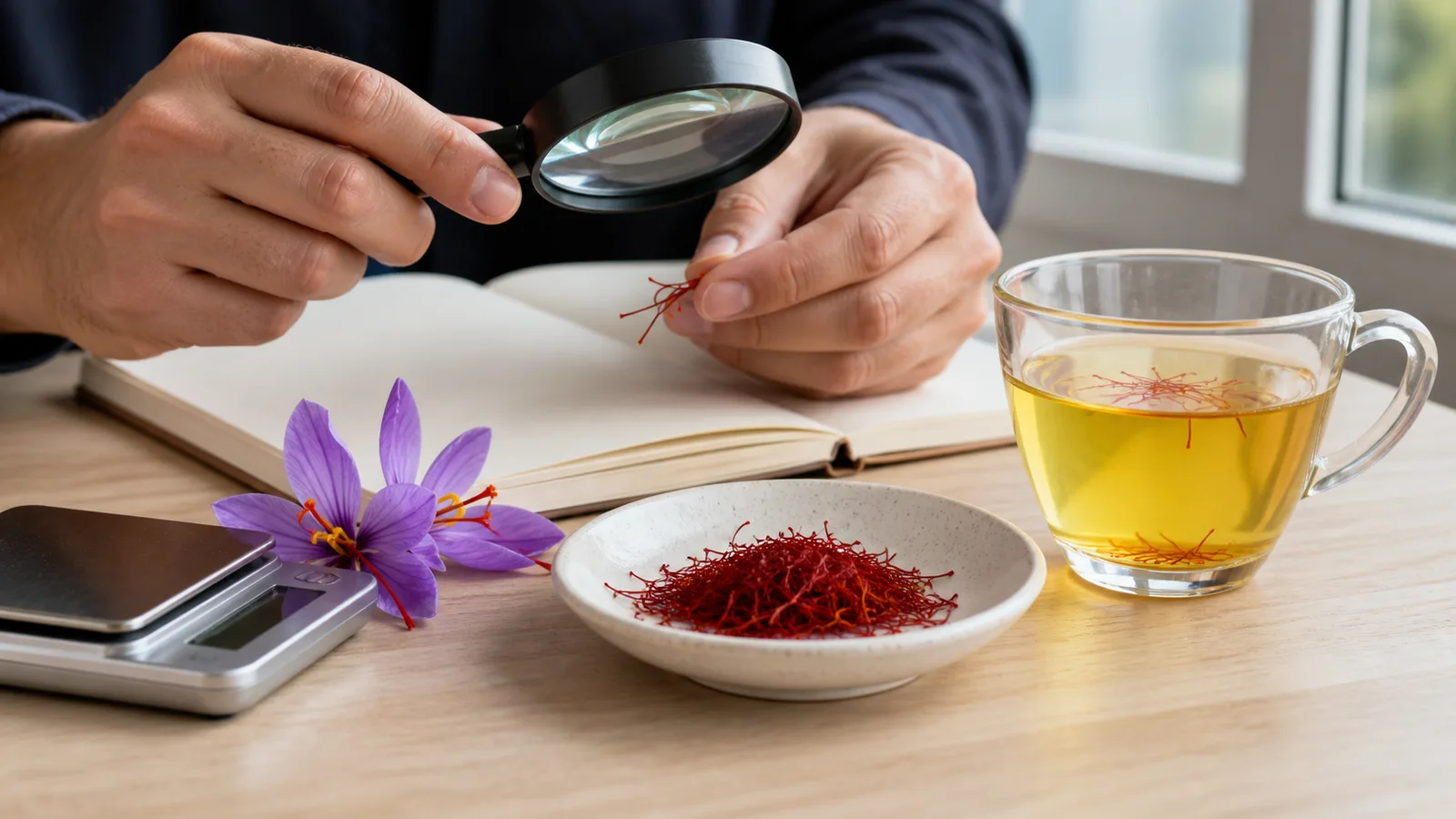
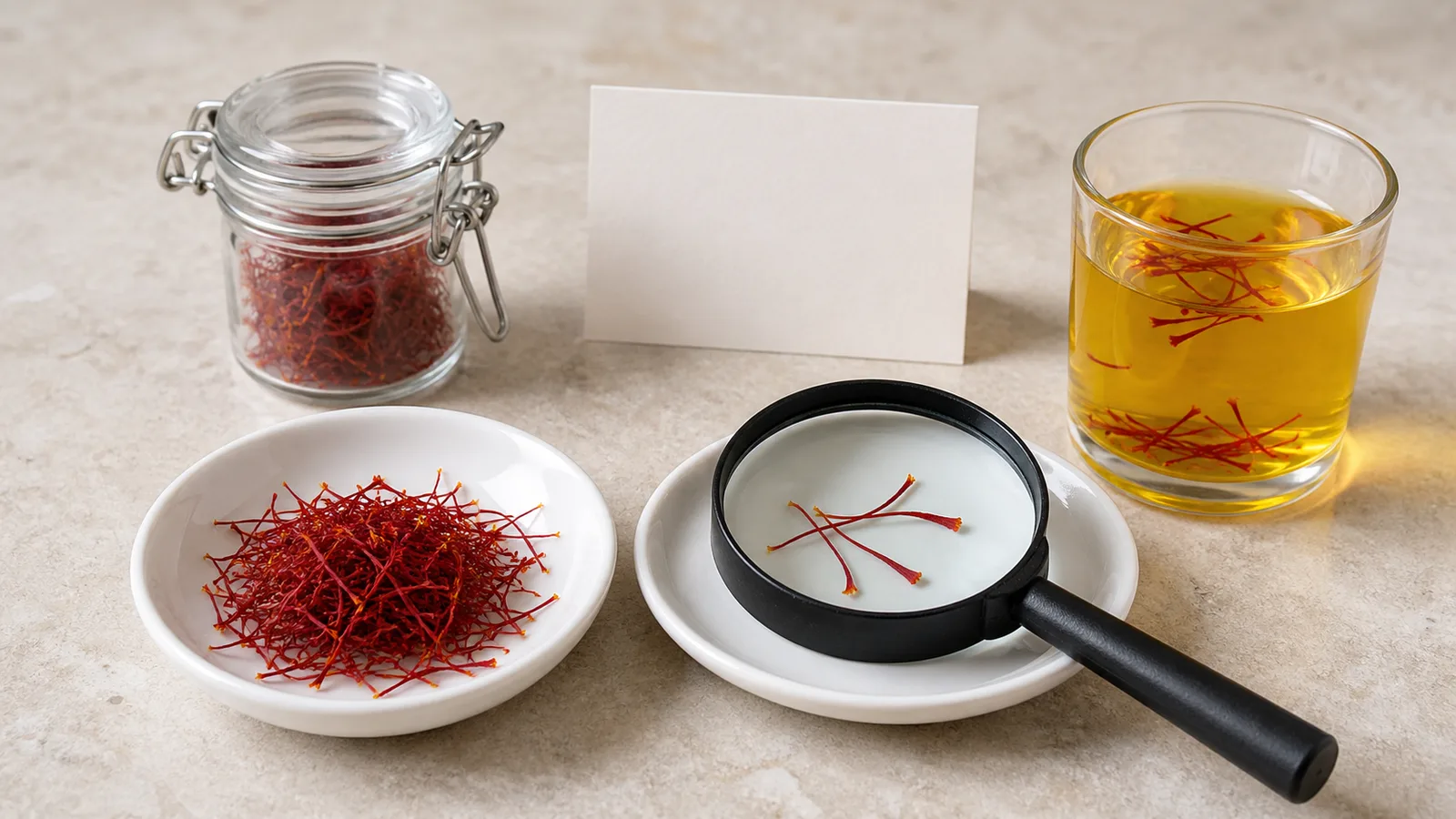
Codex describes the stigma as trumpet-shaped with a serrated or indented top, narrowing where it joins the style. Under a magnifying glass, genuine threads should not look like identical machine-cut strips. Their upper ends are broader, while the lower portions taper.
Expect red to deep orange-red stigma tissue. Some yellow or pale style can be present, particularly in certain commercial styles or grades; it lowers the proportion of red stigma but does not automatically make the lot counterfeit. Be more suspicious of a mixture dominated by flat petals, uniform fibers, shredded paper-like strips, obvious grit, or bright color sitting on the surface.
3. Smell a small sample
Real saffron has a complex, recognizable aroma often described as warm, hay-like, floral, honeyed, or slightly metallic. It should not smell musty, rancid, strongly chemical, or merely sweet. A faint aroma may indicate age or poor storage rather than adulteration, so smell remains a clue—not a verdict.
Avoid tasting an unknown bulk sample as an authenticity stunt. Genuine saffron is not sugary; its taste is gently bitter. Added sugar or another coating can alter taste, but subjective tasting cannot establish what is present.
4. Run a controlled water-screening test
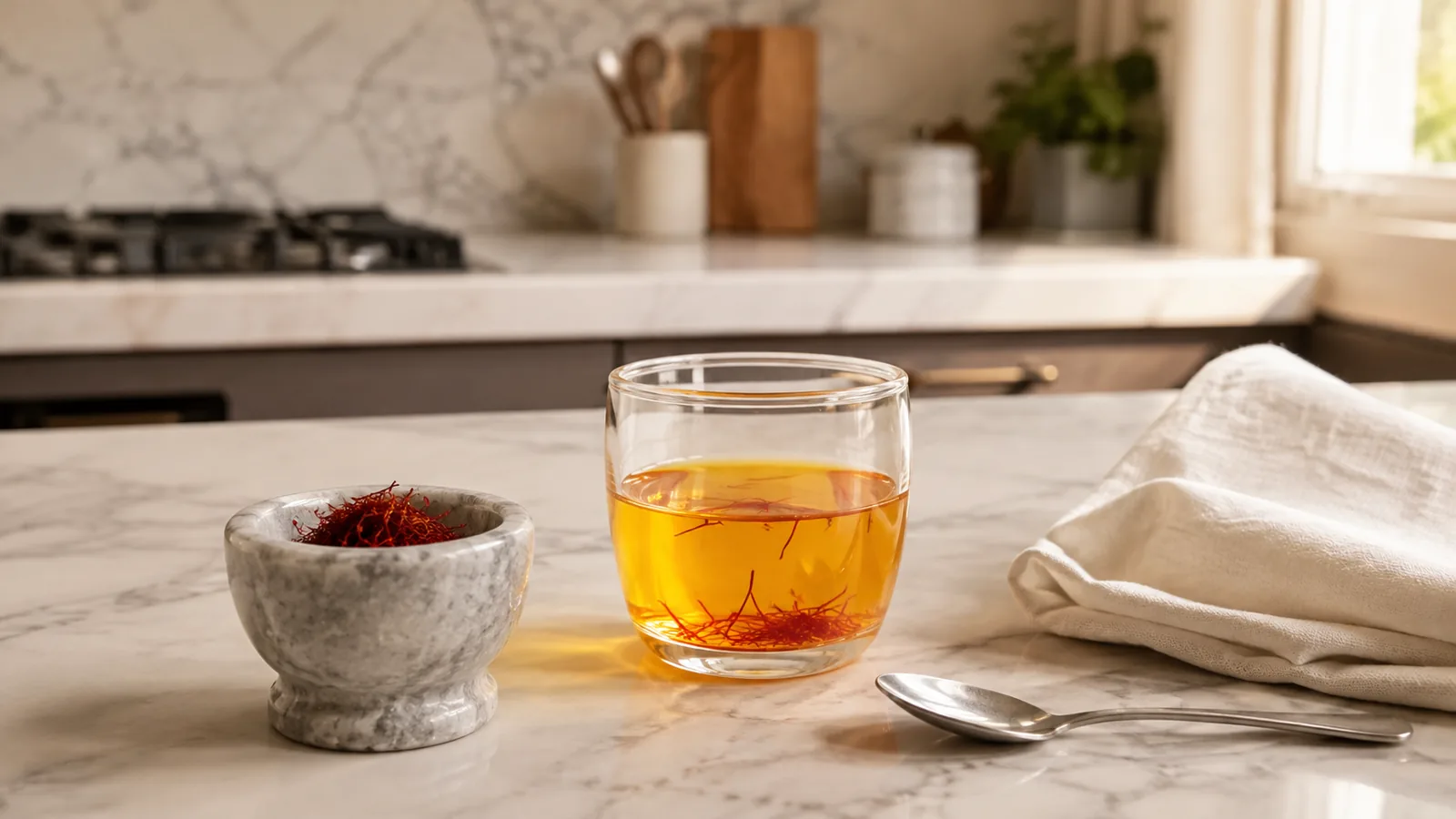
Place 5–10 threads in a clear glass with about 50 ml of warm—not boiling—water. Use a second glass with a known trusted sample if you have one. Watch for 10–15 minutes, then compare again after 30 minutes.
Genuine saffron normally releases a clear yellow-to-golden color that spreads through the water while the thread structure remains recognizable. The process is not an instant red dye cloud. Aroma should become apparent as the infusion develops.
Interpret this carefully. Broken or powdered genuine saffron can release color faster because more surface is exposed. Water temperature, thread size, storage, and concentration also change the speed. Some adulterants are designed to release slowly. The water test can reveal an obvious surface dye or non-saffron material, but it cannot certify purity or grade.
5. Compare the threads after soaking
Lift one thread onto a white saucer after the infusion. A genuine stigma does not have to become completely colorless; it commonly retains red-orange tissue while becoming softer. A strip that reveals a distinctly different plant fiber after a surface color washes off is suspicious.
Use clean tweezers and good light. Do not add bleach, acids, household solvent, or another chemical in an attempt to make the result “clearer.” Once several substances are mixed, the home observer cannot identify the reaction safely or interpret it reliably.
Does real saffron float or sink?
Floating or sinking is not a dependable pass/fail saffron test. Trapped air, thread shape, surface tension, moisture, breakage, and how the sample was placed in the glass can all change its position. Real threads may float at first and later sink; adulterated material can do the same.
Record float-or-sink behavior only as an observation alongside structure, color release, aroma, seller evidence, and comparison with a trusted sample. Do not reject or accept an expensive lot on buoyancy alone.
What is fake saffron made of?
Published authenticity research has examined several forms of substitution and adulteration, including:
- dyed or cut parts of the saffron flower that are not the intended stigma product;
- safflower or calendula petals and other look-alike plant material;
- dyed fibers or plant strips made to resemble threads;
- powder mixed with lower-cost plant material;
- artificial colorants added to strengthen appearance or water color;
- excess plant waste, foreign matter, or moisture that increases weight.
This is why real versus fake saffron cannot always be resolved from one photograph. Microscopy, chemical analysis, chromatography, spectroscopy, or DNA-based methods may be needed for a difficult sample.
Why gasoline is not a saffron purity test
The old article advised placing threads in gasoline and judging whether they dissolved or released color. Do not do this. Gasoline gives off hazardous, highly flammable vapor; bringing it into a kitchen or near ignition creates a needless exposure and fire risk. The test also contaminates and destroys food.
Neither the Codex saffron standard nor ISO’s published description of saffron testing offers “gasoline behavior” as a consumer proof of purity. A seller should not use a dramatic solvent video as a substitute for traceability and batch analysis.
Why a natural-gas flame cannot identify original saffron
Holding threads in a burner flame is also unsafe and inconclusive. Burn color can be affected by salts, contaminants, the burner, the background light, and the way the sample is held. Any food fiber will char. Claims that genuine saffron must turn purple or orange while fake saffron turns yellow are not a reliable identification rule.
Keep saffron away from open flame. An authenticity check should reduce uncertainty without introducing a burn or gas hazard.
What about the paper and oily-stain test?
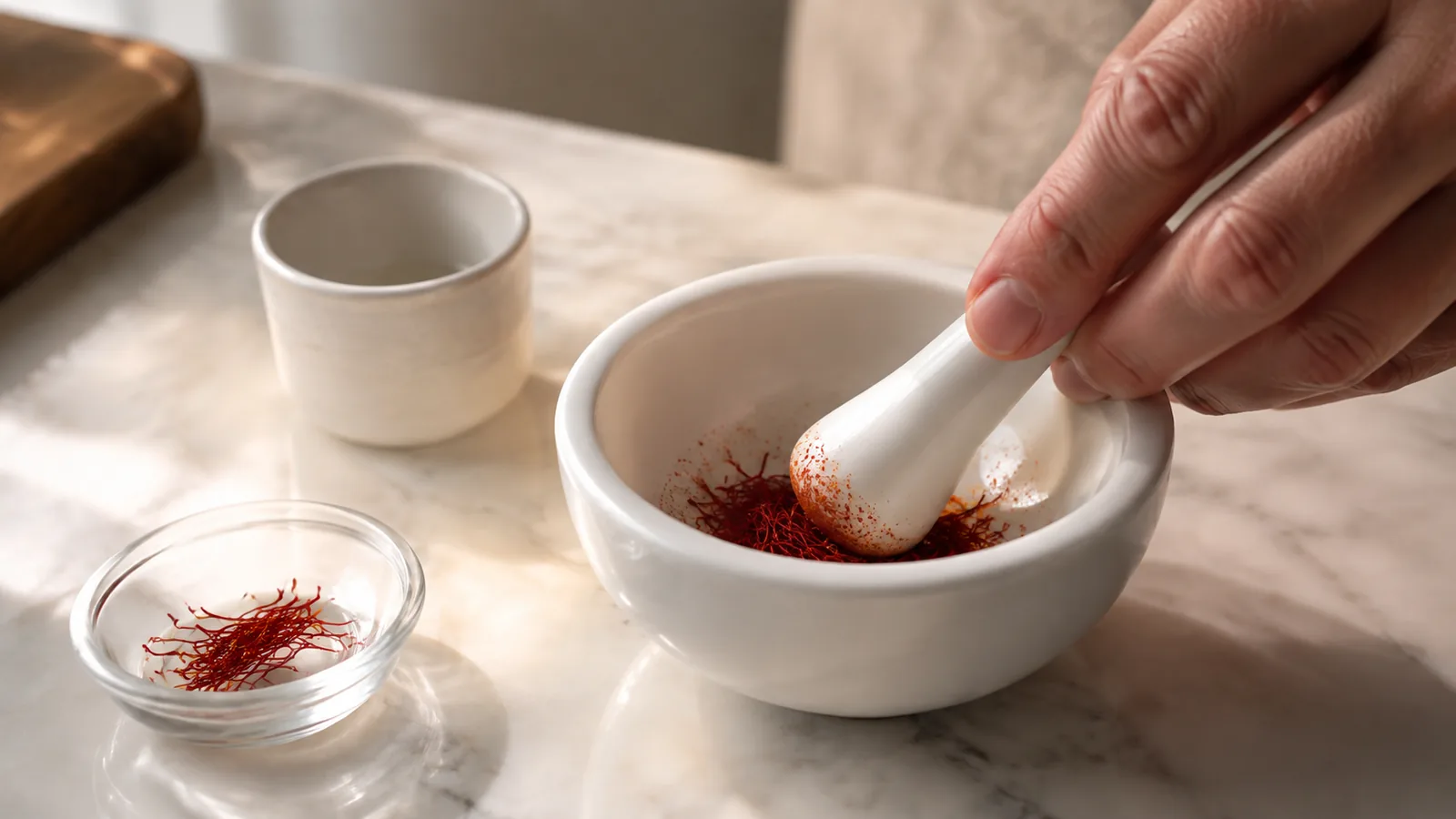
Crushing threads between clean white paper can show obvious grit, colored dust, or an unusual coating. It cannot prove that a sample is pure. Natural moisture, handling residue, added oil, and the paper itself can affect the mark. Newspaper is especially poor because ink and paper additives complicate the observation.
If a sample leaves a conspicuous greasy stain or loose dye, set it aside for further investigation. If it leaves no stain, do not treat that as certification.
How laboratories test saffron purity and quality
ISO explains that the ISO 3632 series provides specifications and test methods for saffron filaments, cut filaments, and powder. Laboratory work can examine moisture and foreign matter and measure characteristics associated with taste, aroma, and color. The current ISO catalogue lists ISO 3632-1:2025 for the specification and ISO 3632-2:2010 for test methods.
Codex CXS 351-2022, amended in 2025, likewise sets chemical and physical requirements, including moisture, ash, cold-water extract, picrocrocin, safranal, crocin, and limits for extraneous or foreign matter. Those measurements are why a proper report can distinguish purity, grade, and quality more precisely than a glass of water.
Research laboratories may add microscopy, chromatography, spectroscopy, imaging, or DNA methods when the suspected adulterant requires it. A peer-reviewed study of low-cost microscopy found that characteristic stigma structure can be highly informative, but its trained imaging workflow should not be reduced to “look for one trumpet end and declare the batch pure.”
What to do if saffron looks fake
- Stop using the questionable sample; do not perform a fire or solvent test.
- Keep the package, receipt, batch number, seller listing, and clear photos.
- Compare a small amount with a trusted sealed sample under the same light and water conditions.
- Ask the seller for a batch-specific report and the test method, not a generic claim of “lab tested.”
- For a commercial quantity or unresolved concern, use an accredited food laboratory or contact the relevant food-safety authority.
How to tell if saffron is real is ultimately an evidence question. Whole-thread structure, a characteristic aroma, gradual golden infusion, and a traceable seller can screen a purchase. They cannot replace analysis when purity, safety, grade, or a large financial decision must be certain.