


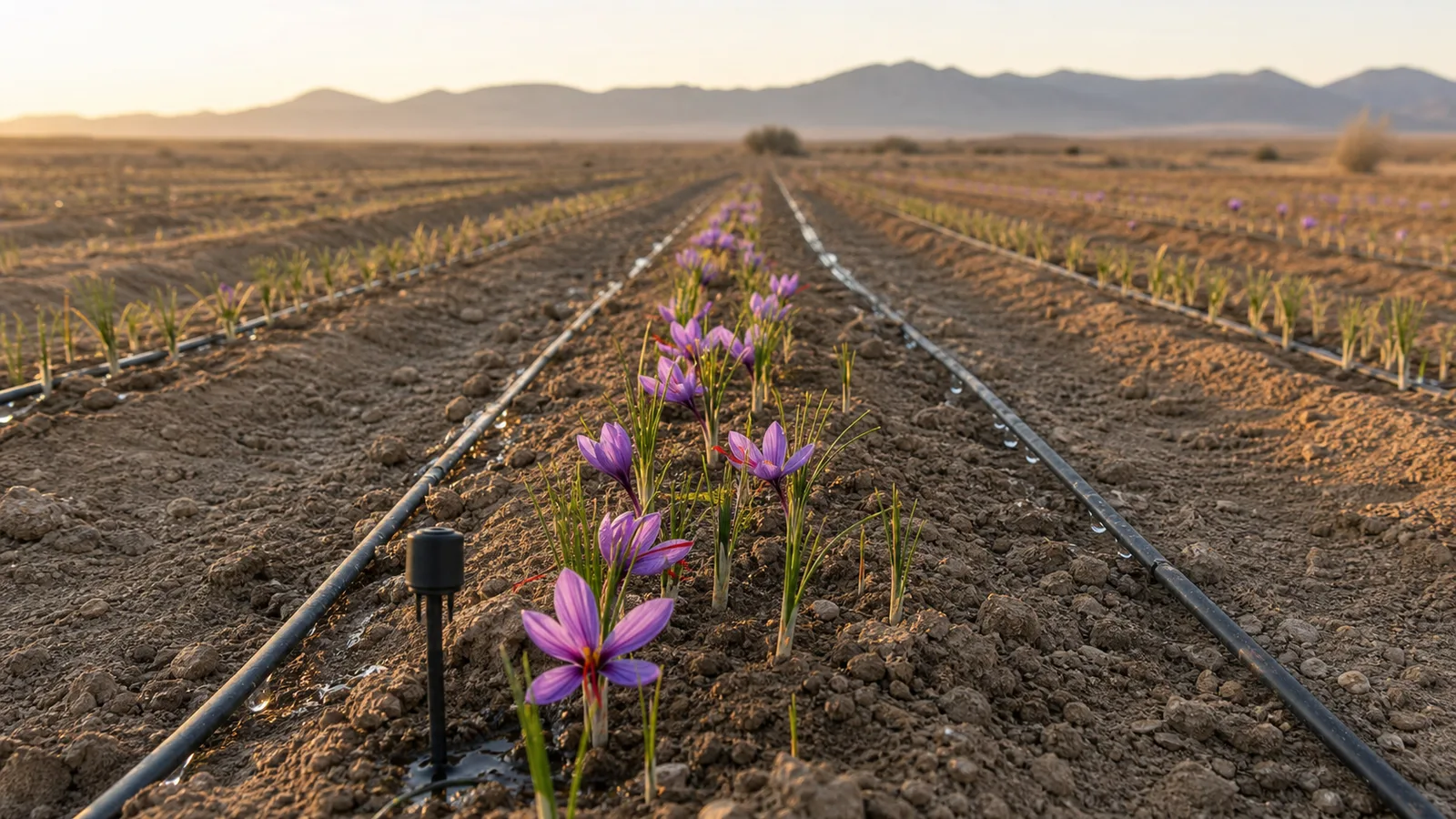
Saffron irrigation timing should follow the crop’s seasonal stage and measured soil moisture, not a fixed calendar alone. In a dry field, the most important applications usually include water that restarts autumn growth before flowering, post-harvest water that supports leaves, and carefully judged winter or spring irrigation for daughter-corm growth. Rainfall can replace some or all of a scheduled round.
These saffron irrigation tips are a framework, not a prescription for every farm. Soil texture, rooting depth, rainfall, temperature, field age, corm size, salinity, and irrigation efficiency change both the date and amount. A grower in Mashhad, Kashmir, Vermont, or a greenhouse should not copy the same four dates without checking local conditions.
What is the right time to irrigate saffron?
The right time is when the plant’s current stage needs water and the effective root zone has dried far enough to justify it. The first autumn irrigation is especially sensitive because moisture helps end summer dormancy and start a new growth cycle. Watering too early under warm conditions can favor leaves over flower emergence; watering too late can delay or reduce emergence in a dry field.
The old article gave a universal seasonal total of 400–500 mm. That figure cannot be used safely without saying whether it includes rainfall, what soil and climate it describes, or how application losses were calculated. Use a local crop-water budget based on rainfall, soil water, evapotranspiration, and system efficiency.
The four stages of saffron irrigation
A two-year field experiment at Ferdowsi University of Mashhad compared no irrigation with combinations of August, October, November, and April irrigation. Four rounds produced the highest flower number and dried-stigma yield in that experiment, while the researchers also found tradeoffs in measured quality components. This supports a four-stage framework for that semi-arid setting; it does not make four rounds mandatory in a rainy region.
First irrigation: pre-flowering autumn water
In an established dry field, the first substantial irrigation is timed to restart growth and prepare the crop for autumn flowering. In colder conditions it may fall in late September or early October; in warmer regions it may be delayed. Soil temperature, expected flowering window, and local experience matter more than the month printed in a generic guide.
For newly planted corms, settle the soil as the local planting method requires, but do not keep it continuously wet. For established fields, inspect moisture below the dry surface before irrigating. The target is even wetting through the active root zone without ponding.
Second irrigation: after flowering and harvest
After the flowers are picked, the leaves become important. A post-flowering irrigation can support leaf development and the next generation of daughter corms when rainfall is insufficient. “Fifteen days after blooming ends” is a useful field reference, not a rigid appointment; check the soil and forecast first.
In cold areas this stage may arrive in early November, in milder regions later in the month. Avoid watering flowers and harvested stigmas unnecessarily, and do not saturate poorly drained ground.
Third irrigation: winter moisture and weed-work stage
The traditional winter round is sometimes associated with weeding because damp soil can make hand removal easier. Irrigation does not itself control weeds. If rain or snow has already replenished the root zone, adding water simply because it is February can cause waterlogging and disease.
Use a soil probe, tensiometer, or another locally calibrated method before this round. Remove weeds with minimal disturbance to saffron leaves and corms. Keep field traffic off saturated beds.
Fourth irrigation: spring daughter-corm growth
A final spring irrigation may support corm growth while leaves are still green and active. In the Mashhad experiment, April was the fourth tested round. Stop treating the calendar as soon as the leaves are naturally yellowing and the crop is entering dormancy; persistently wet soil during senescence and summer is a rot risk.
Do not automatically add fertilizer or a fungicide with this irrigation. Fertility should follow soil or tissue evidence, and a fungicide should address an identified disease under local agronomic and label guidance—not be used as a routine companion to water.
Which irrigation practice is preferred in saffron cultivation?
If possible, drip irrigation is the most efficient method to irrigate saffron, as it delivers water directly to the plant’s roots, reducing evaporation. Drip systems are the most suitable for saffron fields and include perforated pipes or drippers that deliver water close to the plants.
Here, “preferred” means that a well-designed drip system gives the grower fine control over placement and duration. It does not mean that any drip line is automatically efficient. Poor spacing, clogged emitters, pressure differences, leaks, and irrigating longer than the soil can absorb all waste water.
Furrow or basin irrigation can still be workable where land shaping, water quality, labor, and local practice support it. Compare systems by distribution uniformity, actual crop yield, water productivity, energy, maintenance, and whether the method leaves standing water around corms.
How to set up drip irrigation for a saffron field
- Map the planted rows and active bed width before choosing lateral spacing.
- Match emitter flow and spacing to soil texture; water spreads differently in sand, loam, and clay.
- Use pressure regulation where elevation or long runs would otherwise create uneven output.
- Filter irrigation water to the emitter manufacturer’s requirement and provide flushing points.
- Measure catch-can or emitter output in several parts of the field rather than trusting the nominal rate.
- Keep lines positioned so cultivation and harvest work do not damage them.
How much water does saffron need at each irrigation?
Calculate a depth that refills the chosen root zone without pushing water below it. The same number of minutes can under-water one block and saturate another because flow rate, soil intake, slope, and initial moisture differ.
A practical field process is:
- Measure soil moisture at more than one depth and location before irrigation.
- Estimate the deficit relative to the locally determined target or field capacity.
- Convert that deficit to an application depth and account for system efficiency.
- Run the system in a duration the soil can absorb; split the application if runoff or ponding begins.
- Recheck the wetting depth after irrigation and adjust the next run from the result.
A 2026 randomized field study compared schedules based on soil-moisture deficit, moisture tension, and reference evapotranspiration. Its best-performing treatment was irrigation triggered at a 20% soil-moisture deficit under the tested conditions. That supports measured scheduling, but the threshold still needs local validation before it becomes an operating rule elsewhere.
Soil texture changes irrigation timing
Light soil drains and loses available water faster, so it may need smaller, more frequent applications. Heavy soil holds water longer but accepts it more slowly and carries greater waterlogging risk. A two-season study found that soil texture and irrigation interval influenced flower and corm yield; its result should be used to design a local trial, not to water every field weekly.
Dig or probe after a test irrigation to see the wetting pattern. A dry center between widely spaced drip lines and a saturated strip directly under each line indicates a design problem, not a reason to double the run time blindly.
Rainfall impact on saffron irrigation
Count effective rainfall—the portion that actually enters and remains in the root zone—rather than the number shown in a weather app. A short intense storm may run off; steady rain may replace a planned irrigation. Covering structures may exclude rain completely even when the surrounding ground is wet.
After rain, check several parts of the field. Low spots, compacted headlands, and areas beside a blocked drain can stay wet long after the average bed looks dry. Over-irrigation is often a distribution problem before it is a crop-calendar problem.
Water quality and filtration
Test the source before designing treatment. Electrical conductivity, sodium hazard, pH, bicarbonate, suspended solids, and specific contaminants can influence soil structure, crop response, and emitter performance. The right response depends on the result.
- Filtration protects emitters from particles; it does not remove dissolved salts.
- Flushing clears accumulated material from drip laterals when the system is designed for it.
- Chlorination or acid treatment can be appropriate for particular biological or mineral clogging problems, but concentration, contact time, worker safety, compatibility, and local rules require qualified system guidance.
- Reverse osmosis is specialized and energy-intensive. It is not a routine remedy for an entire saffron field and creates a concentrate stream that must be managed.
- Biological filtration is not a generic cure for unknown agricultural-water contamination.
“Clean-looking” water is not the same as suitable irrigation water. Start with analysis and a clear treatment objective.
Signs of too much or too little irrigation
Possible over-irrigation
- standing water or a sour, persistently wet root zone;
- soft or rotting corm tissue;
- uneven decline concentrated in low areas or around leaks;
- algae, surface sealing, or emitters running after the target depth is already wet.
Possible water deficit
- dry soil through the intended root zone, not just at the surface;
- weak or uneven emergence in areas receiving low emitter flow;
- early leaf stress during active growth;
- poor daughter-corm development where other causes have been excluded.
These symptoms are not diagnoses. Corm disease, salinity, planting depth, pests, nutrition, and emitter failure can look similar. Compare affected and healthy areas before changing the entire schedule.
A field record that improves next season’s timing
For every irrigation, record the date, crop stage, rainfall since the previous check, soil moisture by depth, system run time, measured flow, and unusual field conditions. Add flowering start, harvest duration, dry stigma yield, and daughter-corm observations later.
Research demonstrates why that discipline matters. A two-year irrigation-round study found that the number of rounds affected flower yield, stigma yield, quality components, phosphorus uptake, and daughter corms in different ways. More water was not a universal improvement in every outcome.
The best saffron irrigation timing is therefore a repeatable decision process: know the stage, measure the soil, account for rain, apply water uniformly, inspect the result, and keep a record. Preserve the four-stage seasonal logic where it fits, but let field evidence decide whether each round is needed.

![Exporting Saffron to Turkey + Price Guide [Complete 0 to 100]](https://img.rowhanisaffron.com/20260827003933/saffron-export-turkey-quality-inspection.webp)



