


Saffron grade is a documented description of a batch, not a promise created by words such as “premium,” “A+” or “Negin.” A useful grade tells you which standard was used, which laboratory tested the sample and how that particular lot performed for colour, flavour, aroma, moisture and purity.
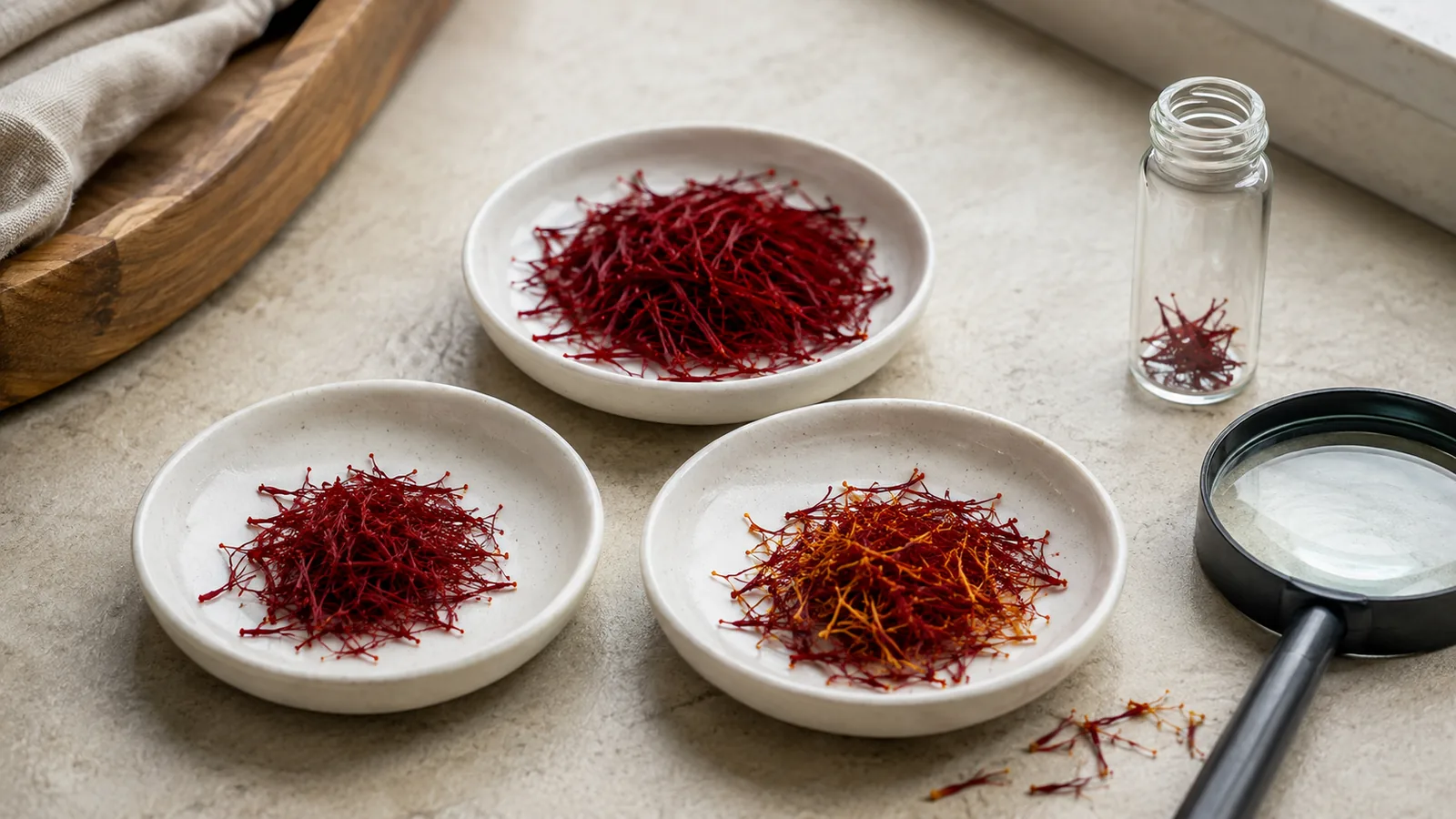
What Is Saffron?
Saffron is the dried stigma of Crocus sativus L., a member of the iris family. Each flower carries only three stigmas, and they are separated and dried after harvest. That labour and the small amount produced by each flower help explain saffron’s high price.
The spice contributes golden colour, a distinctive aroma and a gently bitter flavour to food. These qualities are associated with several compounds, particularly crocins for colouring strength, picrocrocin for bitterness and safranal as one important part of the aroma. A grade can measure selected quality characteristics, but it does not turn every sensory difference into one simple score.
What Does Saffron Grade Mean?
In international trade, saffron grading usually means testing a representative sample against a stated specification. The current specification is ISO 3632-1:2025, which covers dried saffron sold as filaments, cut filaments or powder. The companion ISO 3632-2:2010 test-method standard remains current after confirmation in 2022.
A complete assessment goes beyond a vivid red appearance. It considers physical cleanliness and moisture as well as the characteristics associated with colour, taste and aroma. A lot can look attractive yet fail a requirement that the eye cannot evaluate. Conversely, a few yellow portions do not by themselves prove that the product is fake.
This distinction matters because “saffron grade,” “saffron type” and “saffron quality” are often used as if they mean the same thing. They do not. Saffron grades under an ISO specification are based on stated tests. Negin, Sargol and Pushal are commercial descriptions of how Iranian saffron threads are trimmed and presented. Grade A saffron and Grade A+ are often seller-defined labels unless the supplier identifies a separate national or commercial specification.
How Is Saffron Grade Determined?
A laboratory begins with a representative sample rather than selecting the best-looking threads from a container. It prepares and analyses that sample using the named standard. The report should identify the batch, test date, method and result; otherwise, a number printed on a product page is difficult to verify.
Spectrophotometry
UV-visible spectrophotometry measures how a prepared saffron extract absorbs light at specified wavelengths. Under the established ISO approach, these readings are associated with colouring, bittering and aroma strength. Research descriptions of the method commonly refer to measurements near 440 nm for crocins, 257 nm for picrocrocin and 330 nm for the aromatic index.
Those results must be interpreted under the edition of the standard named on the certificate. A bare claim such as “colouring strength 300” is not a complete grade. It should come with the method, dry-basis calculation, other required results and the identity of the lot tested.
Moisture, foreign matter and other physical checks
Moisture and volatile matter affect stability and the honesty of the weight being sold. Laboratories also examine floral waste, foreign material and other physical or chemical requirements defined by the applicable specification. These checks help distinguish a clean, properly dried spice from one padded with non-stigma plant material or carrying too much moisture.
Chromatography and authenticity testing
Chromatography can separate and quantify individual compounds, and laboratories may use it for deeper quality or authenticity work. It is not accurate to describe chromatography as the routine step that automatically assigns every retail sample an ISO grade. The standard method and any additional analysis should be named separately.
The former explanation also listed titration as the way to measure crocin. That is misleading for the familiar ISO saffron category: the established method is spectrophotometric, not a simple consumer titration. More advanced tools may be used when a buyer needs to investigate adulteration or establish a detailed chemical fingerprint. In 2025, the FAO and Mashhad University of Medical Sciences announced work on stronger authenticity methods, noting that routine tests do not catch every sophisticated form of fraud.
Categories of Saffron Based on Grade
There is no single worldwide A+/A/B/C ladder with values such as 3, 2.5 or 2 that can be applied to every saffron product. The former list on this page defined A+ as a grade of 3 or higher and A as between 2.5 and 3, but it did not identify the scale or test behind those numbers. Such labels may belong to a seller, auction, national scheme or internal purchasing specification. They are meaningful only when the rules are supplied.
ISO literature has traditionally described laboratory categories with Roman numerals, while national and regional systems may use other names. Commercial thread styles add another vocabulary. Different grades of saffron can therefore be valid within different systems, and two products can both be called “top grade” while the labels refer to different things.
If a package says Grade A saffron, ask four questions:
- Which written standard defines Grade A?
- Does the result apply to this lot or to an older sample?
- Which independent or accredited laboratory performed the test?
- Can the seller provide the full report, not only one favourable number?
Highest Grade Saffron
“Highest grade saffron” or “high grade saffron” should refer to a batch that meets the top category of a named standard. It should not be treated as a permanent title owned by one city, country or thread style. Crop year, field conditions, harvest handling, drying and storage can all change the measured quality from one lot to the next. No certificate can name one permanent world’s best grade saffron for every harvest.
Negin saffron is an Iranian commercial type made from separated red stigma portions with little or no yellow style visible. Its long, neatly presented threads are desirable, and a well-produced Negin batch can test very strongly. The word Negin alone, however, is not an ISO certificate. Sargol, Pushal or another presentation can also be genuine and suitable for a buyer’s purpose.
The common statement that Negin is “rated at 300” combines a thread style with what is usually intended as a colouring-strength claim. Some batches may be sold with a result around that level, but the figure is not guaranteed by the name. It needs a batch-specific report.
Which City Produces the Highest Grade of Saffron?
Serayan in South Khorasan is a recognised saffron-growing area and can produce excellent crops. It is not responsible to say that every Serayan lot consistently scores 3.2–3.5 or that it permanently produces the world’s highest grade without a current, comparable dataset covering other regions and batches. Origin can support traceability; it does not replace testing.
Factors Affecting Saffron Grade
Harvest timing and flower handling
Flowers are commonly gathered early while they are still fresh, then moved promptly for stigma separation. The useful principle is speed and gentle handling, not a claim that harvesting before sunrise magically fixes pigment levels. Delays, crushing and contamination make the raw material harder to process well.
Drying
Drying is one of the most consequential steps. Too much residual moisture reduces stability; excessive or poorly controlled heat can damage aroma and colour. The best process is controlled and repeatable, with the finished lot tested rather than judged from the dryer setting alone.
Storage and packaging
Light, moisture, oxygen and heat can weaken saffron during storage. An airtight, food-safe container kept in a cool, dark, dry place protects the qualities measured after production. A strong harvest can arrive as a disappointing retail product if it spends months in unsuitable packaging.
Field and crop conditions
Soil drainage, irrigation, weather, plant health and harvest conditions influence the crop. Broad rules such as “alkaline soil always produces the best grade” are not enough to predict a laboratory result. Post-harvest handling can matter as much as the field name printed on the label.
Non-Laboratory Methods
A customer cannot reproduce a complete saffron grade test at a kitchen table. Visual, scent and infusion checks are still useful for spotting obvious problems and deciding whether a product matches its description; they are screening tools, not substitutes for a certificate. That is the key limitation when learning how to check quality of saffron at home.
Visual inspection
Look for recognisable stigma pieces, a reasonably consistent presentation and no obvious debris, mould or damp clumps. Genuine threads often widen toward one end and vary naturally. Thickness alone does not prove a high grade, and an unnaturally uniform powder is harder to assess than intact threads.
Scent test
Saffron should have a distinctive aroma without mustiness or a harsh chemical note. A strong smell is not automatically a higher grade: added fragrance, warm packaging and recent grinding can all influence what reaches your nose.
Taste and infusion test
A tiny culinary infusion should release golden colour progressively and have a characteristic, gently bitter flavour. Do not eat a large quantity to “test” it. Fast colour, sweetness or bitterness alone cannot establish a grade or prove authenticity. Our guide to buying authentic saffron explains the limits of paper and water checks.
How to Identify High-Grade Saffron
How to identify good quality saffron comes down to several pieces of evidence used together. Start with a sealed, traceable lot and an identified seller. Check the harvest or packing information, inspect the threads and ask for a recent certificate tied to the batch. Make sure the report covers the relevant characteristics rather than displaying only colouring strength.
Long, all-red threads with minimal yellow style are valuable when presentation and colouring material per gram matter. They can be a sensible choice for cooking and gifting, and our all-red saffron collection shows that presentation. Still, appearance cannot tell you the moisture content, confirm every aroma measurement or rule out all adulteration.
How to measure saffron threads
Thread counts are imprecise because lengths and thicknesses vary. If a recipe or purchase specification matters, measure saffron by weight on a suitable small scale. “How many strands of saffron should I use?” is a recipe question rather than a grade test: follow the quantity for the dish, then adjust future batches for the strength of the lot.
How Does Saffron Grade Affect Its Price?
Laboratory quality can influence price because stronger, cleaner saffron may deliver more colour and flavour per gram. It is not the only factor. Origin, crop size, thread presentation, certification, packaging, order volume, currency and the length of the supply chain also affect what a buyer pays.
A higher price therefore does not prove a higher grade, and a lower price does not reveal exactly which requirement is weaker. Compare like with like: the same weight, product form, testing basis and level of traceability.
Which Saffron Grade Is Best?
Which saffron is best depends on what the buyer needs, but a current top-category laboratory result attached to an intact, well-stored batch is the safest answer for strong culinary performance and clean presentation. Choose whole threads when visual inspection matters, and choose a commercial style that suits the use rather than assuming one name guarantees every quality. That is also the honest answer to “which type of saffron is best?”
Best Grade for Flavor and Cooking
Cooking quality depends on the whole lot: colour, aroma, bitterness, freshness and freedom from unwanted material. These are different qualities of saffron, not one interchangeable score. A small amount of well-tested, top quality saffron can be more useful than a larger amount bought on appearance alone. Ask for evidence, store it carefully and judge its performance in a measured recipe.
That is the practical meaning of saffron grade quality. It gives buyers a common way to discuss the tested quality of saffron, while commercial names describe its presentation. Keep those ideas separate, and the numbers used in saffron quality grades become easier to evaluate. Whenever a seller talks about saffron qualities, ask whether they mean laboratory results, thread presentation or both.

![Exporting Saffron to Turkey + Price Guide [Complete 0 to 100]](https://img.rowhanisaffron.com/20260827003933/saffron-export-turkey-quality-inspection.webp)



