


An authentic saffron guide should begin with an honest limit: no color, smell or home test can prove purity on its own. A buyer can screen whole threads for warning signs, check the seller and label, and reject suspicious material. Definitive answers about adulteration or grade require a representative sample and appropriate laboratory methods.
Authentic Saffron Guide
Authentic saffron is the dried stigma of Crocus sativus. It may be sold as whole or cut filaments, or as powder. Whole threads are easier for a shopper to inspect because their natural shape remains visible; powder may still be genuine, but its structure has already been hidden. Questions such as “how to identify original saffron,” “how to identify pure saffron” and “how to tell if saffron is real” all need this same combination of inspection and traceability rather than one magic test.
The current ISO 3632-1 saffron specification applies to filament, cut-filament and powder forms. It provides a technical basis for quality requirements, but an ISO badge printed on a jar is not evidence by itself. A supplier making a standards claim should be able to connect it to a credible, current report for the lot being sold.
This article concentrates on inspecting a sample and understanding home tests. For seller, batch, packaging and purchase decisions, use our separate guide to buying authentic and premium saffron. Keeping those jobs distinct prevents a kitchen trick from replacing supply-chain evidence.
How to buy saffron before opening the pack
Choose a seller whose identity and contact details can be checked. If you are asking how to find original saffron, begin with a traceable product, not a dramatic home trick. The package should state what the product is, its net weight, origin or responsible business, and useful lot and date information. The seal should be intact, and the container should protect the spice from moisture and light.
Price is a warning signal, not a test. A very low price for material advertised as premium whole-thread saffron deserves scrutiny, but an expensive product can also be mislabelled. Buy a small sealed quantity first when the seller is new to you, and save the receipt and package until the product has been inspected.
How to identify authentic saffron by appearance
Look at several threads in good neutral light. Genuine saffron stigmas are biological material, so they are not perfectly identical. A thread usually widens towards its upper end into a flared or trumpet-shaped form, with a narrower lower portion. The three stigma branches begin together in the flower, but commercial processing often separates them; every loose thread is not supposed to have three visible branches.
Color commonly runs through deep red and red-orange, sometimes with a lighter orange or yellow style portion depending on the cut. “Bright red to orange” describes a broad appearance, not a pass/fail shade chart. Perfectly uniform red fibres, obvious flat petals, dyed plant shreds, crystals, excessive yellow material or loose colored dust are reasons to investigate.
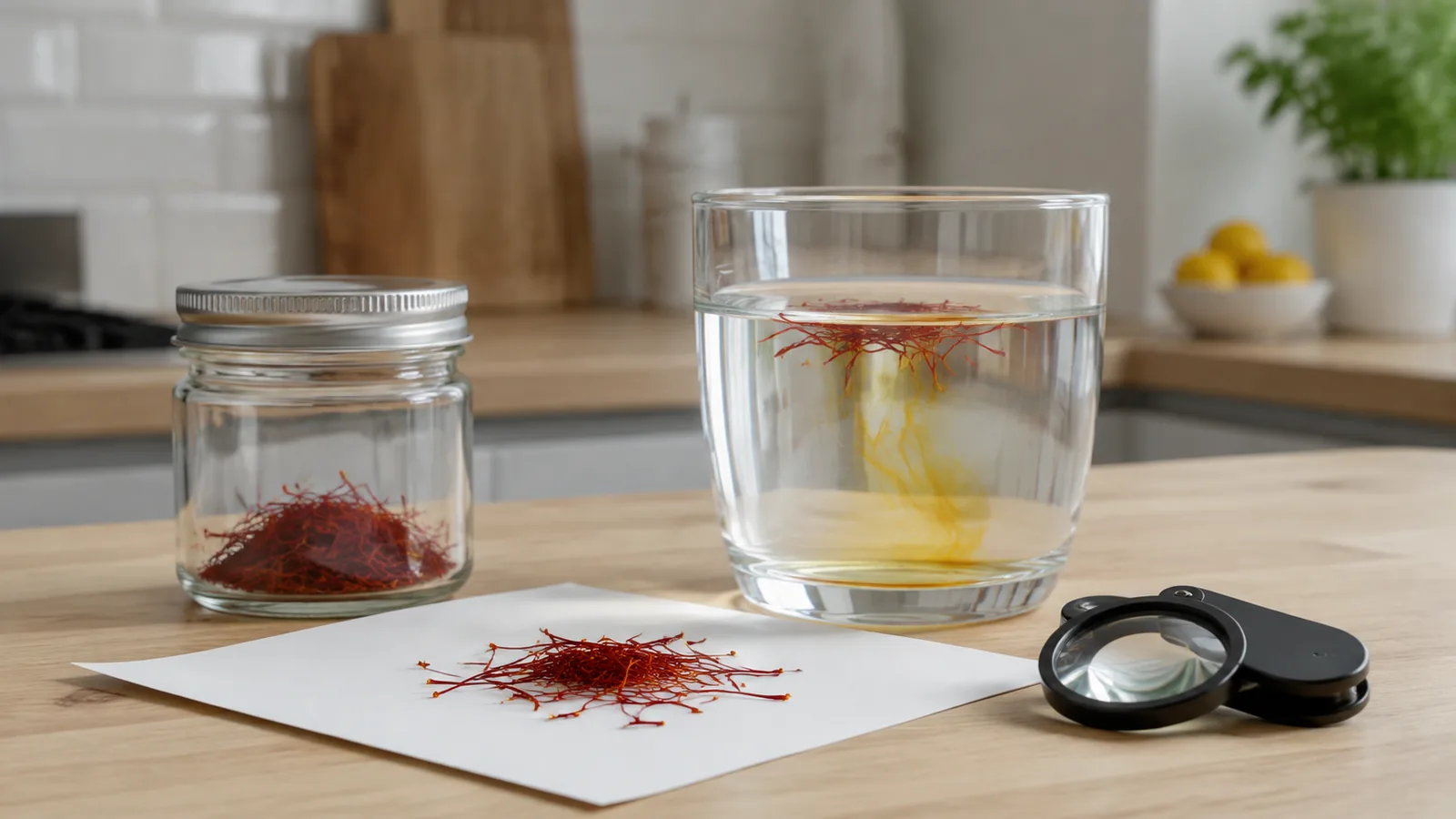
A magnifier or phone macro lens can help reveal a flared tip and uneven plant surface. Compare threads from different parts of the container rather than choosing one attractive piece. Our visual explanation of original saffron features provides a closer look at the expected stigma form.
Texture, aroma and taste
Properly dried threads are light and usually brittle enough to break under firm pressure. Humidity can make real saffron flexible, while excessive drying can make low-quality material brittle, so texture contributes evidence but does not decide authenticity.
Genuine saffron has a distinctive aroma that people describe in different ways: warm, hay-like, floral, earthy or slightly metallic. Age, storage, temperature and personal perception change its strength. An overpowering perfume or unrelated fragrance is suspicious; a mild aroma alone is not proof of a fake.
Picrocrocin contributes bitterness, but do not taste unknown loose material merely to test it. Sweetness may suggest sugar or syrup, yet safe purchasing and visual screening should come before putting a suspect product in the mouth.
The paper test: what it can and cannot show
Place two or three threads between clean white paper and press gently. An oily residue, colored grease or visible coating can flag added oil, syrup or loose dye. If the threads simply break without leaving that kind of stain, the result is reassuring but does not prove the saffron is genuine.
Many possible substitutes are dry. A fake fibre can pass a paper test, and real saffron that was handled or stored badly may behave unusually. Use the paper test to notice a problem, not to certify purity.
The cold-water test
Put a few whole threads into a clear glass of cool water. Watch without crushing or stirring them hard. Genuine saffron generally releases a yellow-gold color into the surrounding water while recognizable thread structure remains for a time. A sudden dense cloud of bright red color washing off the outside is a warning sign.
The familiar claim that authentic saffron must take exactly 15–20 minutes to color cold water is too precise. Release speed changes with water temperature, thread cut, age, quantity and whether the material was damaged or ground. Genuine powder colors water faster because more surface is exposed; a carefully engineered adulterant may release color slowly.
Water therefore helps answer “does this sample behave strangely?” It cannot answer “what percentage is pure?” or identify every added plant and dye.
Real saffron vs fake saffron: what changes?
Fake saffron is not one product. It may be safflower, calendula, corn silk or another plant sold in place of saffron; genuine stigmas mixed with foreign plant matter; lower-value style material presented as a higher cut; added moisture or coating that increases weight; or undeclared synthetic color.
A peer-reviewed review of saffron authentication and quality control describes physical, microscopic, chromatographic, spectroscopic, sensor and DNA-based approaches. It also explains the limitations of simple physical checks, including their weaker sensitivity and inability to quantify adulterants reliably.
Official market sampling confirms that adulteration is a real concern without proving that every cheap jar is false. In a coordinated European control project, the Joint Research Centre reported that 11% of sampled saffron was suspicious of adulteration. That number belongs to the project’s samples and period; it is not a worldwide rate for all saffron.
Why a home test is not laboratory confirmation
Home checks can reveal an obvious problem because the eye can see thread structure, loose dye or a greasy coating. They cannot reliably detect a small amount of foreign material, distinguish every species, quantify moisture or verify a commercial grade.
A laboratory may combine microscopy with chemical or spectral analysis, chromatography or DNA methods depending on the question. No single method answers every authenticity and saffron quality claim. If you need to know how to check quality of saffron for a commercial purchase, ask whether the report matches the exact lot, whether the laboratory is competent for the method, and who collected the sample.
Saffron essence and synthetic color
“Saffron essence” is not a precise substitute for whole saffron. The term may describe a flavouring, extract, colored liquid or blended product. Read the ingredient list and intended use; do not assume a yellow liquid contains meaningful Crocus sativus, and do not accept an essence as proof of authentic threads.
It is also inaccurate to say that synthetic alternatives always contain harmful chemicals that cause severe liver and kidney damage. Safety depends on the actual ingredient, dose, regulation and labelling. For example, the US FDA’s food-color guidance lists certified FD&C Yellow No. 5, also known as tartrazine, for regulated food uses and explains certification and labelling requirements.
That does not make undeclared dye in a product sold as pure saffron acceptable. Misrepresenting colored substitute material as genuine saffron is an authenticity and labelling problem whether or not the color is permitted in a different food.
What to do if saffron looks suspicious
- Stop using the product and keep the threads, container, receipt and lot information together.
- Photograph the package and several parts of the sample in neutral light.
- Write down what you observed without claiming more than the test showed.
- Contact the seller and request the relevant batch evidence, return or refund process.
- For a significant commercial or safety concern, use an accredited laboratory or the appropriate local food authority.
Do not burn threads, add household chemicals or taste unknown material to produce a dramatic answer. Those methods add risk and still do not give reliable identification.
A reliable authentic saffron check
To know whether saffron is real, combine independent clues. Begin with a traceable seller and sealed batch, prefer whole threads for a first inspection, examine shape and color, note aroma and texture, and use paper or cold water only as warning screens. If purity, grade or origin materially affects the purchase, ask for suitable lot-specific testing.
This approach answers how to check if saffron is original more honestly than any single trick. Genuine saffron has recognizable features, but counterfeiters can imitate one feature at a time. Confidence comes from the product, its documented path to the buyer and the evidence agreeing with one another.

![Exporting Saffron to Turkey + Price Guide [Complete 0 to 100]](https://img.rowhanisaffron.com/20260827003933/saffron-export-turkey-quality-inspection.webp)



