


This Original Saffron Buying Guide starts with the part that matters most: no single color, smell or kitchen trick can prove that a sample is authentic. Buy from a traceable seller, inspect whole threads, read the label and treat home tests as warning screens. Proper confirmation of premium saffron comes from a batch-matched laboratory report.
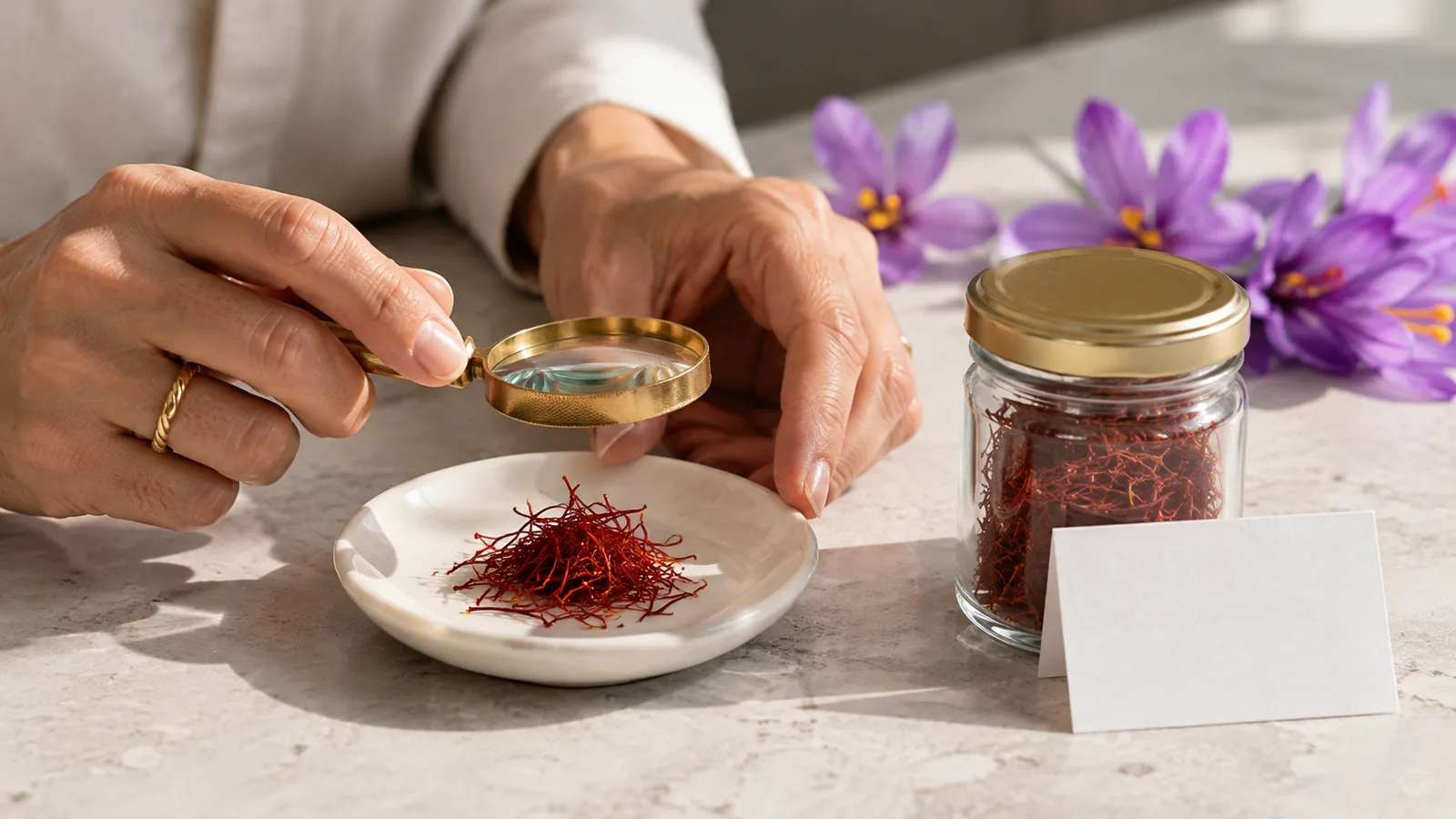
Original Saffron Buying Guide: check the seller first
The safest time to avoid counterfeit saffron is before money changes hands. A responsible seller should identify the business, net weight, lot or batch, country of origin, packer or producer, and a useful packing or best-before date. The container should be sealed and suitable for protecting the threads from light and humidity.
If you are deciding where to buy real saffron, look for a clear returns or complaint route and ask whether the quality document applies to the exact lot on sale. A generic certificate with no matching batch number tells you little about the jar in your hand. Be cautious when the price is implausibly below comparable whole-thread saffron, but remember that a high price alone is not proof of purity.
Depending on the market, a package may use the names saffron, zafran or kesar. The name and spelling do not verify botanical identity; the traceable product and evidence do.
For a first purchase, choose a small sealed quantity. You can inspect and use it while it is fresh instead of committing to a large package based on photographs or marketing language.
What “premium saffron” should mean
Premium is useful only when the seller explains the evidence behind it. Thread style—such as a product sold as Sargol, Negin or Pushal—describes visible portions and presentation, not every aspect of quality or authenticity. Origin is also not a substitute for testing.
The current ISO 3632-1 saffron specification applies to dried saffron in filament, cut-filament and powder forms. When a supplier makes a category or ISO claim, request a recent report from a competent laboratory and check that the lot number, sample form and dates correspond to the product. Our explanation of Iranian saffron standards gives more context for reading those claims.
How to Identify Genuine Saffron by appearance
If you want to know how to identify original saffron before opening a jar, whole threads provide more visible information than powder. Saffron comes from the stigmas of Crocus sativus. Each flower has three stigma branches joined lower down at the style, but processing commonly separates them. Individual genuine threads usually widen toward the top into a flared or trumpet-like shape rather than staying the same width from end to end.
Color is usually deep red to red-orange across the stigma, sometimes with a lighter orange or yellow style portion depending on the commercial cut. “Bright red to orange” is therefore a useful range, not a rule that every thread must match. Perfectly identical size, surface and color can be suspicious, yet natural variation is not proof by itself.
Look closely for flat petals, shredded fibres, dyed corn silk, safflower or calendula material, excessive yellow plant tissue, crystals, oiliness or loose colored dust. These are reasons to ask questions or reject a sample. Visual inspection cannot reveal every added dye or a small proportion of foreign plant material.
Aroma, taste and brittleness
Authentic saffron has a distinctive layered aroma rather than the simple sweetness of perfume or food coloring. Strength varies with age, drying, storage and temperature, so an understated fragrance does not automatically make the product fake. A harsh artificial scent is a warning.
Picrocrocin contributes saffron’s bitter taste. Sweetness on the tongue may indicate added sugar or syrup, but tasting an unknown product is not a sensible authenticity test. Packaging, appearance and traceability should come first.
Properly dried threads are light and brittle enough to break under pressure. Humidity can make genuine saffron flexible, while over-drying can make poor material brittle. As with color and aroma, this characteristic contributes to an assessment; it does not settle the question alone. The illustrated guide to original saffron features can help you compare the expected thread form.
Saffron original vs fake: common substitutions
Fake saffron does not describe one material. Fraud may involve another flower or plant part sold in place of saffron, genuine threads bulked out with foreign matter, lower-value saffron presented as a higher grade, added weight from moisture or coating, or undeclared colorants. Powder hides structure, which is why whole threads are easier for a buyer to screen.
This is a real supply-chain issue, but it should not be exaggerated into a claim that every inexpensive jar is fraudulent. In an EU-wide official control project, the Joint Research Centre reported that 11% of the sampled saffron was suspicious of adulteration. The finding describes that sampling programme and period; it is not a worldwide rate for every market or seller.
How to check original saffron at home
People searching for how to find original saffron, how to identify pure saffron, how to check pure saffron or how to test saffron purity often expect one decisive trick. Home checks can expose an obvious coating or fast-leaching dye, but they cannot certify botanical identity, grade or an exact percentage of adulteration. A scientific review of saffron quality control and authentication describes visual, microscopic, chromatographic, spectroscopic and DNA-based methods—and notes the limitations of simple physical checks.
Paper Test for Original Saffron
Place two or three threads between clean white paper and press gently. A greasy or strongly colored stain can flag an added coating or loose dye. Genuine material should not behave like an oil-soaked product, but the absence of a stain does not prove it is pure. Some adulterants are dry and leave no obvious mark.
Cold Water Test for Authentic Saffron
Place a few whole threads in a clear glass of cool water and watch rather than stirring hard. Genuine saffron generally releases a yellow-gold color into the water while the thread structure remains visible. A dense cloud of bright red color stripping off immediately is suspicious.
The familiar “15–20 minutes” rule is only a rough observation. Temperature, quantity, age, thread cut and whether the saffron has been crushed all change release speed. Genuine powder can color water quickly because it has more exposed surface, and a sophisticated adulterant may release color slowly. Use the cold water test to notice behaviour, not to issue a certificate.
Magnified thread check
A phone macro lens or simple magnifier can reveal flared stigma tips, uneven biological surfaces, flat petals, fibres or colored coatings. Compare several threads from different parts of the package. This is more informative than judging one carefully selected piece, but microscopy by a trained analyst is much stronger evidence than a phone image.
Why laboratory testing is different
A laboratory can assess characteristics such as moisture, extraneous matter and the compounds associated with saffron’s color, taste and aroma. Depending on the authenticity question, analysts may use microscopy, chromatography, spectroscopy or DNA methods. One method does not catch every fraud, which is why the requested report should match the seller’s claim.
When buying premium saffron in commercial quantities, ask who took the sample, which standard and methods were used, when testing occurred, and whether the laboratory is accredited for that work. A cropped screenshot showing a favorable number without the laboratory, sample identity or full result is not enough.
Saffron essence, tartrazine and label accuracy
“Saffron essence” is an ambiguous sales term. It may refer to a flavoring, an extract or a colored product; it should not be assumed to contain meaningful saffron unless the ingredients and specification say so. A yellow liquid is not equivalent to whole stigmas.
Tartrazine is a synthetic yellow color, also known in the United States as FD&C Yellow No. 5. It is inaccurate to say it is legally prohibited everywhere or that any exposure inevitably causes severe liver and kidney damage. The FDA permits certified FD&C Yellow No. 5 for regulated food uses and requires it to be identified on food labels. Rules and labeling names differ by country.
That does not make an undeclared dye in saffron acceptable. Selling colored substitute material as pure saffron is a labeling and authenticity problem, regardless of whether a particular additive is allowed in another food. Do not consume an unlabelled “essence” or suspicious loose powder merely because it produces the expected color.
What to look for when buying saffron
- Identity: the package names saffron and, ideally, Crocus sativus rather than relying on “golden spice” or “essence.”
- Form: whole threads make a first purchase easier to inspect than powder.
- Traceability: seller, packer or producer, origin, net weight and a lot or batch are clear.
- Dates and storage: packing or durability information is usable, and the seal and container are sound.
- Claims: grade, organic, origin and laboratory statements come with specific evidence rather than badges alone.
- Price: it is plausible for the quantity and claimed form; neither the cheapest nor the most expensive jar is automatically genuine.
- Support: the seller answers questions and provides a route for a return or complaint.
Check the product again after opening
Photograph the lot and packaging before discarding it. Compare the threads across the whole jar, note any foreign material, and smell the product in a clean container. If a gentle water check gives strange red bleeding, the package contains oily or crystalline material, or the contents do not match the label, stop using it and contact the seller.
Store accepted saffron tightly closed, dry, away from heat and light. Poor storage can flatten aroma and change texture, making later visual checks harder. If you are comparing named thread cuts, our guide to Sargol saffron and related commercial types explains what those labels describe.
The reliable way to buy genuine saffron
To buy genuine saffron, combine evidence instead of trusting a dramatic trick. Start with an accountable seller and a traceable sealed batch. Prefer whole threads for inspection, use the paper and cold-water checks only as screens, and request competent lot-specific testing when purity or grade materially affects the purchase.
That approach answers how to buy original saffron more honestly than promising that shape, a 15-minute color test or bitterness can guarantee purity. A responsible Original Saffron Buying Guide should connect the product, the supply chain and the evidence instead of turning one clue into a guarantee.

![Exporting Saffron to Turkey + Price Guide [Complete 0 to 100]](https://img.rowhanisaffron.com/20260827003933/saffron-export-turkey-quality-inspection.webp)



