


Iran is the world’s largest saffron producer, with the Food and Agriculture Organization estimating its current share at roughly 85–90% of global output. Most Iranian saffron cultivation remains concentrated in the three Khorasan provinces, but commercial fields also extend west and south into provinces including Kerman, Isfahan, Fars, Hamedan and Kermanshah.
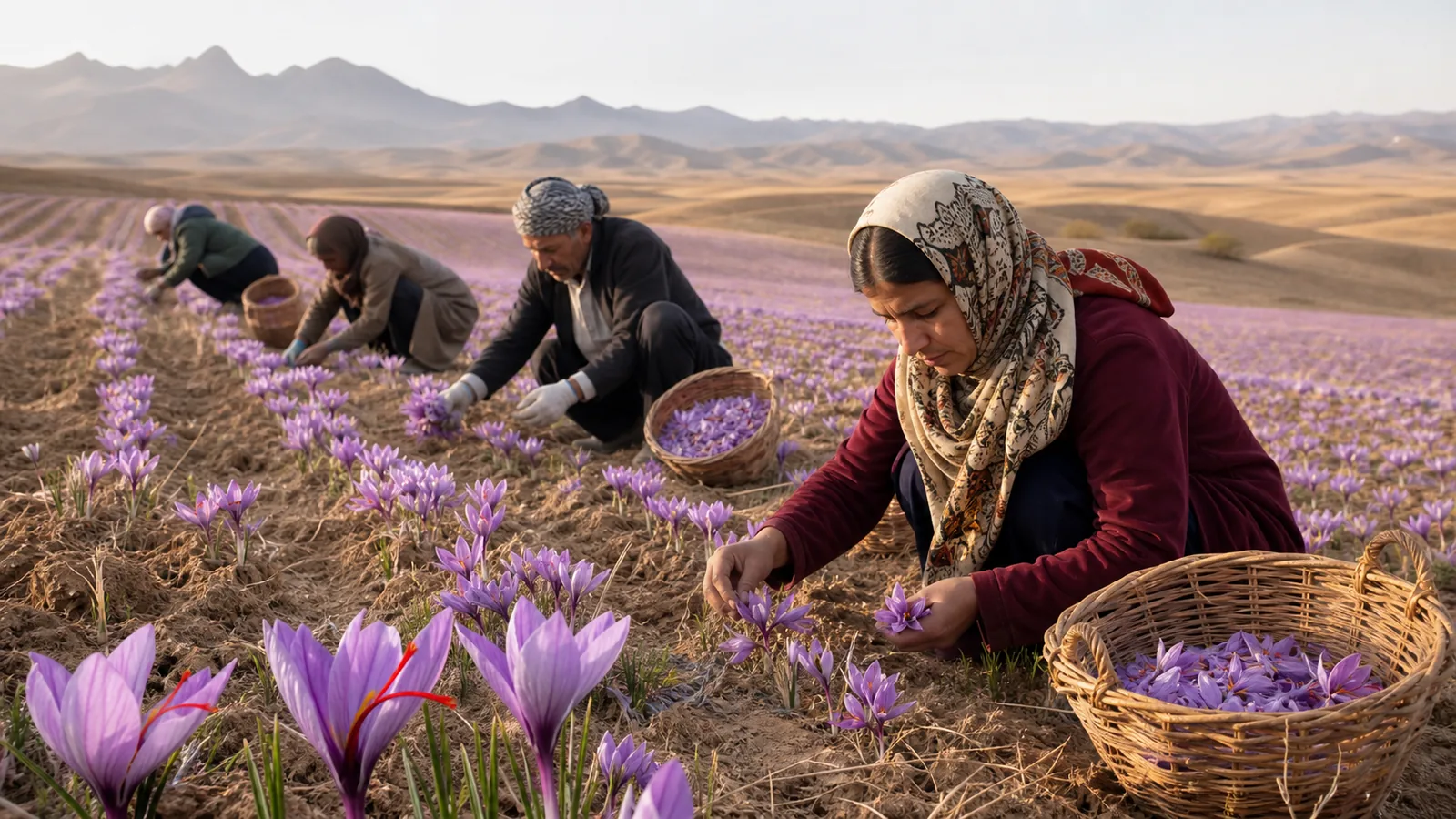
Production and acreage figures change from season to season. This article separates current institutional estimates from older snapshots, explains the yield arithmetic and adds the history and field practices that make the map of Iranian saffron more than a list of hectares.
How much of the world’s saffron does Iran produce?
FAO’s November 2025 account puts Iran at 85–90% of world saffron production. That range is a better current answer than repeating one fixed percentage forever. Weather, corm cycles, planted area and the estimates available for smaller producing countries all affect the annual share.
An older regional statement used a different snapshot: about 220 tonnes worldwide and 180 tonnes from Iran. Those numbers imply an Iranian share of roughly 81.8%. A separate 2020-era account cited 500 tonnes from 125,000 hectares. These figures cannot describe the same season, so they should not be combined into one total.
The stable conclusion is Iran’s leadership, not a timeless tonnage. Greece, India, Afghanistan, Morocco, Spain and other countries also produce saffron, while Iran supplies by far the largest volume.
Where saffron is grown in Iran
Khorasan Razavi is the main production centre, followed by South Khorasan and North Khorasan. The archived acreage set used by this page reported:
- about 85,000 hectares in Khorasan Razavi;
- about 15,000 hectares in South Khorasan;
- about 1,600 hectares in Kerman;
- about 1,300 hectares in Isfahan; and
- about 270 hectares in Hamedan.
Those are historical administrative figures and do not all carry a common publication date in the original article. They illustrate the scale and concentration of cultivation, not a live land register. Fars, Kermanshah and smaller areas in other provinces also cultivate the crop.
For comparison, an Iranian submission to the Codex Committee on Spices and Culinary Herbs reported 2014–2015 provincial data of 69,407 hectares and 218.348 tonnes for Khorasan Razavi, and 14,727 hectares and 48.019 tonnes for South Khorasan. The official Codex working document identifies the Ministry of Agriculture-Jahad as the statistical source. It is useful as a dated benchmark, not as a 2026 count.
Average saffron yield per hectare in Iran
The old version of this page said that 125,000 hectares produced 500 tonnes, then claimed an average yield of 15–20 kilograms per hectare. The arithmetic does not support that claim: 500,000kg divided by 125,000ha equals 4kg/ha.
The older Codex figures show the same general scale. They calculate to 3.1kg/ha in Khorasan Razavi, 3.4kg/ha in South Khorasan, 4.9kg/ha in North Khorasan, 5.2kg/ha in Kerman and 6.1kg/ha in Isfahan for that reporting year.
Individual fields can perform above or below a provincial average. Corm size and health, field age, planting density, soil, irrigation, temperature during flower initiation, disease, harvest labour and drying losses all matter. A national production total divided by planted area is an average, not a promise for a particular farm.
Kermanshah: a historic claim and a modern growing region
Agricultural expert Farshad Hamzaei described saffron cultivation in Kermanshah, including Sarpol-e Zahab, as dating to the Achaemenid period. That is a notable local account, but the archived interview supplied no archaeological citation demonstrating continuous saffron cultivation in those places. It should be attributed, not repeated as a settled date.
The wider origin story is also more complex than the interview’s India-versus-Iran choice. Modern genetic work identifies cultivated Crocus sativus as a sterile triploid descended from Crocus cartwrightianus. A genome-wide study placed its closest origin near Athens, and a later history-and-genetics review found that early Greek evidence and modern genetics converge on an Aegean domestication. Saffron nonetheless has a long cultivation and cultural history in ancient Persia and across the region.
Kermanshah also has native wild crocuses. Encyclopaedia Iranica records Crocus haussknechtii around Kermanshah and Hamedan and notes that it is closely related to cultivated saffron. A wild crocus is not automatically the cultivated spice species, and flower colour alone cannot identify it.
How the saffron plant grows
Saffron belongs to the iris family, Iridaceae—not the lily family stated in the old translation. It grows from a compact underground stem called a corm, commonly but imprecisely called a bulb. Mature planting corms are often around 3–5cm across and enclosed by brown fibrous tunics. New corms form vegetatively because cultivated saffron is sterile.
The plant follows a seasonal rhythm. Flowers appear in autumn, narrow leaves continue through the cool growing period, and the foliage yellows as the plant enters summer dormancy. Good drainage is essential because waterlogging can damage corms. However, “never allow summer moisture” is too absolute: irrigation timing varies with climate, soil, planting date and the production goal, and some field studies include carefully timed summer irrigation.
Sandy loam with good infiltration is a common recommendation. A fixed instruction to irrigate every 15 days is not transferable to every Iranian region. Growers should use local rainfall, soil moisture, drainage and extension guidance rather than a calendar copied from another field.
Why flowers are picked early
Hamzaei recommended collecting flowers in the early morning, before strong sun. That advice is consistent with established harvest practice. Flowers have a short life, open quickly and need prompt separation and drying. FAO’s saffron cultivation overview also describes early morning as the optimal collection period and stresses careful post-harvest handling.
The harvest is labour-intensive because each flower supplies only three stigmas. The job does not finish at picking: flowers must reach a clean work area, stigmas must be separated without unnecessary plant material, and drying conditions must protect colour, aroma and flavour.
Bardaskan, Kashmar and Khalilabad
In the older 180-tonne national snapshot, parliamentary representative Ismail Nia said Bardaskan, Kashmar and Khalilabad together produced and processed more than 30 tonnes of saffron. On the figures he used, that was more than 13.6% of the stated 220-tonne world total and about 16.7% of Iran’s stated output.
He also highlighted flower-processing workshops in Bardaskan that employed many women and aimed to separate saffron under hygienic conditions. The report did not provide workshop counts, payroll data or an audit of hygiene standards, so those details remain attributed to his visit.
Nia argued that Iran’s production scale should give it a leading role in price formation. Volume provides influence, but it does not set a world price by itself. Consistent quality, laboratory verification, origin traceability, packaging, market access and transparent trade data all affect what producers receive.
Production, processing and export are one chain
Iranian saffron has long moved through trading and re-export hubs. The old page named Spain, the United Arab Emirates and Hong Kong, which were important destinations in historical customs data; the mix changes by year and should not be treated as a current ranking without a current export dataset.
FAO’s current Iran programme focuses on quality integrity across production, post-harvest handling, safety, traceability and marketing. That is the practical meaning of Iran’s global impact. A large cultivated area matters, but preserving value requires every lot to connect its field and harvest to defensible quality and origin records.
For growers interested in the field cycle itself, our guide to saffron cultivation methods covers planting and crop care in more detail. For market comparisons, keep the reporting year beside every hectare, tonne and export share. Iran remains the clear leader; accurate dates and arithmetic explain that leadership better than an inflated yield claim.

![Exporting Saffron to Turkey + Price Guide [Complete 0 to 100]](https://img.rowhanisaffron.com/20260827003933/saffron-export-turkey-quality-inspection.webp)



