


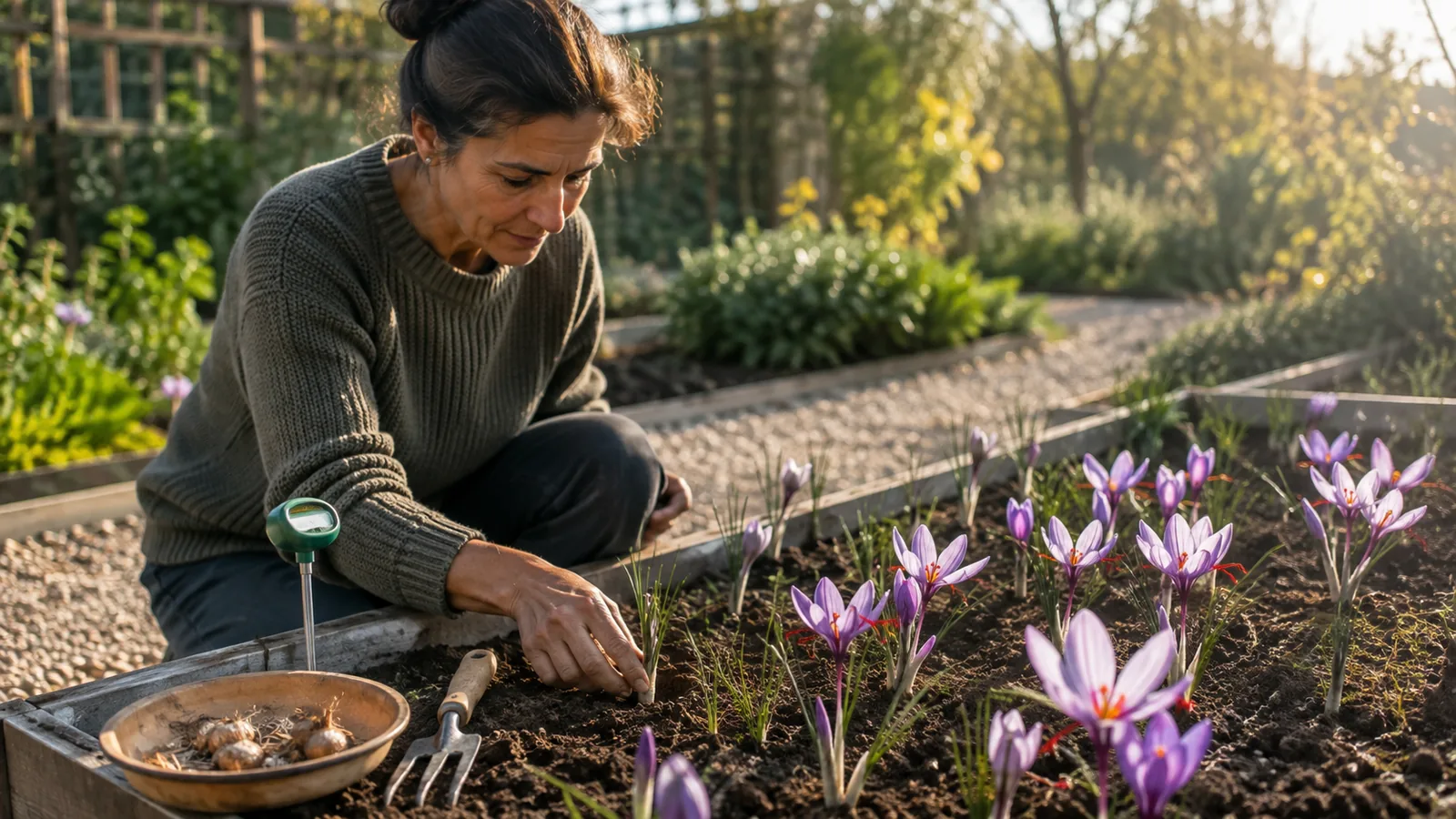
Saffron cultivation methods begin with one non-negotiable detail: culinary saffron comes from Crocus sativus, an autumn-flowering crocus grown from corms. Give those corms sun, free-draining soil and the right seasonal care, and a garden bed or deep container can produce both purple flowers and genuine red saffron threads.
Saffron Cultivation Methods: A Guide to Growing and Caring for Saffron Plants
The practical answer to how to grow saffron begins with its annual rhythm. How saffron is grown depends on climate, soil and scale, but the pattern remains recognisable: corms are planted while dormant, roots and shoots develop as conditions cool, flowers appear in autumn, and narrow leaves continue growing after bloom. The foliage feeds replacement corms before dying back naturally in late spring or early summer. During summer dormancy, the planting needs warmth and protection from prolonged wet soil.
Saffron is possible for a first-time gardener, although “easy” should not be mistaken for maintenance-free. Drainage, corm quality, weeds, rodents, flowering weather and post-harvest handling all matter. A few flowers are enjoyable; producing a useful quantity of spice takes many healthy corms and careful hand work.
Choose the right crocus before planting
Only the three long red stigmas of Crocus sativus are harvested as the spice saffron. Buy correctly identified corms from a reputable specialist. They are sometimes casually called bulbs, but a corm is a solid swollen stem base rather than a layered true bulb.
The earlier version of this guide mixed saffron with ornamental crocuses. Crocus speciosus, C. chrysanthus, C. tommasinianus and garden selections sold as ‘Lady Killer’, ‘E. A. Bowles’ or ‘Tricolor’ can be attractive, but they are not varieties of culinary saffron. It also misspelled C. chrysanthus as “C. chrystanthus.” Some bloom in spring and some in autumn; neither timing nor a purple flower makes them a substitute for C. sativus.
Do not confuse saffron crocus with plants called “autumn crocus” or “meadow saffron” in the genus Colchicum. The Royal Horticultural Society warns that Colchicum is highly poisonous. If the identity of a plant is uncertain, do not harvest it for food.
Check the site and soil first
Good saffron cultivation soil requirements are practical rather than exotic. Choose an open position with strong sunlight and well-drained soil that releases excess rain or irrigation. Sandy loam and other light-to-moderate textures are often suitable. Heavy soil is not automatically impossible, but standing water around dormant or growing corms encourages rot, so a raised bed may be safer than simply adding a little gravel to a wet hole.
Work mature compost into the bed if the soil needs organic matter, but avoid fresh manure against the corm. For a field or serious garden planting, test the soil before choosing fertiliser. Automatic feeding every two weeks, as the old article advised for pots, can supply more nitrogen than the plant needs and promote leaves rather than flowers. Containers need a free-draining growing medium, drainage holes and enough depth to keep the corms insulated without leaving them waterlogged.
When and how to plant saffron corms
Planting time is regional. In the UK, the RHS recommends late summer and notes that September is not too late. The University of Vermont’s home-gardener guidance favours August or early September in its climate, while Penn State describes September to October planting. The previous guide’s July–September and August–November windows combined fall- and spring-flowering ornamentals; they were not a single saffron schedule. Use local conditions and supplier guidance rather than copying a date from a different country. Healthy corms should be firm, free from soft or mouldy areas and planted promptly.
Depth and spacing
Place each corm with its pointed growing tip upward. For many home beds, guidance falls around 10–15 centimetres deep and roughly 8–10 centimetres apart. The older article’s 6–10 centimetre depth may suit some mild or container systems, while the University of Vermont uses about 15 centimetres and notes that colder sites may need deeper protection. Commercial field systems can differ again. Soil texture, winter cold, drainage and the number of years the bed will remain in place should guide the final depth.
- Clear perennial weeds and loosen the bed without leaving a compacted layer beneath it.
- Improve drainage across the bed, not just immediately under each corm.
- Set firm, healthy corms point-up at a consistent depth and spacing.
- Cover them carefully and water them in according to local guidance.
- Label the bed so it is not disturbed during summer dormancy.
For more detail on choosing and handling planting material, see our guide to saffron corms.
Water saffron without keeping it wet
Saffron tolerates dry periods, but a newly planted or actively growing crop is not independent of water. In some temperate gardens, autumn rain supplies most of what is needed after planting. In dry production regions, growers schedule irrigation to initiate growth and support leaves and daughter corms. The safe principle is to match water to climate and growth stage while preventing prolonged saturation.
Check the soil rather than watering by habit. A container can dry faster than an open bed, yet a pot standing in a saucer can also rot corms quickly. Reduce or stop irrigation as foliage dies back and the corms enter summer dormancy, unless reliable local production guidance says otherwise. Our separate saffron irrigation timing guide explains why a calendar must be adapted to place and weather.
Care through flowering, winter and dormancy
Keep the bed open and weeded
Short saffron leaves compete poorly with dense weeds. Remove weeds carefully so shallow daughter corms and roots are not damaged. Avoid a thick, wet mulch over the crown in climates where winter moisture is already a concern.
Let green foliage finish its work
Do not cut the leaves simply because flowering has ended. They continue photosynthesising and help form the daughter corms that support the next season. Allow them to yellow and die naturally before tidying the bed.
Protect corms with physical barriers
Saffron is not pest-proof. Squirrels, voles, mice, rabbits, deer or birds may be troublesome depending on the location, and wet conditions can encourage corm rot or fungal problems. Secure mesh beneath or over a small bed can deter digging and feeding. The old recommendation to coat food-crop corms with paraffin is not supported by the cultivation sources reviewed for this guide and is not recommended here.
Saffron propagation method: divide corms, not seeds
Crocus sativus is a sterile triploid and does not produce viable seed. Its normal saffron propagation method is vegetative: each mother corm forms daughter corms, or cormlets, before it dies. This is a crucial correction to the previous article, which suggested collecting saffron seed and waiting about three years for flowers. That advice applies to some ornamental crocuses, not culinary saffron.
Lift and divide crowded clumps during dormancy when foliage has finished. Discard damaged or diseased material, sort healthy corms and replant them at suitable spacing. Penn State suggests division every four to six years as a general home-growing interval, while the actual timing depends on crowding, flower performance and the production system.
Harvest the right part of the flower
Pick flowers in dry conditions, ideally soon after they open, and bring them to a clean processing space. Each flower has three red stigmas—the saffron threads—and shorter yellow-orange stamens that are not saffron. Separate the stigmas with clean hands or tweezers, keeping soil, petals and other material out of the batch.
Yield is modest. The RHS estimates that about 150 flowers are needed for one gram of dry saffron, although flower and stigma size vary. That explains why a decorative cluster will not fill a kitchen jar and why handling quality matters even in a small harvest.
Dry and store the threads carefully
Fresh stigmas need controlled drying before storage. The aim is to remove enough moisture for stability without scorching the threads or exposing them to dust and odours. Once fully dry and cool, keep saffron in an airtight food-safe container away from light, heat and moisture. The detailed guide to drying saffron covers the choices and their trade-offs.
A realistic first-season checklist
- Confirm that the corms are genuine Crocus sativus.
- Choose the sunniest free-draining bed available.
- Set planting time, depth and spacing for the local climate.
- Keep a simple record of corm count, planting date and source.
- Watch moisture and weeds rather than following a rigid weekly routine.
- Protect the bed from local animals with physical barriers where needed.
- Harvest only the three red stigmas and dry them promptly.
- Leave green foliage untouched until it dies back naturally.
These saffron cultivation methods are simple enough to follow, but they leave room for local judgement. Start with a manageable bed, record what happens through a complete season, and adjust water, protection and spacing from evidence in your own soil. That approach produces more useful knowledge than treating saffron as either effortless garden colour or an automatic high-value crop.
Sources
Plant identity, UK timing, depth, harvest and toxicity cautions are supported by the Royal Horticultural Society’s saffron guide. Propagation biology and temperate growing guidance are supported by Penn State Extension. The climate-dependent discussion of depth, density and drainage draws on the University of Vermont Saffron Center’s home-gardener factsheet.

![Exporting Saffron to Turkey + Price Guide [Complete 0 to 100]](https://img.rowhanisaffron.com/20260827003933/saffron-export-turkey-quality-inspection.webp)



