


A saffron corm is the underground storage organ that grows into Crocus sativus, the autumn-flowering plant whose red stigmas become saffron. A healthy corm is firm, dry and free from rot; choosing it well matters, but planting depth, drainage and local climate matter just as much.
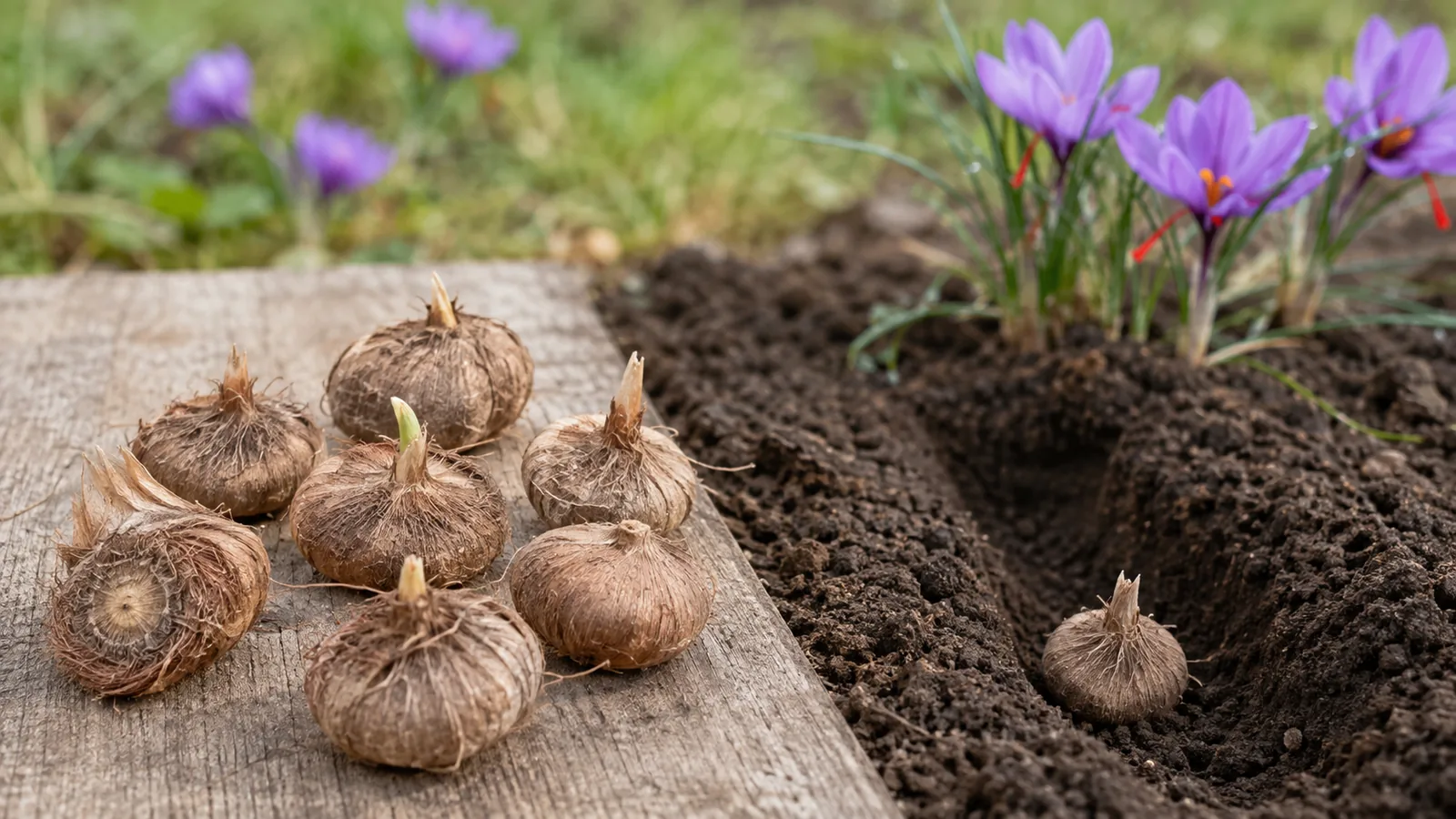
What is a saffron corm?
The corm of saffron is a short, swollen underground stem. It stores the energy and buds needed for the next cycle of roots, leaves and flowers. Garden shops often call it a saffron bulb because that word is familiar, but botanically it is not a true layered bulb such as an onion or tulip.
The outside is wrapped in a dry brown fibrous tunic. Beneath it, a sound saffron corm is pale and solid, with a flatter basal area where roots emerge and one or more buds towards the top. The tunic offers physical protection during handling and dormancy; it does not make a waterlogged or diseased corm safe to plant.
Crocus sativus is propagated through corms rather than ordinary garden seed. Listings for “saffron seeds” may refer to a different crocus, another plant entirely, or an inaccurate product name. Confirm the botanical name before buying. Our overview of the anatomy of saffron explains how the corm, flower and red stigmas relate to one another.
How to recognise healthy saffron corms
Begin with condition, not size alone. When sellers advertise “healthy saffron bulbs,” confirm that they mean Crocus sativus corms. Healthy saffron corms should feel firm for their weight, with no wet patches, deep cuts, crushed base, sour or musty smell, or visible fungal growth. A loose piece of dry outer tunic is not automatically a problem. Soft tissue beneath it is.
Inspect a batch rather than only the best-looking corm on top. Reject or isolate corms with:
- soft, sunken or watery areas;
- white, green or black mould;
- tunnels, webbing, insects or extensive feeding damage;
- a missing or badly damaged basal plate;
- unexpectedly high surface moisture;
- an off odour or signs of overheating in transit.
Do not accept a corm merely because it has been rehydrated to increase its weight. Added surface water can hide shrivelling and raises the risk of damage in storage. A dormant corm may look dry on the outside while remaining firm inside.
What is a good saffron corm weight?
The often-quoted 8–13 g range is a useful commercial buying bracket, especially when a grower wants corms likely to flower without paying for the very largest grade. It is not a universal definition of quality. Diameter, cultivar material, health, intended density and growing conditions all affect the result.
Research consistently shows that mother-corm size influences flowering. A three-year study of 27 weight grades found that larger starting corms generally produced more flowers and fresh stigma than smaller ones, while the best management cycle depended on whether the goal was flowers or large daughter corms. The paper also describes roughly 8–16 g as a common commercial planting range; its results do not support a claim that every corm below 8 g will fail or that 13 g is an upper optimum. See the peer-reviewed study on mother-corm size, flowering and stigma production.
Ask a seller to state both size grade and measurement method. Weight is easy to compare, but a fresh heavy corm and a damp heavy corm are not equivalent. For a farm trial, record the average weight of saffron corms by lot and keep smaller propagation stock separate from the grade intended for near-term flowers.
When to buy and plant saffron corms
Buy dormant corms close enough to planting time that they do not spend unnecessary weeks in storage. Planting is generally done in late summer before the local autumn growth and flowering period, but the calendar changes with climate. The familiar mid-August to September window is suitable in many northern locations, not a rule for every country.
The University of Vermont’s North American Center for Saffron Research and Development advises its regional home growers to plant as soon as possible in August or early September rather than holding corms until spring. Its home-gardener planting guide is useful evidence for that climate. Growers elsewhere should use local soil-temperature, rainfall and winter guidance rather than copying a northern date without adjustment.
If the shipment arrives before the bed is ready, unpack and inspect it promptly. Hold sound dormant corms in a cool, dry, shaded and well-ventilated place for the shortest practical period. Do not seal damp corms in plastic, expose them to direct sun, or place them beside ripening fruit and strong-smelling chemicals.
Choose a site with excellent drainage
Saffron tolerates dry summer dormancy far better than standing water around the corm. Choose a sunny site with soil that drains freely after rain. A raised bed can help where the native soil is heavy, but it still needs an outlet for excess water; a raised box sitting over compacted wet ground is not automatically well drained.
Loosen the planting area and remove perennial weeds before the corms go in. Add mature compost only as the soil and a local soil test justify. Fresh manure in direct contact with corms is a poor substitute for a planned fertility programme.
How to plant saffron corms
Place each corm with the flatter basal plate down and the pointed bud end up. If the shape is unclear, set it on its side rather than forcing a damaged base into the soil. Cover it gently and mark the row so emerging shoots are not mistaken for grass.
- Prepare a sunny, weed-free bed with free-draining soil.
- Sort out soft, mouldy or badly damaged corms.
- Plant the selected corms at a depth and spacing suited to your climate and production goal.
- Firm the soil lightly without compacting it.
- Water to settle the soil when conditions are dry, then avoid keeping the bed saturated.
Planting depth and spacing
There is no single correct depth for every saffron field. Penn State Extension gives home gardeners a practical starting point of 3–4 inches deep and 3–4 inches apart, while the Vermont guide uses a depth around 6 inches for its colder northern conditions. Both emphasise drainage. The appropriate choice changes with winter exposure, soil texture, bed design, corm size, machinery and whether the priority is flower yield per area or daughter-corm development. Compare the Penn State saffron growing guidance with your local extension advice before settling on a layout.
Controlled studies also show interactions between corm size and planting depth rather than one measurement working everywhere. A recent open-access experiment on corm size and planting depth is a useful reminder to treat published numbers as conditions to test, not universal promises.
The saffron corm life cycle
After planting, roots and narrow leaves emerge as the seasonal cycle begins, and mature corms can produce purple flowers in autumn. Each flower carries three red stigmas. These are harvested carefully and dried to make the culinary spice.
The leaves continue feeding the underground plant after flowering. Do not cut healthy green foliage simply to tidy the bed; let it yellow and die back naturally. The original mother corm is gradually replaced as daughter corms form around it. That is why a saffron planting expands even though the crop is not grown from conventional seed.
A well-managed bed may remain productive for several years, and 5–8 years is sometimes quoted for a planting. This does not mean one unchanged corm is harvested for eight seasons. Crowding, daughter-corm size, disease pressure and declining flower numbers determine when the bed should be lifted and divided. Penn State suggests division every 4–6 years as a general home-garden guide; commercial systems may use shorter cycles for specific production goals.
When and how to divide a saffron corm bed
Lift corms during dormancy after the foliage has died back. Work carefully so a fork or spade does not slice through the cluster. Separate daughter corms, brush away loose soil, and sort them by health and size. Discard rotting material rather than returning it to the bed.
Replant sound corms promptly when the local schedule allows. If they must be held, keep lots labelled and ventilated. Long-stored corms are not automatically diseased, but every extra week creates more opportunity for desiccation, premature sprouting, pests or fungal damage.
Greenhouse and indoor saffron corms
Greenhouse production still depends on a seasonal plant. A roof does not remove the need to manage temperature, light, airflow, rooting space and dormancy. Moisture is important, but “keeping the corm dry” is not a complete greenhouse programme: roots need appropriate water during active growth, while persistent saturation and wet foliage increase disease risk.
Density and depth also affect the outcome. Packing corms closely may raise flower count per square metre while reducing space available to each plant and its daughter corms. A grower should decide whether the current cycle is intended to maximise stigmas, multiply planting stock or test a new environment, then record the response instead of promising a yield from corm weight alone.
Questions to ask before buying saffron corms
- Is the plant identified as Crocus sativus?
- Is the grade stated by weight, circumference or diameter?
- When were the corms lifted, and how have they been stored?
- Can the seller show representative corms from the actual lot?
- Are there local plant-health or import requirements?
- Does the quoted price include delivery, inspection and losses?
A “saffron corm price” is meaningless without country, currency, date, size grade, order quantity and health condition. The price in Turkey, Iran, Europe or North America can differ for reasons that have nothing to do with biological quality. Compare like with like, and do not let a low per-corm figure hide undersized or poorly stored stock.
Common saffron corm problems
The corm does not flower in its first season
Small starting size is one possibility, but it is not the only one. Late planting, poor establishment, unsuitable seasonal temperatures, deep shade, damaged buds, excess water or disease can also prevent flowers. Keep the foliage healthy and review the whole site before blaming the corm grade.
The corm becomes soft
Softness usually calls for immediate inspection. Stop watering, check drainage and separate affected corms from firm ones. Do not cut rot away and return a questionable corm to a commercial lot without a plant-health assessment.
Leaves appear but flowers do not
This can happen when corms are still building size, when planting conditions favour vegetative growth, or when the seasonal cycle is wrong for the site. Allow green leaves to finish their cycle, note the corm size at the next dormant inspection, and adjust only one or two management variables at a time.
The best saffron corm is therefore not simply the heaviest one in a catalogue. It is correctly identified, healthy, suited to the intended system and planted into well-drained soil at the right local time. Protect those basics first; size then becomes a useful planning variable rather than a guarantee.

![Exporting Saffron to Turkey + Price Guide [Complete 0 to 100]](https://img.rowhanisaffron.com/20260827003933/saffron-export-turkey-quality-inspection.webp)



