


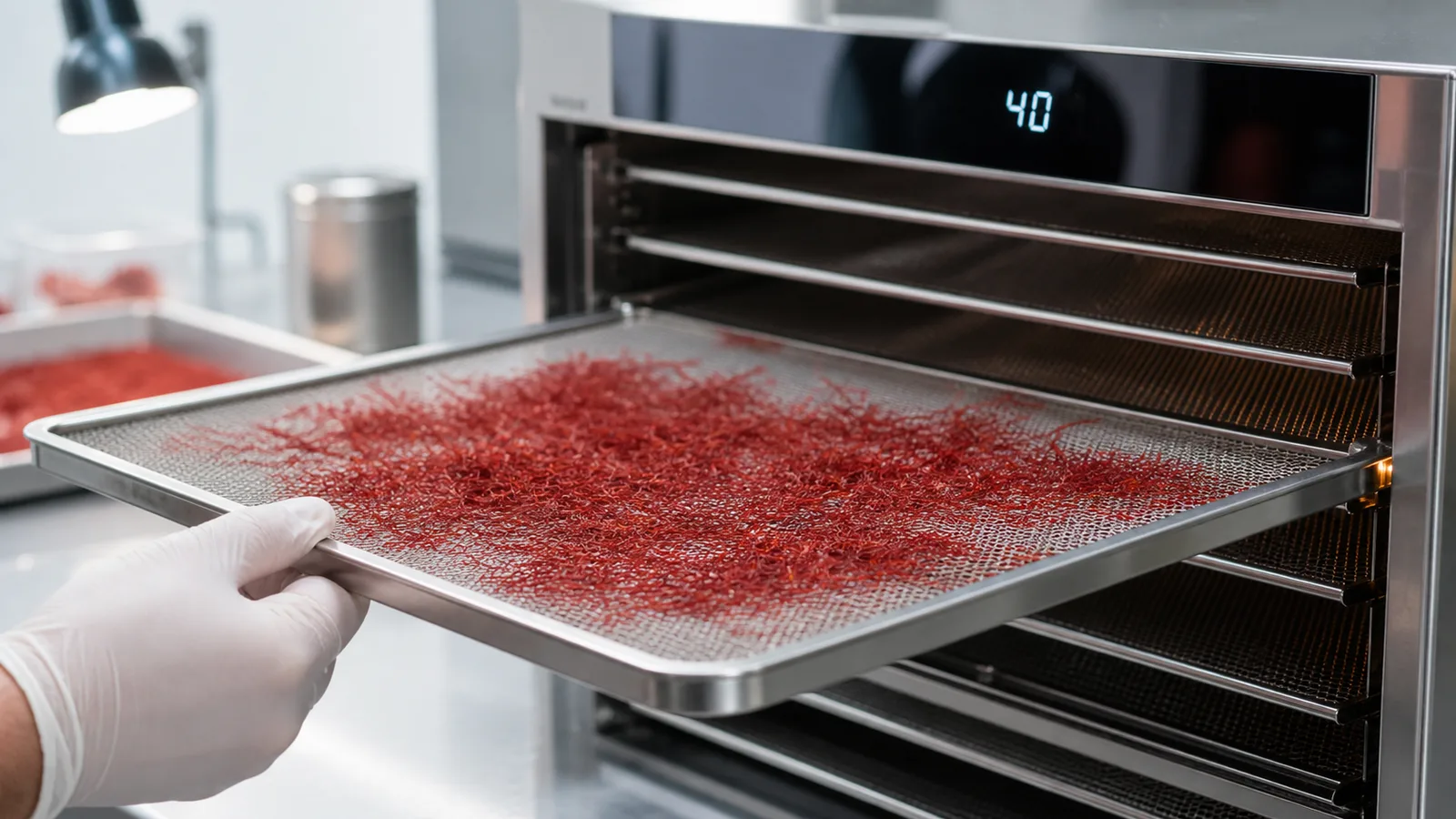
The best method for drying saffron is the one that controls temperature, airflow, cleanliness, time, and final moisture consistently. For most small producers, a calibrated food dehydrator or forced-air tray dryer offers the best balance. A carefully monitored oven can work for a small batch. Microwave drying is fast, but it needs a validated procedure because uneven heating can damage the spice.
Drying does more than preserve harvested stigmas. It helps develop saffron’s characteristic aroma and influences its color, taste, microbial stability, and storage life. No method is automatically superior simply because it is traditional or modern.
Why saffron must be dried promptly
Freshly separated saffron stigmas contain enough moisture to deteriorate quickly. Delayed or uneven drying creates opportunities for microbial growth, discoloration, and unwanted odors. At the other extreme, excessive heat can darken the stigmas and alter volatile and color compounds.
Picrocrocin contributes to saffron’s bitter character and acts as a precursor involved in forming safranal, an important aroma compound. Crocin-family compounds provide the intense color. Research shows that drying conditions change the balance among these constituents, which is why speed alone is not a quality standard.
Before drying: harvest and preparation
- Collect flowers in clean, food-safe containers and keep them out of direct sun.
- Separate the stigmas as soon as practical in a clean, dry work area.
- Remove visibly damaged plant material and foreign matter without washing the stigmas.
- Arrange the saffron in a thin, even layer. Clumps trap moisture and dry unevenly.
- Record the batch, harvest time, start time, equipment setting, and operator.
Hands, trays, tools, and contact surfaces should be clean. Keep insects, dust, smoke, cleaning chemicals, and strong odors away from the spice.
Modern saffron drying methods
Controlled dehydrator or forced-air tray dryer
This is the most practical choice when repeatability matters. Heated air moves across shallow trays while temperature and time are monitored. Commercial equipment may also control humidity and airflow.
The advantage is not the machine itself; it is the ability to reproduce a tested process. Sensors should be calibrated, trays should not be overloaded, and representative samples should be checked across the chamber because the warmest and coolest positions may differ.
Electric oven drying
A small batch can be dried in a clean electric oven with accurate low-temperature control. The frequently repeated instruction to use 50–60°C for 30–40 minutes is only a starting range, not a universal guarantee. Oven temperature, layer thickness, airflow, stigma moisture, and tray material change the outcome.
Use a separate calibrated thermometer, spread the threads in one layer on a food-safe tray, and check them frequently. Avoid direct contact with heating elements and do not assume the dial temperature equals the temperature at the saffron. A fan-assisted oven may dry more evenly, but it can also blow very light stigmas unless the tray is designed for them.
Microwave drying
Microwave energy can shorten dehydration from hours or days to minutes. Peer-reviewed work shows that microwave conditions can preserve useful quality characteristics when power, load, time, and sample arrangement are controlled.
It is not a simple “high power for a few minutes” method. Domestic microwaves create hot and cold spots, and a tiny load can overheat quickly. Producers should use a validated protocol for the specific equipment and batch size, then verify the product analytically. Without that control, a microwave is a higher-risk option than a calibrated dryer.
Industrial drying machines
Industrial systems can process larger quantities with logged temperature, humidity, airflow, and residence time. They reduce manual exposure and can improve batch consistency. They do not eliminate human error: loading depth, maintenance, sanitation, sensor calibration, and packaging still determine the result.
Traditional saffron drying
A traditional method spreads saffron on clean cloth, paper, mesh, or a fine screen in a shaded, ventilated place. Some processes take 3–4 days. The low equipment cost is attractive, and experienced producers can obtain good saffron in a suitable climate.
The drawbacks are variable temperature and humidity, slower moisture removal, exposure to dust and insects, and difficulty reproducing one batch after another. Slow drying can increase mold risk when the air is humid. Traditional drying is therefore not automatically poor, but it requires clean protected space, active monitoring, thin layers, proper airflow, and conditions that reliably remove moisture.
How to compare the methods
- Dehydrator or forced-air dryer: best general option for controlled, repeatable small-to-medium production.
- Electric oven: accessible for a small batch, but only with independent temperature checks and close supervision.
- Microwave: fastest, but highly dependent on equipment-specific validation and uniform loading.
- Industrial system: suitable for high throughput when sanitation, sensors, process records, and maintenance are robust.
- Traditional shade drying: low cost and potentially effective in favorable conditions, but harder to control and protect.
Profitability comes from usable, consistent saffron rather than the shortest advertised drying time. A fast process that scorches part of the batch or leaves wet spots increases loss.
How to know when saffron is dry
Properly dried threads feel dry and light, separate readily, and do not show damp clumps or condensation after cooling. Color and aroma should be characteristic, not brown, smoky, or musty. A simple touch or bend test is useful for process monitoring but cannot prove compliance.
For commercial production, verify moisture and volatile matter using an appropriate laboratory method and test the characteristics relevant to ISO 3632. Color, bitterness, and aroma measurements help compare batches, while microbiological and contaminant controls address food safety. A quoted ISO category should be supported by a report tied to the specific batch.
Cooling and packaging after drying
- Move dried saffron to a clean protected area.
- Allow it to cool before sealing; packing warm threads can trap condensation.
- Transfer it promptly into airtight, food-safe, light-protective packaging.
- Label the batch and drying date so any quality issue can be traced.
- Store it in a cool, dry, dark place away from strong odors.
Do not leave dried saffron exposed while waiting to package a larger batch. It can absorb moisture and surrounding odors. See our saffron storage guide for post-drying handling.
A sensible drying plan
Start with a published or professionally developed procedure suited to the equipment. Run a small trial, document every setting, test samples from different tray positions, and change one variable at a time. Once the method produces safe, consistent saffron, define acceptable ranges and keep records for every batch.
Modern saffron drying methods are valuable because they make control possible, not because technology guarantees quality. Clean handling, even loading, measured conditions, protection from scorching or burning, prompt cooling, protective packaging, and verification are what turn a drying method into a reliable process.

![Exporting Saffron to Turkey + Price Guide [Complete 0 to 100]](https://img.rowhanisaffron.com/20260827003933/saffron-export-turkey-quality-inspection.webp)



