


Iran is the largest producer of saffron in the world. Recent FAO statements place Iran’s share at roughly nine-tenths of global output, while the country’s main growing belt remains concentrated in the three Khorasan provinces. Production leadership, export rankings and batch quality are related, but they are not the same measure.
How large is saffron production in Iran?
A September 2025 FAO report said Iran produces more than 90% of the world’s saffron. A later FAO account from November 2025 used a range of 85–90%. Those official figures are close enough to support a clear conclusion: Iran remains the dominant global producer, but “about 90%” is more responsible than presenting one permanent decimal.
The percentage changes with Iran’s harvest, crops in other countries and the year attached to the estimate. Different reports may also use different production calendars. This is why claims that Iran produces exactly 85%, 90% or 96% should always carry a source and date.
It is harder to give one current tonnage for Iran saffron production from a globally harmonised database. Saffron is not reported as consistently as larger crops, and production, customs exports and retail sales are often confused. A quantity exported during a calendar year is not necessarily the amount harvested in that year.
Where is saffron grown in Iran?
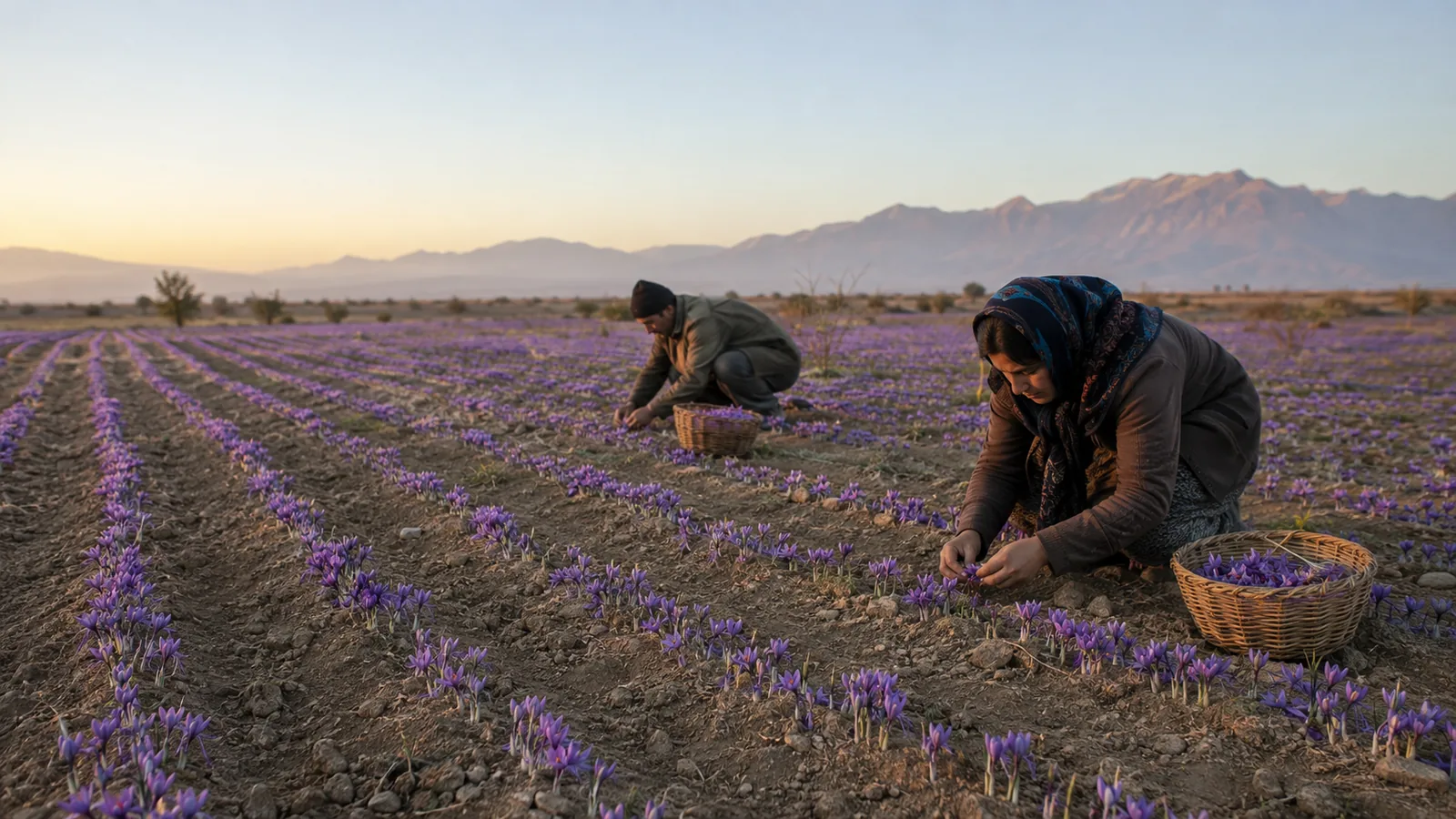
Saffron cultivation in Iran is centred in the northeast. Khorasan Razavi, South Khorasan and North Khorasan are the principal provinces named in FAO’s current work with Iranian farmers, processors and laboratories. The crop also grows in other provinces, including parts of Yazd, Kerman, Fars, Isfahan and Lorestan, but on a smaller scale.
Khorasan Razavi saffron production
Khorasan Razavi contains major growing and trading centres such as Torbat Heydarieh, Gonabad, Kashmar, Taybad and areas around Mashhad. Its combination of experienced farm communities, corm stocks, dry summers, cold winters, processing capacity and trade infrastructure explains its central role.
Older Ministry of Agriculture-Jahad data reproduced in a 2017 Codex project paper put Razavi Khorasan at 218.348 tonnes in 2014–15, far ahead of the other provinces listed. That historical figure explains repeated references to the province producing around four-fifths of Iran’s crop at the time. It should not be relabelled as a current Razavi Khorasan saffron production percentage.
South Khorasan saffron production
South Khorasan is another core production area, particularly around Qaenat, Birjand, Ferdows and Sarayan. The same historical Ministry table reported 48.019 tonnes in 2014–15. Current FAO material still identifies South Khorasan alongside Khorasan Razavi as a centre of saffron farming and rural knowledge.
North Khorasan and newer production areas
North Khorasan contributes a smaller but established crop. Production has also spread to suitable dry regions elsewhere in Iran. Expansion alone does not guarantee yield or quality: soil drainage, corm health, irrigation timing, labour availability and post-harvest handling remain decisive at farm level.
Rafsanjan saffron production is sometimes searched for as though it were a separate national category. Rafsanjan is in Kerman province, where saffron is grown, but the historical 2014–15 Ministry table reported 2.632 tonnes for Kerman province as a whole; it did not publish a Rafsanjan-specific total. A current figure should not be invented from the provincial number.
How saffron is produced
Saffron comes from the dried red stigmas of Crocus sativus. The plant is propagated through corms rather than seed. A field remains in production for several seasons, although the useful life and yield pattern depend on corm density, soil, disease pressure, climate and local management.
- Site and corm preparation: growers choose well-drained ground, prepare the soil and plant healthy corms at a depth and spacing suited to their conditions.
- Seasonal irrigation: carefully timed water helps trigger growth and flowering. Saffron is associated with dry regions, but that does not mean a crop succeeds without planned irrigation.
- Flower harvest: purple flowers are picked by hand, usually early in the day during a short autumn flowering period. A delay can expose the delicate material to heat, contamination or physical damage.
- Stigma separation: workers remove the red stigmas from each flower. The amount of attached yellow style influences familiar Iranian commercial cuts such as Negin, Sargol and Pushal.
- Drying: controlled drying reduces moisture while trying to retain the compounds associated with colour, aroma and taste. Excessive heat can damage quality; insufficient drying raises storage risk.
- Sorting and testing: processors remove foreign matter, group the product by specification and may test moisture, colouring strength, aroma-related measures, residues, microbes and authenticity.
- Packaging and storage: the dried threads need protection from humidity, strong light, heat, oxygen and contamination before sale or export.
The work is labour-intensive because flowering is brief and the usable part of each flower is so small. Mechanisation can assist with field preparation, cleaning, drying and packing, but careful flower picking and stigma separation still rely heavily on people.
Which countries produce saffron?
Iran leads saffron production in the world by a wide margin. Afghanistan, India—especially Kashmir—Greece, Morocco and Spain also have recognised saffron-growing sectors. Smaller or newer crops exist in countries including Italy, Azerbaijan, China and the United States.
A neat “top 10 saffron producing countries” list can be misleading when it combines estimates from different years. The same caution applies to any saffron production by country comparison. Some figures measure dried saffron, others cultivation area or exports, and national reporting is uneven. The defensible comparison is that Iran is the largest producer, while the order and volumes below it need a dated, like-for-like source.
The country of origin does not by itself determine the best saffron. A protected local origin may carry cultural and traceability value, but quality still varies between fields, harvest dates and batches. Buyers need evidence about identity, moisture, foreign matter, colour strength, aroma, storage and food-safety compliance rather than a country-only ranking.
Production is not the same as export
Iran can lead global production without appearing first in every export table. Customs data measure what a reporting country declares as crossing its border under a product code. They do not capture all domestic consumption, informal movement, inventory changes or later re-exports by an importing country.
The latest complete Iran-reporter row available on World Bank WITS for HS 091020 is 2022. It records Iranian gross saffron exports of 215,879 kg worth US$201.69 million. The leading destinations in that table were the United Arab Emirates, Spain and China. Iran has no reporter row on the same WITS page for 2023 or 2024, so substituting another country’s mirror data without saying so would give a false impression of precision.
Spain and the UAE can import, pack, distribute and re-export Iranian-origin saffron. Packaging in another country does not change where the flowers grew. Nor does re-export prove that all saffron shipped from that country is Iranian; Spain, for example, also has genuine domestic production. This distinction matters when asking for the biggest exporter of saffron rather than the biggest producer.
What determines Iranian saffron quality?
Iranian saffron has the potential to be excellent, but “Iranian” is not a laboratory grade. Two lots from the same district can differ because of harvest timing, separation, drying temperature, moisture, age and storage. Negin, Sargol and Pushal describe thread composition and presentation; none guarantees a particular analytical result by name alone.
International trade commonly refers to ISO 3632 methods for characteristics such as colouring strength, bitterness-related compounds and aroma-related measures. Those tests help describe a sample, but they are not a complete authenticity system. In 2025, FAO and Mashhad University announced work on stronger saffron fingerprinting and post-harvest guidance, noting risks from adulteration and inconsistent handling.
For a buyer, a credible specification should identify the batch and origin, state the thread form or cut, define measurable acceptance limits and explain which laboratory methods were used. Appearance alone cannot establish origin, purity or food safety.
Why saffron matters to Khorasan
Saffron suits a seasonal farming calendar in parts of arid and semi-arid Iran and can create high value from a small dried volume. Its value chain supports growers, seasonal flower pickers, stigma separators, drying and processing facilities, laboratories, packers, traders and exporters.
That value is not evenly distributed. Yield risk, labour cost, water access, price volatility and the bargaining power of intermediaries can all affect what reaches a farm household. A high retail price per kilogram does not mean every producer receives a high or stable return.
Gonabad’s qanat-based saffron system is recognised by FAO as a Globally Important Agricultural Heritage System. It illustrates how the crop is connected to water management, community knowledge and a long agricultural tradition, not simply to a luxury-product label.
Challenges facing Iran’s saffron industry
- Climate and water pressure: heat, drought, poorly timed irrigation and extreme weather can reduce flowering or yield.
- Corm and field health: disease, pests, overcrowding and declining corm vigour affect productivity over successive seasons.
- Labour concentration: many flowers must be collected and separated during a short period, creating a seasonal workforce challenge.
- Post-harvest consistency: uneven drying, hygiene or storage can weaken otherwise good raw material.
- Authenticity and trust: adulteration and ambiguous origin claims damage confidence across the entire category.
- Trade friction: payment constraints, sanctions compliance, exchange rates, freight, testing and import rules influence market access.
- Value capture: bulk sales can leave more packaging, branding and distribution margin outside the producing community.
These issues require more than a new label. Better field records, defined drying protocols, lot-level traceability, capable laboratories, reliable packaging and honest origin communication all contribute. Our separate guide to the main challenges facing saffron exports examines the trade side in more detail.
The outlook for global saffron production
Other countries will continue building local production, particularly where saffron offers a high-value crop for suitable dry climates. Iran’s scale, knowledge and established supply chain are difficult to reproduce quickly, so diversification of world production does not imply the end of Iranian leadership.
The more important question is how much verified value reaches the market. Consistent post-harvest handling, authenticity testing, transparent origin, practical product formats and long-term buyer relationships can matter as much as adding hectares. Production leadership is strongest when it is supported by evidence a buyer can verify.
For now, the concise answer remains stable: Iran is the world’s largest saffron producer, Khorasan is its production heartland, and current official estimates put Iran’s share at about 85–90% or slightly more. Exact tonnage, provincial percentages and exporter rankings should always be tied to a named year and dataset.

![Exporting Saffron to Turkey + Price Guide [Complete 0 to 100]](https://img.rowhanisaffron.com/20260827003933/saffron-export-turkey-quality-inspection.webp)



