


The hardest part of exporting saffron is not finding a country where people know the spice. It is delivering a documented, compliant and consistent lot at the agreed time, then receiving payment through a workable financial channel. Market knowledge, quality testing, packaging, logistics, currency risk and trust all meet in the same sale.
This article began as a report from a Birjand Chamber of Commerce meeting about South Khorasan, Spain and Afghanistan. Its figures describe that period around 2019; the practical export challenges remain useful, but they must be separated from current tariffs, prices and shipment requirements.
The main saffron export challenges
- Limited knowledge of the destination market and its buyers
- Inconsistent grade, testing or compliance documentation
- Late delivery and insufficient stock close to the customer
- Packaging and branding that do not suit the sales channel
- Language and commercial-communication gaps
- Banking, settlement and export-proceeds constraints
- Exchange-rate and saffron-price volatility
- Weak traceability and overreliance on bulk re-export markets
These issues are connected. A seller who does not know the buyer’s grade, label and delivery expectations cannot quote accurately; a good quote is still unusable if payment or shipment cannot be completed.
1. Understanding the destination market
“Spain” is not one saffron customer. A bulk importer, spice blender, supermarket supplier, restaurant distributor and direct-to-consumer brand want different pack sizes, documents, margins and delivery schedules.
Before offering a lot, an exporter should identify the buyer type, intended use, expected grade, annual volume, preferred Incoterm, test documents, packaging language, shelf-life expectations and whether the buyer will resell the saffron under another brand.
Damon Afkari, identified in the original meeting report as the liaison of Iran’s embassy in Spain, placed lack of destination-market knowledge first among the challenges facing saffron exports. That remains a better starting point than sending the same catalogue and price to every prospect.
2. Proving saffron quality consistently
A visual sample is not enough for a repeat commercial relationship. Buyers need a lot definition, traceability and test results that correspond to the saffron actually shipped.
The current ISO 3632-1:2025 saffron specification applies to dried saffron in filament, cut-filament and powder forms. Its publication does not replace destination-country food law, but it gives exporters and buyers a common product specification to discuss.
A practical file can include lot code, harvest and packing dates, origin, form, net weight, storage conditions, laboratory certificate, supplier and processor identities, and records connecting the sample to the final shipment. Tests and labels must be renewed when the lot changes.
3. Meeting EU and Spanish food requirements
Spain is part of the European Union, so EU food-safety, contaminants, hygiene, traceability and labelling rules matter alongside any Spanish procedures. Requirements can also vary with product form, packaging and origin.
The European Commission’s Access2Markets food and plant-product guidance explains that foodstuffs of non-animal origin entering the EU must meet official-control and food-safety requirements. Exporters should use its trade assistant with the correct commodity code and current origin/destination details rather than rely on an old generic checklist.
Afkari’s list included non-compliance with international standards and tests. The commercial consequence is wider than a failed border check: incomplete documentation can delay release, shorten remaining shelf life and make a buyer less willing to reorder.
4. Delivering on time
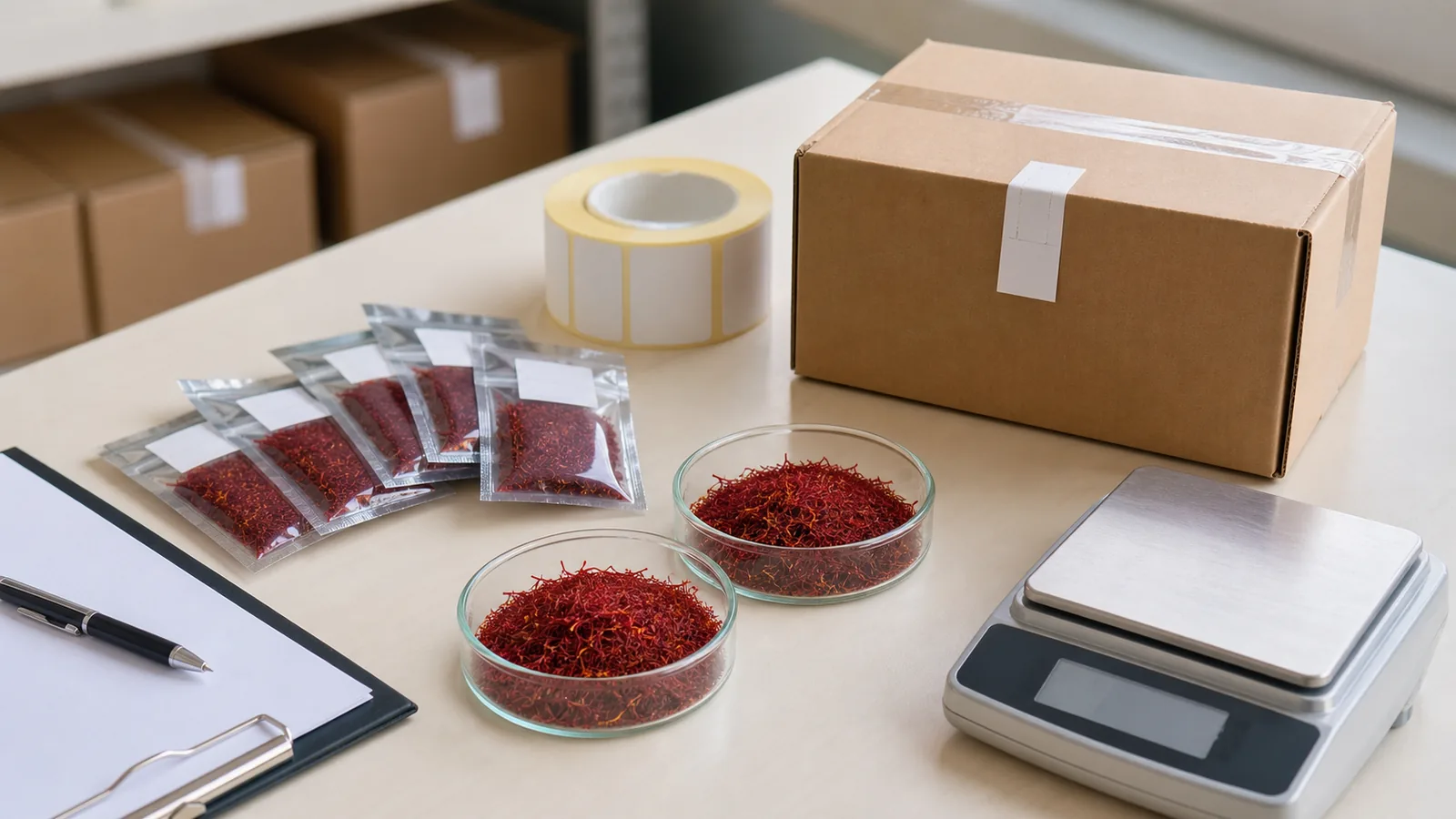
Saffron is light, but reliable logistics still require planning. The exporter must allow for testing, certificates, packing, customs processing, transport, buyer inspection and possible document correction.
The Birjand meeting proposed holding inventory in Spain to reduce delivery time. A local stock point can help regular customers, but only if ownership, importer responsibility, storage conditions, insurance, tax, unsold stock and lot rotation are clear.
Late delivery is especially damaging for seasonal promotions and food-production schedules. Promise a date from the whole process, not from courier transit time alone.
5. Building a brand that survives re-export
The meeting also proposed packaging in Spain under an internationally registered brand. That may suit a partnership or local distribution model, but it is not the only route. Iranian packing at origin can work when it meets the buyer’s legal and commercial requirements.
The strategic question is where value is created and who owns it. Bulk sales may move volume quickly; consumer packs can preserve origin and brand value but add marketing, compliance, inventory and customer-service costs.
Labels and claims must be designed for the target market, not translated word for word. Product name, origin, net quantity, lot, best-before date, responsible operator and storage instructions need review by the importer or a qualified compliance adviser.
6. Managing payment and currency risk
The historical report referred to difficulty returning export currency, sharp exchange-rate changes and the absence of a reliable mechanism for receiving money. Those constraints can make a profitable invoice unworkable by settlement day.
Before shipment, both parties should agree the invoicing currency, payment milestone, bank charges, compliant payment route, documents that trigger payment and responsibility if a transfer is delayed. Currency exposure should be calculated for the interval between buying saffron and receiving cleared funds.
This is a legal and banking matter as well as a sales matter. The exporter and buyer need current professional advice for sanctions, customs and financial compliance; an old news report cannot authorise a payment route.
7. Handling volatile saffron prices
Afkari also named unstable saffron prices as a barrier. A fixed customer price is difficult to maintain when farm, wholesale and currency values move at different speeds.
A quotation should specify grade, lot, quantity, validity period, currency, delivery term and whether testing, packing, insurance and freight are included. That turns “the saffron price” into an offer a buyer can actually compare.
Longer relationships can use scheduled volumes or an agreed review mechanism. They still require a clear definition of what triggers a price change; vague promises create disputes rather than stability.
What the 2019 Spain figures said
The meeting cited Spain’s 2019 industrial production at more than $421 billion and imports at more than $378 billion, with mineral fuels and related products accounting for a reported 13.78 percent of imports. It also cited China and other Asian countries at 21.7 percent of Spanish imports.
One translated sentence said Iran’s share of Spanish exports was “two hundred percent.” That is impossible and no reliable correction can be inferred from the stored text, so it is rejected rather than silently changed to a guessed number.
For saffron, the report gave Spanish exports of about $47 million and 287 tonnes, and imports of about $32 million and 54 tonnes, including 44 tonnes from Iran. Those figures are preserved as meeting statements, not current market totals. The large difference between reported import and export tonnage also needs the original dataset, commodity code and scope before analysis.
The meeting further mentioned a medicinal-plant market of roughly $96 million and 25,000 tonnes. That was used to encourage South Khorasan producers to introduce other regional products, but it should not be treated as a present-day opportunity estimate.
South Khorasan as an eastern trade corridor
Alireza Khamehzar of the Birjand Chamber’s Export Commission said South Khorasan handled more than one third of Iran’s exports to Afghanistan and described the province as a route into that market.
The report also gave wider provincial customs totals for the first four months of its year: $186.113 million and about 1.049 million tonnes, up 98 percent in value and 43 percent in weight from the comparison period. These are all-goods customs figures in the article, not saffron figures.
Another passage mentioned 1,573 export declarations worth $35,648,138 and a translated weight of 473,407 tonnes. Its time frame and scope are unclear. The figure is retained here only as an unresolved statement from the meeting and should not be combined with the national saffron numbers.
A practical pre-export checklist
- Confirm the commodity code, destination and latest import requirements.
- Define the buyer, channel, grade, form, quantity and pack format.
- Test the actual lot and connect the certificate to its traceability records.
- Approve compliant label copy before printing commercial quantities.
- Agree price validity, currency, Incoterm, payment route and bank charges.
- Build testing, documents, customs and inspection time into delivery.
- Protect saffron from moisture, heat, light, contamination and lot mixing.
- Keep a sample and complete shipment file for claims or repeat orders.
The most important challenge facing saffron exports is coordination. Quality, rules, payment, delivery and branding cannot be solved by separate promises made after a buyer is found. They need to be designed as one export offer, checked against the destination’s current requirements and delivered consistently enough to earn the next order.

![Exporting Saffron to Turkey + Price Guide [Complete 0 to 100]](https://img.rowhanisaffron.com/20260827003933/saffron-export-turkey-quality-inspection.webp)



