


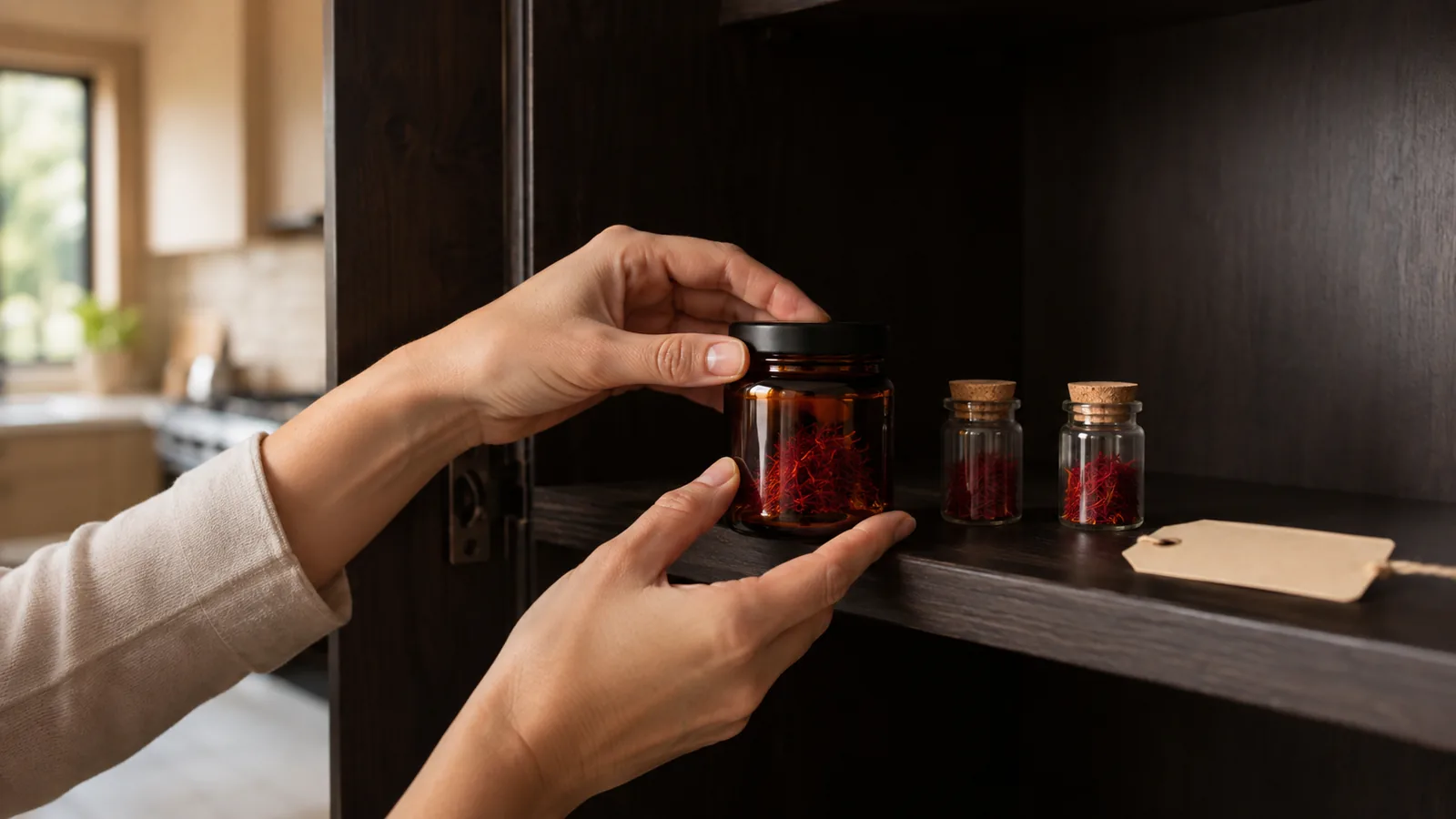
Saffron Storage Methods work when they control four things: moisture, light, heat and air. For most homes, keep dry threads in a small airtight container inside a cool, dark cupboard. Refrigeration is optional rather than automatic; if you use it, prevent condensation by keeping the jar sealed until it returns to room temperature.
Best Methods for Storing Saffron
The best way to store saffron is simple: leave most of it as whole threads, use a clean dry container with a tight seal, keep the headspace small, and place it away from the cooker, window and sink. Open the main jar as rarely as practical. If you bought a larger quantity, divide it into several small containers so one portion handles the repeated exposure.
These directions concern dried saffron spice, also called kesar—not fresh flowers or planting corms. “How to store saffron bulbs” is a different agricultural question involving dormancy, temperature and disease control.
Understanding saffron’s chemical components
Three groups of compounds are commonly used to discuss saffron quality:
- Crocins contribute the yellow-gold colour.
- Safranal is an important part of the characteristic aroma.
- Picrocrocin contributes bitterness. It is sometimes misspelled “Picocrocin.”
They do not stay fixed forever. A peer-reviewed review of saffron compounds and commercial quality describes the influence of temperature, humidity, oxygen, light, drying and storage time. A separate study comparing fresh and two-year-stored samples found that storage time changed saffron’s chemical profile. That is why storage is mainly about slowing quality loss, not preserving a jar unchanged indefinitely.
How to store saffron at home
- Keep it away from direct natural or artificial light.
- Do not leave it beside an oven, hob, radiator or other source of excessive heat.
- Keep dry saffron away from steam, wet spoons and moist conditions.
- Use a tight-fitting lid and close it promptly after measuring.
- Keep it away from strong-smelling substances and open spice containers.
- Write the opening date on the package and keep the original lot information.
Use a clean dry spoon or tweezers rather than damp fingers. If you grind saffron, remove only the amount needed and close the thread jar before cooking starts.
Best Containers for Storing Saffron
A good container is food-safe, non-reactive, airtight and easy to clean. It should either block light or sit inside a dark cupboard. Small glass jars with sound lids work well in a cupboard; amber glass adds light protection. Metal containers can also work when the inside is food-safe, dry and not rusty, and the lid is genuinely tight.
Material alone does not decide the result. A loose metal tin is worse than a well-sealed glass jar, while clear glass left on a sunny shelf defeats the purpose. Thin bags are convenient for transport but are easily punctured and may not provide a reliable moisture or aroma barrier after opening.
Choose a container close to the quantity being stored. Less empty space means less air is exchanged each time the lid opens. For bulk saffron, portioning also protects the unopened reserve from kitchen humidity.
Does saffron need to be refrigerated?
No. Properly dried threads do not normally need refrigeration when the home has a cool, dry, dark cupboard. Room-temperature storage avoids the condensation that can form when a cold jar is opened in warm, humid air. In other words, the answer to “should saffron be refrigerated?” is usually no, unless room conditions are consistently unsuitable.
The fridge can help in a persistently hot home where no stable cool cupboard exists, but only if the saffron is in a fully airtight, moisture-resistant container. Keep it away from strong foods and the refrigerator door, where temperature changes are frequent.
Can I store saffron in fridge conditions safely?
Can saffron be stored in refrigerator or fridge conditions? Yes, with careful handling. Divide it into small sealed portions, refrigerate those portions unopened, and remove one at a time. Let the closed container reach room temperature before opening it. This prevents warm room air from depositing moisture on cold threads.
The same answer covers common questions such as “can saffron be kept in the fridge?”, “can I keep saffron in fridge?”, “can we keep kesar in fridge?” and “should kesar be kept in fridge?” Refrigeration is an environmental workaround, not a freshness guarantee. A wet seal, frequent opening or food odours can make it the worse option.
Can you store saffron in the freezer?
Dry saffron can be frozen in an airtight, moisture-proof portion when long storage is unavoidable, but the freezer is not automatically better than a sound cupboard. Repeated opening, thawing and refreezing create the same condensation risk as refrigeration.
If you store saffron in the freezer, use several small packets or jars. Remove one portion, leave it sealed until fully at room temperature, and do not return that opened portion to the freezer. This directly answers “can you freeze saffron?” without turning freezing into a default recommendation.
How long can saffron be stored?
There is no universal date at which every dry thread suddenly becomes unusable. Quality declines at different rates according to the original drying, seal, temperature, light, humidity and opening frequency. Follow the producer’s date and local labeling requirements.
“Up to two years” is a practical quality horizon often used for carefully stored dried saffron, not a guarantee for every jar. Buy an amount you are likely to use within that period and compare color and aroma over time. Whole threads generally keep their character better than pre-ground saffron because less surface is exposed.
The old claim that saffron never truly spoils is too broad. Dry spices may remain usable after their best-quality period, but moisture, insects, mould, a damaged package or contamination can make a product unsuitable. A date cannot overrule what you see and smell.
How to preserve saffron for long time
For long-term preservation, begin with a dry, fresh batch and reduce how often the reserve is opened. Keep one small working jar and leave the other portions sealed. Record the lot, purchase date and opening date. Store the reserve in the coolest stable dark cupboard available; use a refrigerator or freezer only when the room environment makes that necessary and condensation can be controlled.
The current ISO 3632-1 saffron specification covers dried filament, cut-filament and powder forms and includes storage and transport recommendations. A supplier handling commercial volumes should follow its documented storage programme rather than relying on a household rule.
Proper Storage of Bulk Saffron
Bulk saffron needs more control because a single container may be opened many times and a small failure affects a valuable quantity. Use food-grade barrier packaging or sealed containers in a clean, dry, odour-controlled area. Keep cartons off floors and away from walls where condensation or pests may go unnoticed.
Monitor storage temperature and relative humidity, keep lot identities separate, and use stock in a planned order. Sample or laboratory checks should be representative of the lot. Never mix a damp or questionable batch into sound saffron to make it disappear.
Saffron storage conditions and temperature
The right saffron storage temperature is stable and cool rather than one universal number for every package. Avoid hot shelves and daily swings. Where to store saffron depends on the room: choose a dark interior cupboard in a temperate, dry home, or a carefully sealed cold-storage portion where heat and humidity cannot otherwise be controlled.
Best Ways to Store Ground Saffron
Ground saffron has more surface exposed to oxygen, light and humidity, and it is harder to inspect for foreign material. Grind a small amount near the time of use. If powder remains, transfer it immediately to the smallest suitable airtight opaque container and keep it in the same cool, dark, dry conditions as threads.
Do not store powder in an open mortar, paper sachet or a clear shaker near the stove. Avoid dipping a steaming spoon into it. The comparison of grinding and preparing saffron for cooking explains how to make a small batch without exposing the whole supply.
Best Method for Storing Dried Saffron
For dried threads, keep the product whole, sealed and dark; for dried powder, reduce the quantity and storage time. Neither form benefits from routine exposure to air. Inspect the seal whenever you open the jar and replace a cracked lid or damaged liner.
Best Way to Store Dissolved Saffron
Once saffron is dissolved or brewed in water, treat it as prepared food rather than a shelf-stable dry spice. Cool it promptly in a clean covered container and refrigerate it at 4°C/40°F or below. Make only what you expect to use soon.
Do not keep homemade saffron water in the refrigerator for two weeks. General official guidance says to refrigerate prepared leftovers promptly and use them within three to four days; ingredients added to an infusion may require an even shorter period. Discard it sooner if it develops cloudiness, gas, mould, an unusual smell or a damaged seal.
Freezing dissolved saffron in an ice cube tray
For portions you will not use within a few days, freeze the cooled infusion promptly in a clean covered ice cube tray. Once solid, transfer the cubes to a labeled airtight freezer container so they do not absorb odours or dry out. Thaw only the amount needed and use it in cooking rather than repeatedly refreezing it.
Freezing saffron water for a short planned period is a quality and convenience choice, not a validated “two weeks” safety guarantee. The recipe’s other ingredients and hygiene still matter. For preparation options, see the guide to brewing saffron with hot water or ice.
Effect of Light on Saffron’s Quality
Light can contribute to pigment degradation, so the easiest protection is an opaque container or a dark cupboard. Artificial light deserves the same practical caution as direct sunlight when a clear jar is displayed for weeks. There is no culinary advantage to leaving saffron visible on the counter.
Heat, oxygen and moisture interact with light. Solving only one exposure is not enough: an opaque jar beside a hot oven or a dark tin with a loose lid is still poor storage.
When stored saffron should be discarded
Fading aroma or weaker color usually signals quality loss, so the product may simply need replacement for better cooking. Discard it rather than testing it in food if you see mould, insects, damp clumps, unexplained oily residue, a leaking container or foreign material, or if it smells musty or otherwise wrong.
If a refrigerated or frozen jar was opened while cold and the threads became damp, do not hide the problem by grinding them. Check the whole portion carefully. When in doubt about contamination, replacement costs less than trying to rescue a questionable food.
Saffron storage checklist
- Keep dry threads whole until needed.
- Use a small, clean, airtight, food-safe container.
- Protect it from light, heat, steam and strong odours.
- Choose a stable cupboard unless climate makes cold storage necessary.
- When using the fridge or freezer, let the sealed portion warm before opening.
- Store ground saffron briefly and dissolved saffron as prepared food.
- Label portions with the lot and opening or freezing date.
- Discard saffron with moisture, mould, pests or an abnormal smell.
The best Saffron Storage Methods are consistent rather than complicated. To understand how to keep saffron fresh, focus on a sound seal, dry handling, darkness and a stable cool setting; manage condensation if you use cold storage, and treat a water infusion as perishable. Those habits preserve more of the colour, fragrance and flavour you paid for.

![Exporting Saffron to Turkey + Price Guide [Complete 0 to 100]](https://img.rowhanisaffron.com/20260827003933/saffron-export-turkey-quality-inspection.webp)



