


Saffron for Cooking is sold under names such as Negin, Sargol, Pushal and Bunch, but these categories describe how much red stigma and pale style remains and how intact the threads look. They do not, on their own, prove purity, freshness or flavour. The useful choice is the genuine form that suits the dish, budget and way you plan to measure it.
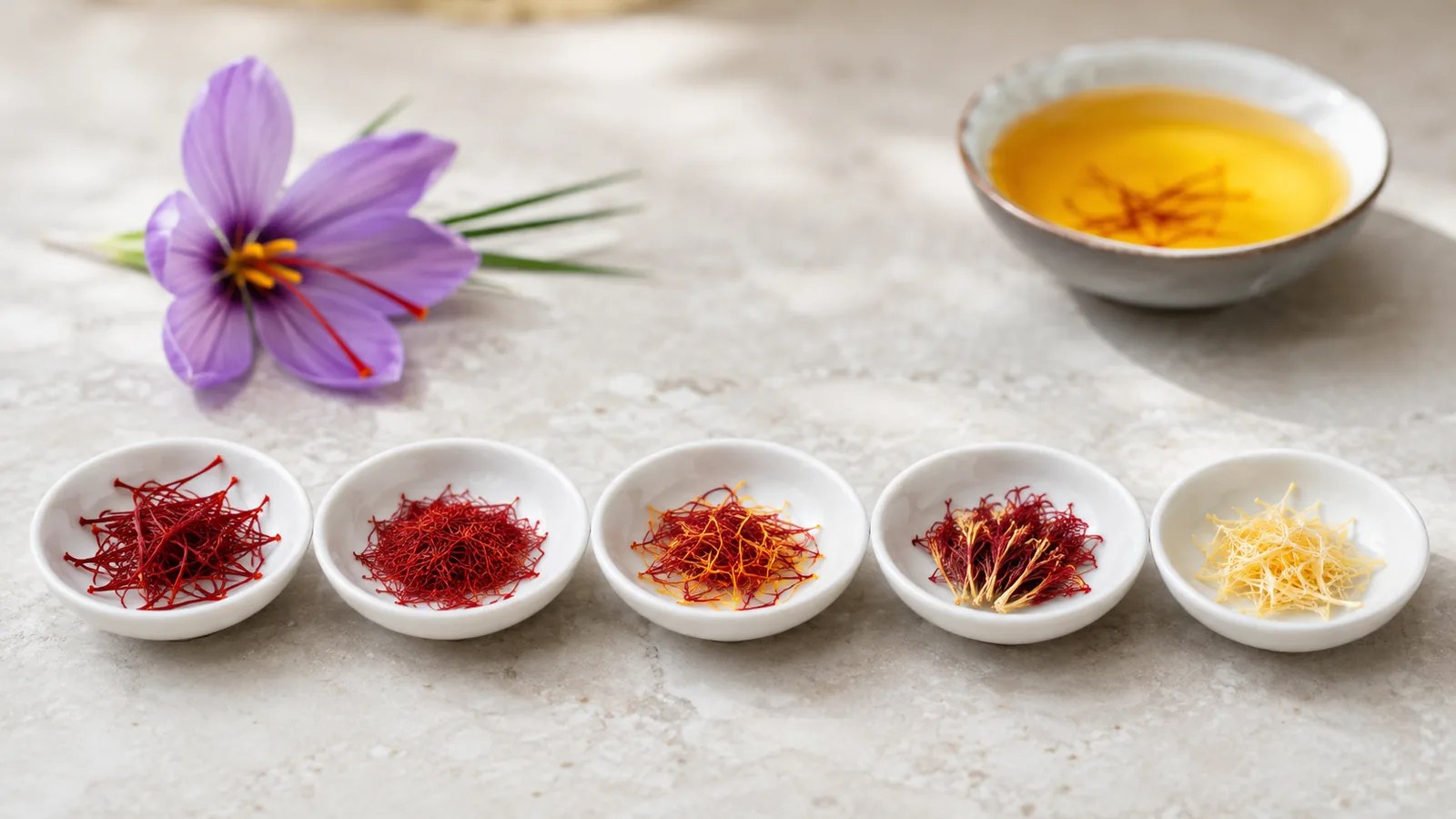
Saffron Categories Overview
Iranian trade terminology usually separates saffron into a few visible forms. Spelling varies between sellers, and names are sometimes translated literally. This overview uses the most recognisable terms while retaining the alternatives a shopper may see:
- Negin or Super Negin: long, mostly intact red stigma branches with little or no pale style.
- Sargol: separated red stigma tips, usually shorter and more likely to include broken pieces.
- Pushal or Poushal: red stigma attached to a short section of yellow or orange style.
- Dasteh, Dokhtar-pich or Bunch: fuller stigma-and-style threads traditionally arranged together.
- Konj or “root”: the pale style separated from the red stigma; it is not the plant’s botanical root.
Powder is a form rather than a visible thread category. It is convenient for recipes, but its structure cannot be inspected in the way whole threads can.
Start with the stigma and style
The terminology becomes easier once the flower anatomy is clear. Each saffron flower has three red stigma branches. Lower down, those branches meet a style that becomes orange, yellow and then pale. Harvesters and processors cut or separate different portions to create commercial presentations.
- Stigma: the red portion valued most for the colour, bitter taste and characteristic aroma associated with culinary saffron.
- Style: the lower orange-to-white portion between the stigma and the flower’s ovary. It is part of the pistil, not a stigma and not a root.
More red stigma generally means more colouring potential per gram than a batch containing substantial pale style. Still, “the redder the thread, the higher its quality” is too simple. Drying, age, moisture, storage, adulteration and the chemistry of the batch also affect what reaches the pan.
Understanding Saffron Types and Their Quality
A peer-reviewed study of Iranian commercial saffron classification describes Sargol, Negin and Pushal as the three main local market forms and also identifies Dasteh, Dokhtar-pich or Bunch. The researchers used visible colour and texture to classify samples, yet appearance is not the whole quality assessment.
The current ISO 3632-1 saffron specification covers dried saffron in filament, cut-filament and powder forms. A serious grade claim should be tied to a representative batch result from a competent laboratory, not inferred from a product name or photograph alone.
Negin and the old “Saffron Necklace” wording
Negin is made up of long red stigma branches that are largely intact and separated from the style. Super Negin is a seller or market designation for especially long, visually uniform pieces; it is not a universal promise that overrides laboratory results.
The earlier terms “Saffron Necklace” and “Super Necklace” appear to be legacy translations used for Negin presentations. They are not widely standardised English grade names. When a seller uses either phrase, ask for the corresponding Iranian type and the actual specification instead of assuming a fixed rank.
Negin’s long, tidy appearance suits visible garnish and premium presentation. It also works in an infusion. Its intact look may command a higher price, but a beautiful thread can still be old, damp or poorly stored.
Sargol or all-red Saffron Threads
Sargol consists of the red stigma portion separated from the style. In the old wording on this page, “Saffron Threads” referred to this all-red category. Pieces may be shorter or broken; that is a presentation difference, not automatic evidence of weak flavour.
For cooking, Sargol is practical when you plan to grind and infuse the saffron. Paying extra for long display-perfect threads brings little benefit if the recipe immediately turns them into powder. What matters is an authentic, properly dried batch with good measured quality.
Saffron Poushal or Pushal
Saffron Poushal retains the red stigma with a small yellow or orange style section attached. The visible transition can help a buyer recognise the thread’s botanical structure, although it is not proof that nothing has been added.
Because some pale style contributes weight with less colouring strength than the red stigma, a cook may need a little more Pushal than an all-red batch to reach the same visual result. That does not make genuine Pushal defective. It can offer sensible value when it is fresh, clean and honestly described.
Saffron Bunch, Saffron Daughter and Dasteh
Saffron Bunch keeps a longer section of the pistil, from red stigma into yellow or pale style, and the threads are traditionally arranged in small bundles. Dokhtar-pich is sometimes translated as “Saffron Daughter.” The fuller form shows how the parts connect and involves less trimming after harvest.
A fixed claim that every Bunch sample is 70% red and 30% yellow is not reliable. Proportions vary with cutting and sorting. Bunch is often less expensive per gram than all-red Negin or Sargol, but compare the usable colouring result rather than price alone.
Saffron Roots or Konj
“Saffron Roots” is a commercial nickname for the pale style remaining after red stigmas are separated. The material did not grow underground and should not be confused with the corm or roots of the plant. It contributes much less saffron colour than the red stigma.
Some cooks use genuine style threads for a mild aromatic infusion or as a lower-cost product, but it is not interchangeable gram for gram with red culinary saffron. A seller should label it plainly. Our white saffron style threads listing shows the appearance of this specific product form rather than presenting it as red stigma.
Which category is best for cooking?
There is no single best category for every kitchen. Match the form to what the dish needs:
- Rice, stews and everyday savoury dishes: genuine Sargol or good Pushal can be practical when the saffron will be ground and infused.
- Custards, drinks and batters: a measured infusion from Sargol, Pushal or Negin distributes more evenly than scattered dry threads.
- Visible garnish and gourmet cooking: intact Negin threads give a neat presentation, although appearance does not create extra flavour by itself.
- Budget-led cooking: compare price with the amount needed for equivalent colour and aroma. Cheaper style-heavy material can cost more per finished dish if substantially more is required.
- Powder: convenient when traceability is strong, but harder for a customer to examine for foreign plant material.
Named grades are not recipes. A fresh, well-stored Pushal batch may cook better than old, heat-damaged Negin. Buy a manageable quantity and judge the infusion as well as the dry appearance.
How to compare two saffron products
Begin with like-for-like information. Check the net weight, product form, lot, origin, packing date and storage conditions. If the seller gives laboratory values or an ISO category, make sure the document matches that lot and identifies the test method.
Then inspect the threads. Negin should be predominantly long and red; Sargol red but often shorter; Pushal red with a modest attached style section; Bunch a fuller red-to-pale thread; Konj mostly pale style. Excessive moisture, mustiness, loose dye, foreign petals or an implausibly uniform imitation shape are reasons not to use the product.
A product does not become premium merely because its label says “Super,” “Necklace” or “Threads.” Those words must agree with what is in the package and with any measurable quality claim.
Prepare each type to suit the dish
For most recipes, grind a small measured amount shortly before use, then infuse it in the liquid appropriate to the dish. Fine particles expose more surface and help colour disperse; prolonged high heat can flatten aroma. Long Negin threads kept for garnish may be added separately after the main infusion.
The method is the same principle across categories, but the amount can change with the batch. Begin modestly, note the result and adjust next time rather than assuming every red thread has identical strength. The complete guide to preparing and grinding saffron for cooking explains the kitchen steps.
Buying saffron for cooking without relying on names
- Choose an accountable seller and a sealed, traceable lot.
- Prefer whole threads when you want to inspect form before buying.
- Read Negin, Sargol, Pushal, Bunch and Konj as presentation terms, not guarantees.
- Check whether the price reflects stigma content, intact appearance, testing and origin evidence.
- Ask for a batch-matched report when a laboratory grade materially affects the purchase.
- Store the product airtight, dry, cool and away from light after opening.
For a closer look at one all-red category, see the guide to Sargol saffron and related Iranian types.
Why Saffron for Cooking is valuable
Saffron contributes a distinctive golden colour, bitter edge and aroma to both traditional and modern dishes. A tiny amount can spread through a full recipe when it is ground and infused carefully. That concentration, together with the labour required to collect and separate stigmas, helps explain its value.
The best purchase is not automatically the longest or reddest thread. It is genuine saffron whose form is honestly named, whose quality has been protected, and whose price makes sense for the result you need. Once those conditions are met, Sargol, Negin and Pushal can all be excellent Saffron for Cooking.

![Exporting Saffron to Turkey + Price Guide [Complete 0 to 100]](https://img.rowhanisaffron.com/20260827003933/saffron-export-turkey-quality-inspection.webp)



