


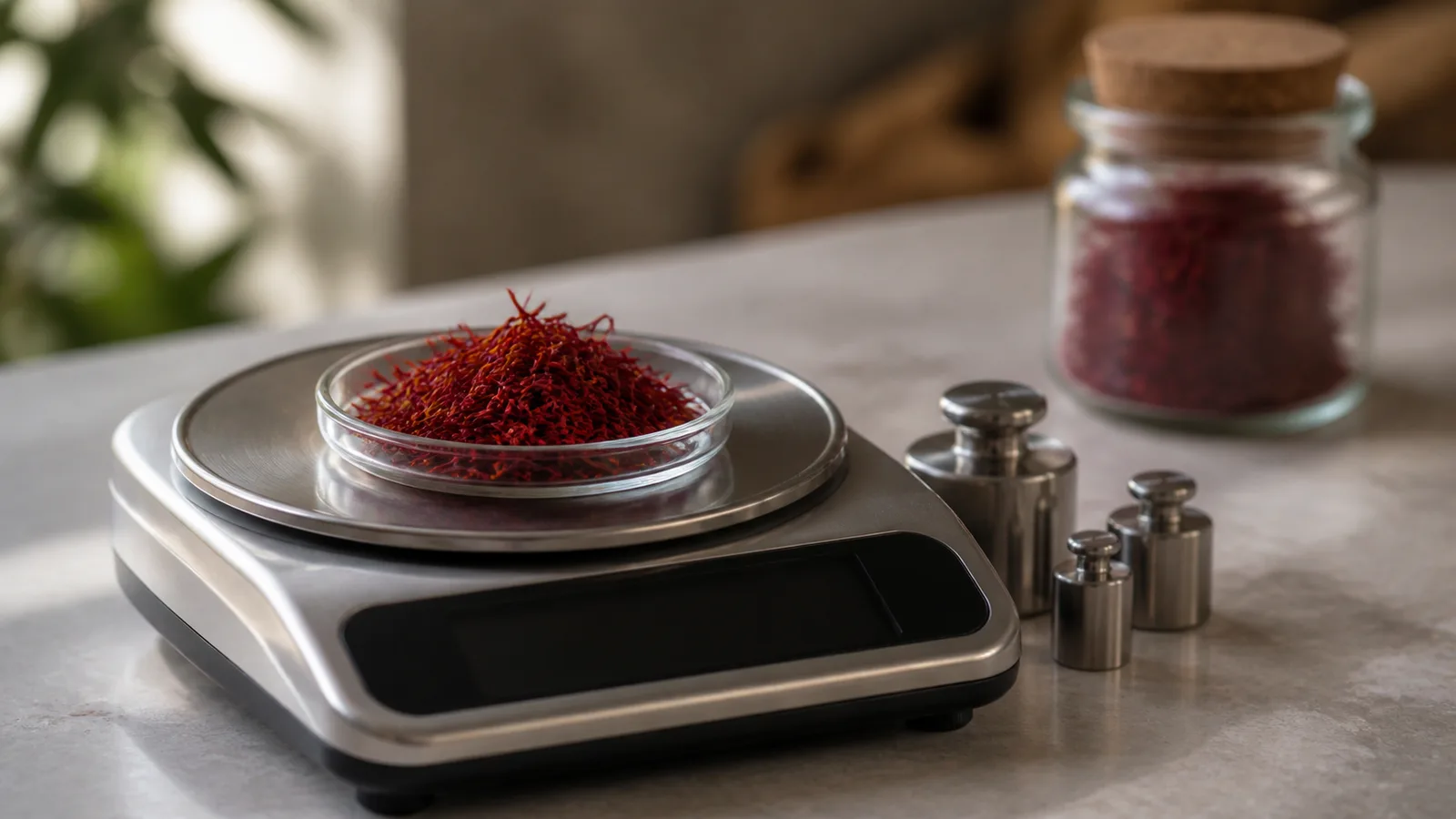
One saffron mesghal is normally 4.608 grams in Iranian trade. Sellers often round that figure to 4.6 grams for a quick quotation, but contracts, invoices, and bulk calculations should state the exact unit being used. A different unit called the Sharia or legal mesghal equals 3.456 grams, so the name alone is not precise enough.
For the usual saffron conversion:
mesghals × 4.608 = grams
grams ÷ 4.608 = mesghals
Understanding Saffron Weight Measurements: How Many Grams in a Mesghal?
The mesghal—also written misqal, mithqal, mesqal, or mesgal in English—is a traditional unit of mass used for high-value goods. In modern Iranian saffron trading, the intended unit is generally the common or sarrafi mesghal of 4.608 grams.
That convention matters because saffron is valuable even in a small package. A difference of a few tenths of a gram, repeated across many units, changes the amount delivered and the effective price per gram.
How Many Grams Does One Saffron Mesghal Weigh?
1 mesghal of saffron = 4.608 grams. If a shop rounds to one decimal place, the label may say 4.6 grams. The rounded value is convenient for conversation, but 4.608 grams is the figure to use when reproducing a precise conversion.
The following examples use the common 4.608-gram unit:
- 1 mesghal = 4.608 grams
- 2 mesghals = 9.216 grams
- 5 mesghals = 23.04 grams
- 10 mesghals = 46.08 grams
- 100 mesghals = 460.8 grams
For a mesghal-to-gram conversion, multiply by 4.608. For example, 7 mesghals × 4.608 gives 32.256 grams.
The Sharia and Sarf Mesghals
Two definitions commonly cause confusion:
- Common or sarrafi mesghal: 4.608 grams. The name refers to the money-changer or trading usage. This is the value normally meant in Iranian saffron and gold-market contexts.
- Sharia or legal mesghal: 3.456 grams. This unit appears in religious and legal calculations and should not be silently substituted into a saffron quotation.
An official table of Islamic weights lists both figures, while the London Bullion Market Association has described Iranian gold pricing in rials per mesghal using approximately 4.6083 grams. For saffron, agree on the gram equivalent rather than assuming that every country or seller uses the same historical definition.
Gram to mesghal conversion
To convert grams to the common saffron mesghal, divide the gram weight by 4.608:
- 1 gram = about 0.2170 mesghal
- 5 grams = about 1.0851 mesghals
- 10 grams = about 2.1701 mesghals
- 100 grams = about 21.7014 mesghals
- 500 grams = about 108.5069 mesghals
Keep more decimal places while calculating, then round only the final figure to the precision agreed for the sale. Repeatedly rounding 4.608 to 4.6 during a large calculation introduces avoidable error.
Calculating Mesghals in a Kilogram of Saffron
One kilogram contains 1,000 grams. Using the common trade unit:
1,000 ÷ 4.608 = 217.0139 mesghals
So a kilogram of saffron is approximately 217 common mesghals, not an undefined range of 210 to 220. If someone used the 3.456-gram Sharia mesghal, the same kilogram would contain about 289.35 of those units. That large difference is why the unit definition belongs on any bulk agreement.
Saffron measurement units beyond the mesghal
Grams and kilograms are the clearest units for an international buyer because they belong to the metric system. The mesghal remains useful when a local price or package is quoted that way. A smaller traditional unit, the nokhod, equals 0.192 gram; 24 nokhod make one 4.608-gram common mesghal.
When comparing offers, convert every package to grams first:
price per gram = quoted mesghal price ÷ 4.608
This reveals whether two packages that use different labels actually offer the same quantity and unit price.
Accurate Scales for Measuring Saffron Weight
A digital display with two decimal places is not automatically an accurate scale. The display resolution tells you the smallest step shown; accuracy also depends on calibration, repeatability, capacity, the weighing surface, temperature, air movement, and how the instrument is used.
For commercial sales, use a scale approved for trade in the relevant jurisdiction and follow its verification requirements. NIST’s Handbook 44, for example, sets technical requirements for commercial weighing devices in the United States. Rules differ by country, so a pocket scale marketed online may be suitable for kitchen estimates yet unsuitable for a transaction.
Using Gram Scales to Measure Saffron
A scale that reads to 0.01 gram is practical for many small saffron packages. A 0.1-gram scale can be adequate for rough cooking quantities, but its increments are too large when a seller needs to verify a small high-value pack precisely.
To weigh saffron consistently:
- Place the scale on a firm, level surface away from drafts and vibration.
- Turn it on and allow it to stabilize according to the manufacturer’s instructions.
- Put an empty, clean weighing dish on the platform and press tare so the display returns to zero.
- Add the saffron without touching or leaning on the platform.
- Wait for a stable reading and record the unit as well as the number.
- Check the scale with the correct calibration weight on the schedule required for the work.
A dish protects the threads and keeps loose pieces from falling into the scale. Taring removes the dish weight; subtracting it later by memory is more likely to create an error.
Digital Scales for Precise Saffron Weighing
Digital scales are popular because they are compact, quick to read, and available with fine resolution. Choose capacity and resolution together. A model designed to weigh several kilograms may not be the best instrument for a one-gram sample, while a very small precision scale can be overloaded by a bulk container.
Mechanical balances can still weigh accurately when they are in good condition and used correctly. Digital technology is convenient, but it does not replace calibration or careful technique.
How much does one saffron thread weigh?
There is no reliable universal weight for one saffron thread or stigma. Threads differ in length, cut, moisture, grade, and how much yellow style remains attached. Counting threads can help a cook repeat a recipe, but it cannot verify a commercial gram or mesghal weight.
What does a gram of saffron look like?
A gram of saffron also looks different depending on how loosely the threads are arranged and the shape of the container. Use a scale when the weight matters. For culinary technique after measuring, see our guide to using saffron in cooking.
Conclusion: The Significance of Accurate Saffron Measurement
For most saffron transactions, the answer is straightforward: one common mesghal is 4.608 grams, and one kilogram contains about 217.014 of those mesghals. The 3.456-gram Sharia mesghal is a real but different unit.
Write the gram equivalent on the quote, use an appropriate verified scale, tare the container, and round only at the end. Those small habits make saffron weight measurements clear for both buyer and seller.
References reviewed: table defining the common and legal mithqal; London Bullion Market Association discussion of the Iranian mesghal; and NIST Handbook 44 for commercial weighing devices.

![Exporting Saffron to Turkey + Price Guide [Complete 0 to 100]](https://img.rowhanisaffron.com/20260827003933/saffron-export-turkey-quality-inspection.webp)



