


Saffron in Persian literature carries more than one meaning. Its rarity and golden colour can suggest wealth, celebration and beauty; the same yellow can evoke pallor, longing or sorrow. Poetry, epic, proverbs and ritual history all draw on a spice that has long been present in Persian daily life.
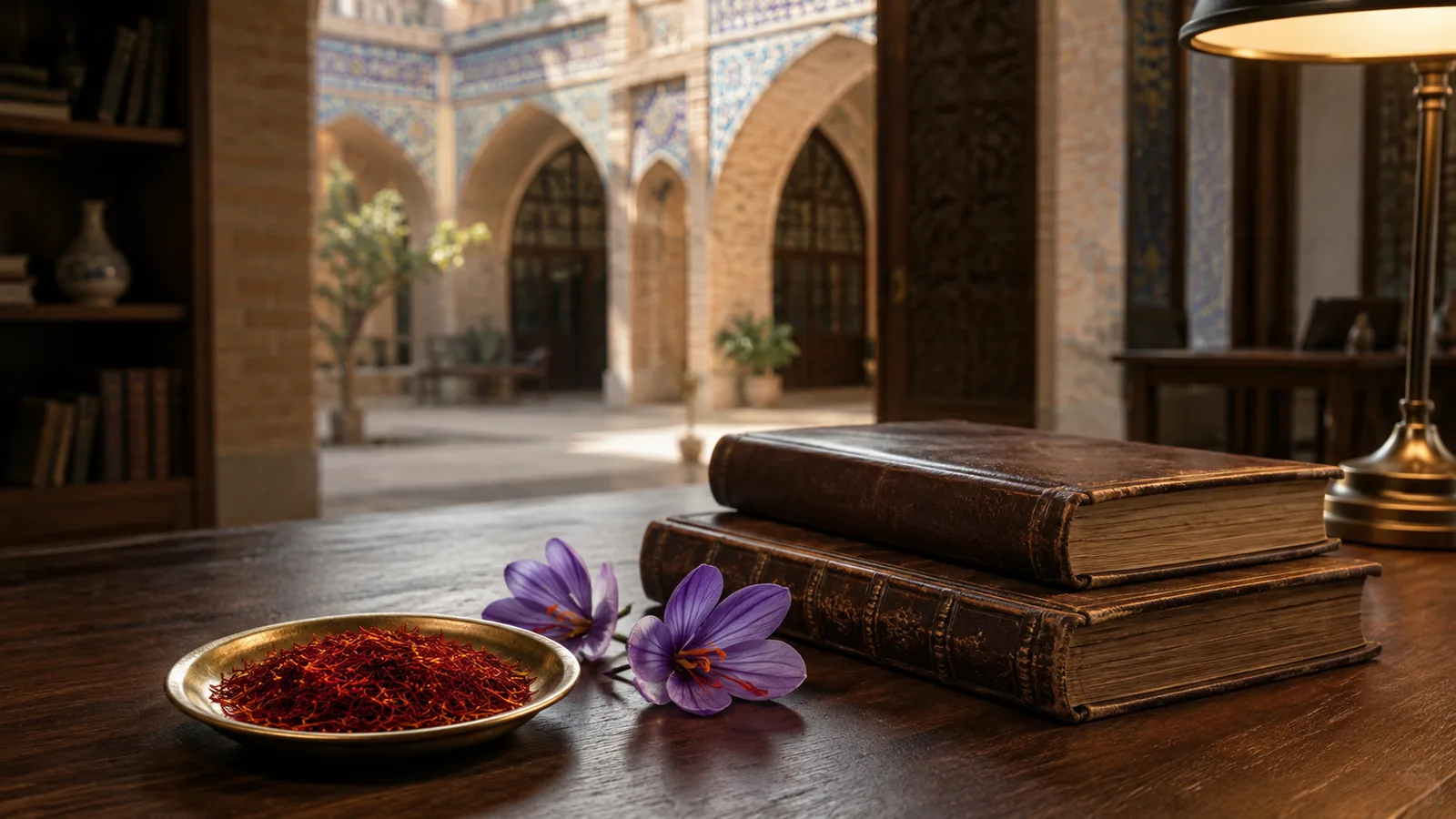
What is saffron called in Persian?
In Farsi, saffron is called za’ferān, written زعفران. English transliterations vary, so readers may also see zaferan, zafaran or za‘farān. The search phrase “saffron in Farsi” asks for this word; “saffron in Persian” can refer either to the word itself or to the spice’s place in Persian language and culture.
That place is broader than cooking. Saffron has appeared in food, fragrance, dyeing, gifts, celebrations, oral traditions and historical medical writing. Calling this medicinal value does not establish that every traditional remedy works; it tells us how people understood and used the material in their own period.
The relationship is often described as thousands of years old, but individual claims still need a dated object, text or archaeological context. A useful cultural history separates what a source actually records from the attractive stories repeated later. The overview of Iranian saffron history provides that broader timeline.
What does saffron symbolize?
Saffron does not have one permanent symbolic definition. Context changes the reading. In a royal procession, a costly aromatic may signal abundance and status. In a festive dish, its colour and fragrance may suggest hospitality, happiness or good fortune. In a poem about separation, a saffron-yellow face can indicate that the lover has become pale.
This is why summaries such as “wealth, health, and happiness” or “richness, joy, and positivity” capture only part of the tradition. They describe some uses, but not the tension that makes the image useful to a poet. Gold and yellow can be radiant; yellow skin can also convey exhaustion, illness or grief. Red tulips, roses or blood may then provide a deliberate contrast.
Colour, fragrance and value
Three physical qualities help explain saffron’s literary range:
- Colour: a small quantity stains liquid yellow-gold, giving poets an immediate image for light, gold, dyed cloth or a pale face.
- Fragrance: saffron belongs to the vocabulary of perfumed rooms, celebrations and sensual description. Words such as “heavenly” express literary praise, not proof of a particular rite.
- Cost: because genuine saffron required substantial hand labour, it could stand beside gold, jewels, musk and fine textiles as a marker of value.
A scholarly chapter on saffron and folklore documents its place in meals, gifts, stories, riddles, prayers, popular medicine and proverbs. That breadth is better evidence for cultural importance than saying every mention means the same thing.
Saffron in Ferdowsi’s Shahnameh
Ferdowsi’s Shahnameh, the Persian Book of Kings, places saffron within a material world of courts, hospitality and public display. In an English translation of the epic, processions are welcomed with saffron, musk, precious stones and gold coins. The spice helps build a scene that the audience can smell and see.
King Siavash is part of this saffron imagery. In the account of his birth and reception, streets and houses are decorated, gold is scattered, and horses are associated with saffron, wine and musk. It is more precise to describe this as a celebration surrounding Siavash than to say saffron rewards one undefined heroic triumph.
The same vocabulary appears elsewhere in the epic, including a welcome for the sons of Faridun. Readers can check the searchable Warner translation of the Shahnameh. Saffron and gold work together there as tangible signs of honour, expense and ceremonial abundance.
Saffron in Rumi’s poetry
Rumi’s saffron imagery is more inward. In A. J. Arberry’s translation, saffron-coloured cheeks and a tulip bed become part of a language of love, pallor and spiritual longing. Love does not simply make everything cheerful: it can drain the lover’s face while transforming how the world is seen.
The University of Chicago Press edition of Mystical Poems of Rumi identifies Arberry’s translation and the scholarly preparation behind it. That matters because English renderings differ, and lines shared online are often detached from a poem number or edition.
A note about a widely shared quotation
The following English lines are often circulated under Rumi’s name:
Love fell like heavy clouds on this and that,
It turned one side into saffron, the other side into a field of tulips.
This exact wording could not be matched to a reliable cited edition during this review. It should not be presented as a verified Rumi quotation without a poem number, Persian text and translator. The underlying contrast—a saffron-yellow face or landscape beside red tulips—is consistent with a wider Persian poetic colour vocabulary, but consistency is not proof of authorship.
So saffron’s connection to relief from sadness needs careful wording. A poem may move from grief toward love or joy, and historical texts may describe saffron as cheering. Neither use turns a literary metaphor into a medical treatment claim.
Saffron in Persian proverbs and sayings
Proverbs use saffron’s high value to talk about judgment. “A donkey knows not the value of saffron” is an English rendering of a documented saying: something precious is wasted on a person unable to recognize it. Related versions ask what a donkey knows of saffron’s price or compare loading the animal with saffron and hay.
The joke works because the audience already understands the difference in value. It is less a statement about the animal than a criticism of human ignorance. Folklore collections also record sayings about carrying saffron to Ghaen, the equivalent of taking an abundant local product back to its own centre of production.
The phrase “a saffron face” is more ambiguous than “cheerful and full of life.” In some contexts saffron colour can be radiant or freshly dyed; in poetry, a yellow face frequently signals grief, separation, fear or the bodily cost of love. Readers should look at the surrounding image before assigning positivity.
Religious and historical significance
Saffron has religious and historical significance across several traditions, but broad claims should not be blended into one story. Its roles have included colour, perfume, offering, adornment and an ingredient in scented preparations. A custom recorded in one time and community cannot be assigned to all Persian religion.
Zoroastrianism and fire temples
The claim that Iranian Zoroastrians used saffron in fire temples appears in popular summaries, yet this review did not find a reliable source that establishes that specific practice. Zoroastrian worship is historically associated with fire temples, but that fact alone does not prove a saffron rite. Until a primary or specialist source identifies the place, date and practice, the two ideas should remain separate.
Mecca, the Kaaba and saffron perfume
Early Islamic sources do discuss scented material at the Kaaba. A scholarly study of perfume in early Islamic pilgrimage notes khaluq, a saffron-based perfume paste, in sacred-space contexts. That is not the same as proving that Persian saffron was exported to Mecca specifically to wash the Kaaba.
The current official description of washing the Kaaba lists Zamzam water, rosewater, oud and amber; it does not list saffron. Historical perfuming, modern cleaning and the commercial origin of an ingredient are three different questions, and a careful account should not merge them.
Saffron and Persian identity today
Saffron remains visible in Persian cuisine, hospitality, farming and trade, as well as in the literature people quote at tables and celebrations. Its importance is not “undeniable” because every historical story is true. It endures because the real material connects several parts of life: a crop from particular landscapes, painstaking work, a recognizable fragrance and colour, and a vocabulary inherited through poems and sayings.
That continuity explains why saffron in Persian literature still feels immediate. Ferdowsi can use it to make royal welcome visible; Rumi can turn its colour toward longing; a proverb can make it a test of discernment. The spice carries beauty, value and well-being in some passages, pallor and sadness in others. Reading the source and its context is what keeps that rich symbolism intact.

![Exporting Saffron to Turkey + Price Guide [Complete 0 to 100]](https://img.rowhanisaffron.com/20260827003933/saffron-export-turkey-quality-inspection.webp)



