


Zaj Ab irrigation is the post-harvest watering used in some saffron-growing traditions to support the crop as its leaves develop. It can be valuable when the root zone needs water, but its timing, depth and nutrient plan should come from field conditions rather than a fixed recipe.
What is Zaj Ab watering?
Zaj Ab, also written Zaj-Ab, is a regional name for irrigation after the main saffron flower harvest. In many Iranian production schedules, that places it in late November or early December. Calendar dates shift with climate, the first autumn irrigation and the season’s flowering pattern, so the crop stage is more useful than the month alone.
By this point, the flowers have been picked and the narrow green foliage is becoming the visible part of the crop. Some growers call these “grass leaves” because of their appearance. They are not expendable: active saffron leaves photosynthesize during winter and spring while daughter corms develop below ground.
The traditional description of Zaj Ab as a mother recovering after childbirth is a memorable farming metaphor. Scientifically, the irrigation does not “restore the soil’s energy.” Its practical job is to replace a measured water deficit in the root zone and, where testing supports it, help place an appropriate nutrient application into moist soil.
Why the post-flowering stage matters
Flowering relies heavily on reserves already stored in the planted corm. After harvest, the plant enters a long vegetative period. Green leaves continue growing, roots take up water and nutrients, and replacement or daughter bulbs develop around the old mother corm. Their number, size and health influence the planting stock available for the next flowering season.
Research on saffron corm development follows the structural and metabolic changes that occur through this cycle. It supports a simple management principle: flower harvest is not the end of crop care. Protecting healthy foliage and avoiding water or nutrient stress after bloom can matter to the corms forming below it.
Decide whether the field needs water
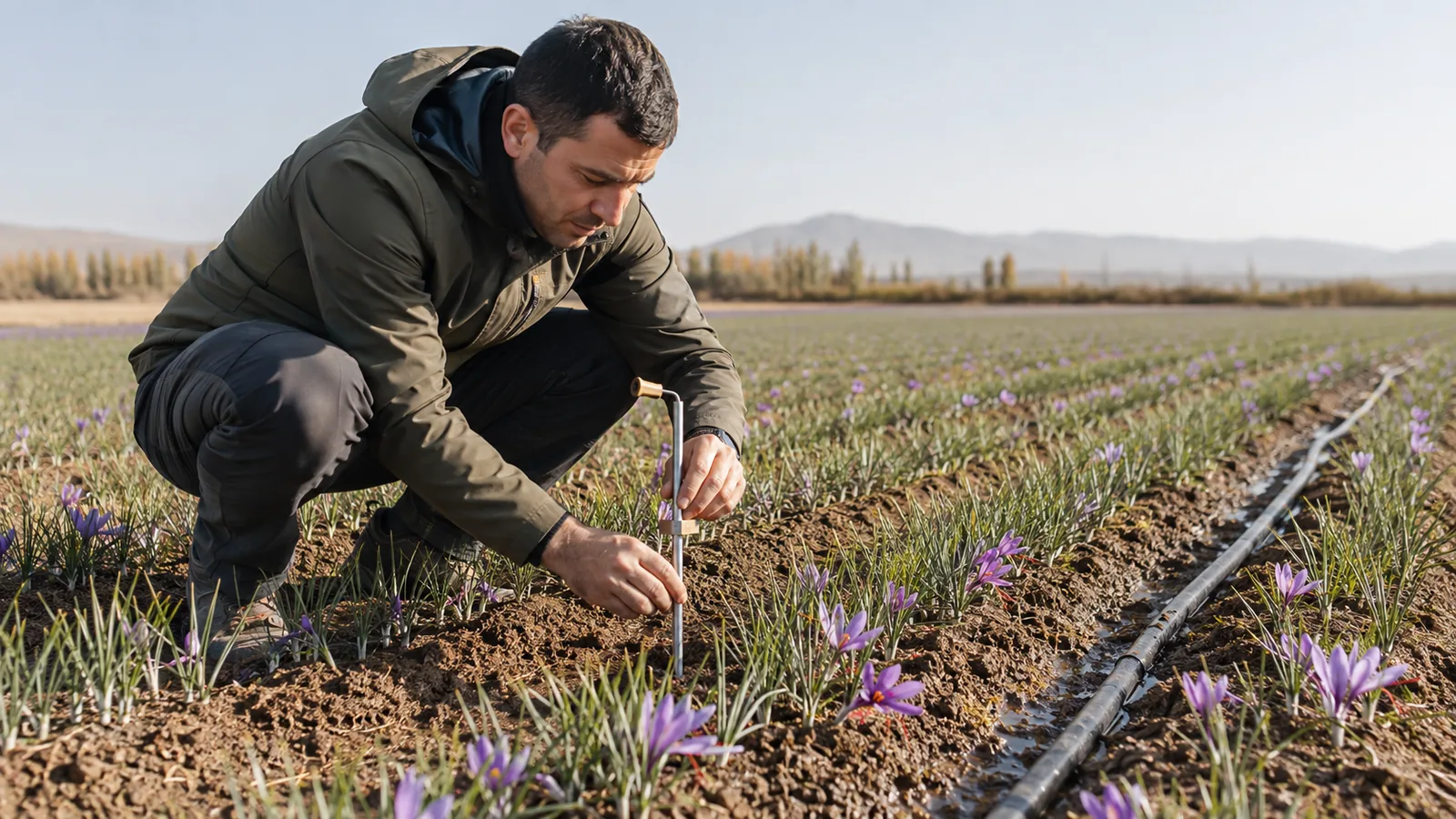
Zaj Ab should not be automatic. Check recent rainfall, irrigation history, soil texture, rooting depth and actual moisture first. A light irrigation may be appropriate in a dry, moisture-retentive field; the same volume can be unnecessary after rain or risky where drainage is poor.
Use a soil probe, auger or small inspection pit in several representative areas. The surface can look dry while moisture remains below, or look damp while the active root zone is dry. Compare strong and weak patches and note how deep the preceding irrigation reached.
“Shallow irrigation” needs a clear meaning
Traditional instructions sometimes call Zaj Ab a shallow irrigation that moistens only the surface soil because the pre-flowering watering already reached deeper layers. Taken literally, that can waste water: moisture that never reaches active roots may evaporate, encourage surface weeds or move an applied fertilizer unevenly.
The useful target is adequate, even wetting of the active root zone without prolonged saturation, deep drainage loss or runoff. That depth differs between sandy and clay soils and between drip, furrow and other irrigation systems. Observe the wetting front after a measured run time, then adjust the next event from evidence.
Do not attach a fertilizer recipe to the name
Urea and high-potassium fertilizers are often mentioned alongside Zaj Ab irrigation, but neither belongs in every field. Urea products are commonly labelled as 46% nitrogen; that concentration tells you the nitrogen content of the product, not the amount a saffron crop needs. Soil and plant testing, expected yield, organic inputs, irrigation-water quality and the rest of the annual nutrient budget must come first.
Nitrogen supports amino acids and protein synthesis and contributes to leaf growth. Healthy roots are involved in nutrient absorption, but applying extra nitrogen does not directly guarantee root development, daughter-corm weight or a better harvest. Too much can be lost below the root zone or create an imbalance, particularly when the dose and water movement are not matched.
A multi-year lysimeter study of nitrogen, irrigation and saffron systems measured both crop outcomes and nitrogen leaching. Its field conditions, rates and irrigation intervals should not be copied as a universal recipe, but the work shows why yield response and environmental loss have to be considered together.
Use potassium only where the evidence supports it
Potassium has important functions in plant water relations and metabolism. A “high-potassium” label still does not prove that a field is deficient or that post-harvest application is the right timing. Check the soil result, the laboratory’s extraction method, salinity, product analysis and any local recommendation before choosing a source and rate.
Keep a record of the product, nutrient analysis, amount per hectare, treated area and irrigation used to incorporate it. This prevents a commercial product rate from being confused with the amount of elemental nutrient. The site’s saffron farm nutrition plan explains how to organize those decisions around testing and crop stage.
How to time Zaj Ab irrigation
Use the end of the main flower harvest and the establishment of active green leaves as the starting signals. In a field that flowered normally, inspect moisture once harvest traffic has eased. Irrigate when the sampled root zone and local schedule show a deficit, not merely because the date has arrived.
If a field did not flower, the old rule is to wait until the leaves are about 10 centimeters long and dark green. Those observations can confirm that vegetative growth is underway, but 10 centimeters is not a biological switch and dark green is not proof that no more flowers can emerge everywhere. Compare with the normal flowering window for that farm, corm size, planting depth and temperature before treating the season as finished.
Separate unusually weak or non-flowering patches in the records. Water alone may not solve small corms, crowding, depth, rot, salinity or poor establishment. The broader diagnostic checks appear in the two-part flowering guide, including field management after flowering.
A measured application workflow
- Confirm crop stage. Record the last meaningful harvest date and observe leaf emergence across the field.
- Measure soil moisture. Sample the surface and the active root zone in both representative and weak areas.
- Review the forecast and drainage. Delay an event that would overlap substantial rain or leave the field saturated.
- Decide on nutrients separately. Use a current test and the annual nutrient budget; do not add urea or potassium simply because the irrigation is called Zaj Ab.
- Apply evenly. Use a known flow rate and run time, then check the wetting front rather than judging only by the surface.
- Record the result. Note water volume, treated area, fertilizer analysis and rate, weather, leaf condition and any runoff or ponding.
Common mistakes to avoid
- Using the same late-November or early-December date in every climate and season.
- Assuming a previous irrigation means the deeper soil is still wet.
- Moistening only the surface without checking whether water reached active roots.
- Applying urea or high-potassium fertilizer without a test, product calculation and annual budget.
- Keeping the field saturated in the belief that more water will create more daughter bulbs.
- Calling early leaf yellowing a nutrient problem before checking roots, drainage, salinity and disease.
What the practice can and cannot do
A well-timed Zaj Ab irrigation can maintain useful soil moisture through early vegetative growth and help an evidence-based fertilizer application work as intended. Applying only the water the root zone needs can also conserve water compared with an unmeasured event.
It cannot guarantee maximum yield, fix unhealthy planting stock or keep a saffron field productive for years by itself. Flower production reflects corm reserves, leaf duration, temperature, planting density, depth, soil conditions and the rest of the irrigation programme. Use Zaj Ab as one measured step in that system, then compare the following season’s flower count and daughter-corm distribution with the field’s own baseline.

![Exporting Saffron to Turkey + Price Guide [Complete 0 to 100]](https://img.rowhanisaffron.com/20260827003933/saffron-export-turkey-quality-inspection.webp)



