


Enhancing Saffron Flowering starts with protecting the crop through the whole season, not applying one product just before bloom. Water and salinity, healthy leaves, weed pressure, soil depth, field level and corm crowding all influence what appears at harvest.
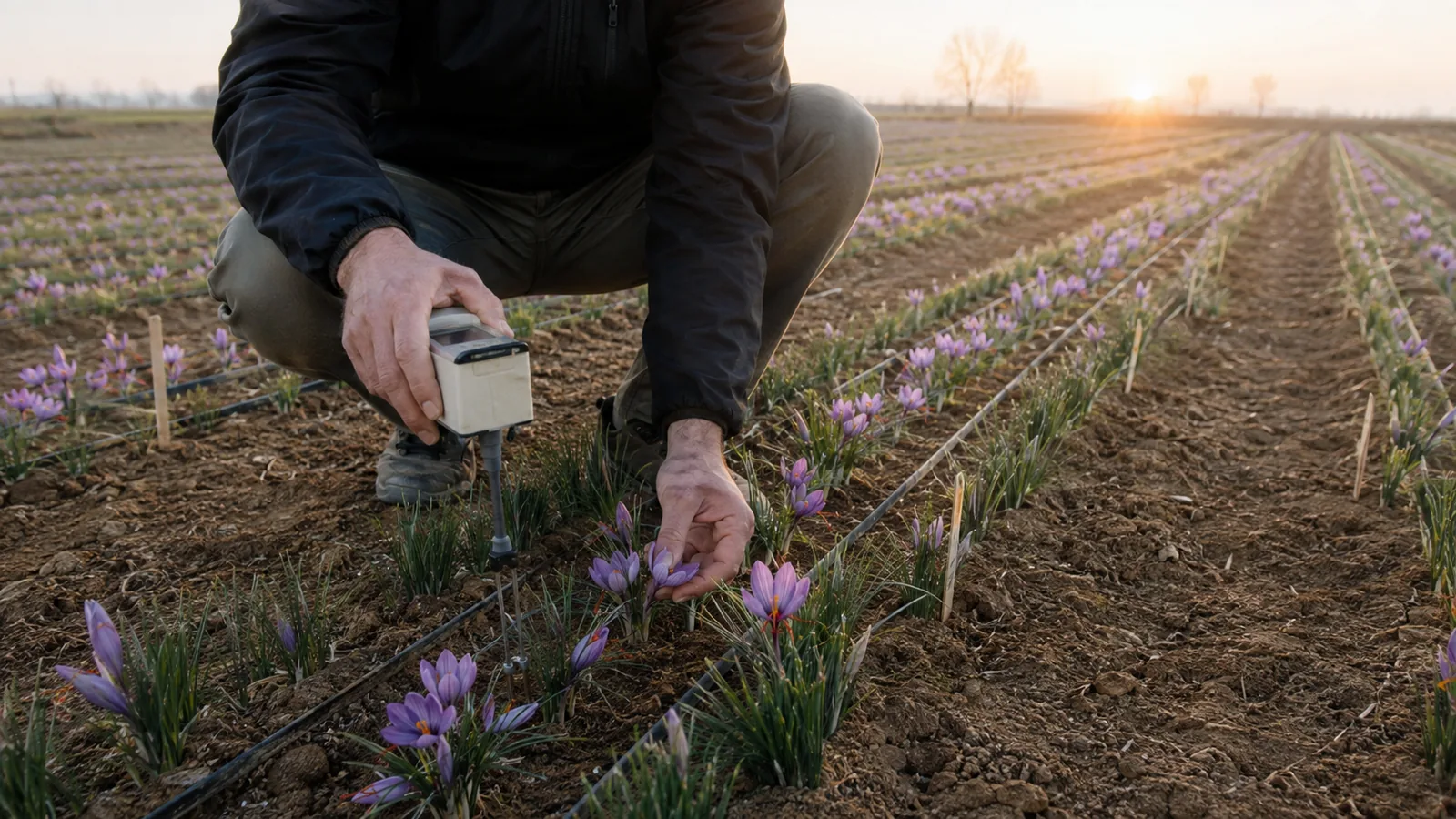
What should a grower measure?
“More flowering” can mean more flowers per square metre, a higher dry-stigma yield, a more even flowering period or larger daughter corms for the following season. Record these separately. A field can produce many small flowers without delivering the quality or future corm stock a grower expects.
Map weak patches before changing management. Compare their emergence, soil moisture, drainage, weed cover, leaf condition and corm density with healthier areas. This turns a general concern into a problem that can be sampled and tested.
This article continues the environmental and planting foundations covered in Part One of the saffron flowering guide. Here the focus is on in-season field management and the way today’s leaf and corm care affects a later crop.
1. Test water and soil salinity correctly
Electrical conductivity, usually shortened to EC, is an indirect measure of dissolved salts. Always record the sample type, method and unit. An irrigation-water result, a soil-water extract and a saturated-paste soil test are not interchangeable.
The often-repeated advice to keep “EC under 4000” is incomplete. If the unit is microsiemens per centimetre, 4,000 µS/cm equals 4 dS/m, but the practical meaning still depends on whether the value describes water or soil, when it was sampled, and how salts accumulate in that field. Do not turn the bare number into a universal saffron threshold.
Controlled saffron research has examined nutrient-solution EC values of 0.7, 1.4 and 2.1 dS/m, while multi-environment field research has not found one simple salinity-to-yield relationship across all locations. These different settings show why a measured value needs context; see the controlled EC study and the multi-environment field analysis.
What to do with a high EC result
First identify the source: irrigation water, fertilizer, poor drainage, a saline soil layer or some combination. Then ask a local soil and irrigation specialist whether leaching is feasible and where the drainage water will go. Adding water without drainage can move salts temporarily and leave the root zone no better.
2. Treat soil pH as evidence, not a target slogan
Soil pH affects nutrient availability, but the statement that saffron soil must be below pH 7.5 is too rigid. Saffron is grown in many neutral to alkaline and calcareous soils. What matters is whether the measured pH is associated with a real nutrient limitation, structural problem or amendment need in that field.
Use the laboratory’s calibrated recommendation. Do not add acidifying material merely to move a number, and do not assume a high-pH field lacks every micronutrient. Tissue analysis and crop symptoms can help test the interpretation.
3. Schedule irrigation by crop stage and soil moisture
Some production guides describe four to five irrigations per year. That may suit a particular rainfall pattern, soil and irrigation system; it is not a global rule. A sandy soil with low water-holding capacity behaves differently from a heavy field, and a wet winter may replace an irrigation that an arid season requires.
Use actual soil moisture, rooting depth, rainfall and crop stage to decide. Field studies comparing irrigation methods and intervals have produced different responses across years and settings, which is exactly why a farm should calibrate rather than copy a count.
Flower-inducing irrigation
In dry saffron regions, the first autumn irrigation is often timed to initiate growth and flowering. Timing also affects how concentrated the harvest becomes, so labour capacity matters. Irrigating too early or too late can shift emergence; the date should follow local temperature and production experience.
Zaj-Ab after harvest
The local term Zaj-Ab is often used for a post-harvest irrigation. Its purpose is to support the crop after flowers are picked and leaves are developing. Whether water is needed, and how much, depends on rainfall and the soil profile rather than the name of the irrigation alone.
Zard-Ab near leaf yellowing
Zard-Ab refers to irrigation around the period when leaves begin to yellow. Natural senescence signals the approach of dormancy, so avoid keeping a field wet by habit after active growth has ended. Confirm that yellowing is seasonal rather than the result of a patch-specific disease or water problem.
4. Control weeds before they take water and light
Late-winter and early-spring rain can produce a strong weed flush while saffron leaves are still feeding daughter corms. Remove weeds before seed set and before large roots disturb the corm zone. Shallow hand or mechanical work must avoid slicing leaves and corms.
Perennial weeds need a planned approach. Khar-e-Shotor is a regional name often associated with camelthorn, but common names can cover different species. Confirm the weed’s botanical identity before choosing cultivation, spot treatment or a legally approved herbicide. A control suitable for one species or country may be ineffective or unregistered elsewhere.
5. Keep saffron leaves until natural senescence
Green saffron leaves carry out photosynthesis and send carbohydrates toward developing daughter corms. Cutting, grazing or heavily shading them early reduces the time available for that process. Protect the foliage even after the valuable flowers have been harvested.
Do not use a fixed date for removal. Wait until the leaves have yellowed and dried naturally across the field. If one patch dies much earlier, inspect roots, corms, moisture and disease symptoms instead of treating premature collapse as normal.
Research into saffron corm development and carbohydrate allocation documents how corm growth changes through the season. It supports treating post-flowering foliage as part of next season’s production system, not as waste after harvest.
6. Evaluate mixed cropping rather than assuming it is harmless
A vigorous companion crop can compete with saffron for light, water, nutrients and working space. Barley is a particular concern when its roots and canopy are active during saffron’s leaf-growth period. It may also make weeding, inspection and harvest access more difficult.
That does not make every intercropping design impossible. If a grower is testing mixed cropping, define the purpose and compare it with a saffron-only strip. Record stigma yield, daughter-corm size, water use, labour and the companion crop’s return. Continue only if the combined result justifies the competition.
7. Add soil or sand only after testing the material
Growers sometimes add soil or sand when corms have moved closer to the surface or when they want to alter texture. Test the imported material for salinity, pH and contamination first. Unknown fill can introduce salts, weed seed, pathogens or a texture layer that restricts drainage.
Adding sand does not automatically fix heavy soil. The proportion and particle-size distribution matter, and a small amount may create an unhelpful mixture rather than a freely draining one. Research has found interactions between soil texture and irrigation interval in saffron, so changing one changes the other.
Apply an even, justified depth. Excess material can bury shoots too deeply, delay emergence and reduce aeration. Dig a few inspection points first to learn the current corm depth instead of covering the entire field by eye.
8. Level the field without compacting the corm zone
Uneven ground creates dry high spots and wet depressions under surface irrigation. Gentle grading before planting can improve distribution. In an established field, use the least disruptive method available and protect known corm depth.
Heavy machinery in summer can compact soil or crush shallow corms even when no leaves are visible. Dormancy is not an empty field. Mark traffic lanes, avoid working wet soil and check the machine’s axle load and working depth before it enters.
9. Manage field age through corm density
Saffron propagates through daughter corms, so plant density rises over successive seasons. More corms can increase flowering at first, then competition and the proportion of small corms can become limiting. Soil nutrients are only one part of that change.
The statement that production rises for exactly five years and declines after exactly eight should be treated as a field observation, not a biological timetable. Research across 1- to 8-year-old fields has documented increasing corm numbers with age, but the point at which a stand becomes overcrowded depends on planting density, corm size, depth, soil and management.
Each year, count plants or sample corms from marked quadrats. Record corm number, weight classes, depth, rot and flower density. Consider lifting, sorting and replanting when the field’s own data show crowding and yield decline, not simply because an anniversary arrives.
10. Connect flowering management to nutrition
Water, pH, salinity and leaf health all affect how plants access and use nutrients. Review them together with the soil-test approach in the saffron farm nutrition plan. Fertilizer should not be used to disguise poor drainage, corm disease, weed competition or premature leaf loss.
A field check before the next flowering season
- Map strong and weak areas and keep them as separate sampling zones.
- Record soil and irrigation-water EC with units and test method.
- Review pH alongside nutrient and tissue results.
- Schedule water from soil moisture, rainfall and crop stage.
- Identify perennial weeds before selecting a control.
- Protect green leaves until natural yellowing and senescence.
- Test any imported soil or sand before it enters the field.
- Keep heavy machinery away from wet soil and shallow corms.
- Measure corm density and size instead of using field age alone.
- Compare flower count, dry-stigma yield and daughter-corm results year by year.
Saffron flowering reflects several seasons of decisions. The safest way to improve it is to diagnose the limiting factor, make one justified change, and record what the field actually does.

![Exporting Saffron to Turkey + Price Guide [Complete 0 to 100]](https://img.rowhanisaffron.com/20260827003933/saffron-export-turkey-quality-inspection.webp)



