


Saffron Flowering Improvement begins with a careful diagnosis of the field, because a disappointing harvest rarely has one cause. Corm size and health, planting density and depth, soil structure, summer moisture and the previous season’s leaf growth can all influence the flowers that emerge.
Start with the harvest record, not the fertilizer shelf
Early December, when flowering has ended in many Northern Hemisphere production areas, is a useful time to review performance. Record the flower count, dry-stigma yield, harvest dates and labour demand. Then map the parts of the field that emerged late, produced fewer flowers or showed weak leaves. A field average can hide the pattern that explains the loss.
Do not assume that poor-quality fertilizer or an improper fertilization method caused every low yield. Dig inspection points in both strong and weak areas. Compare corm weight classes, corm number, planting depth, roots, signs of injury or rot, soil moisture and compaction. The contrast between those areas is usually more informative than a general treatment applied everywhere.
How corm size affects saffron flowering
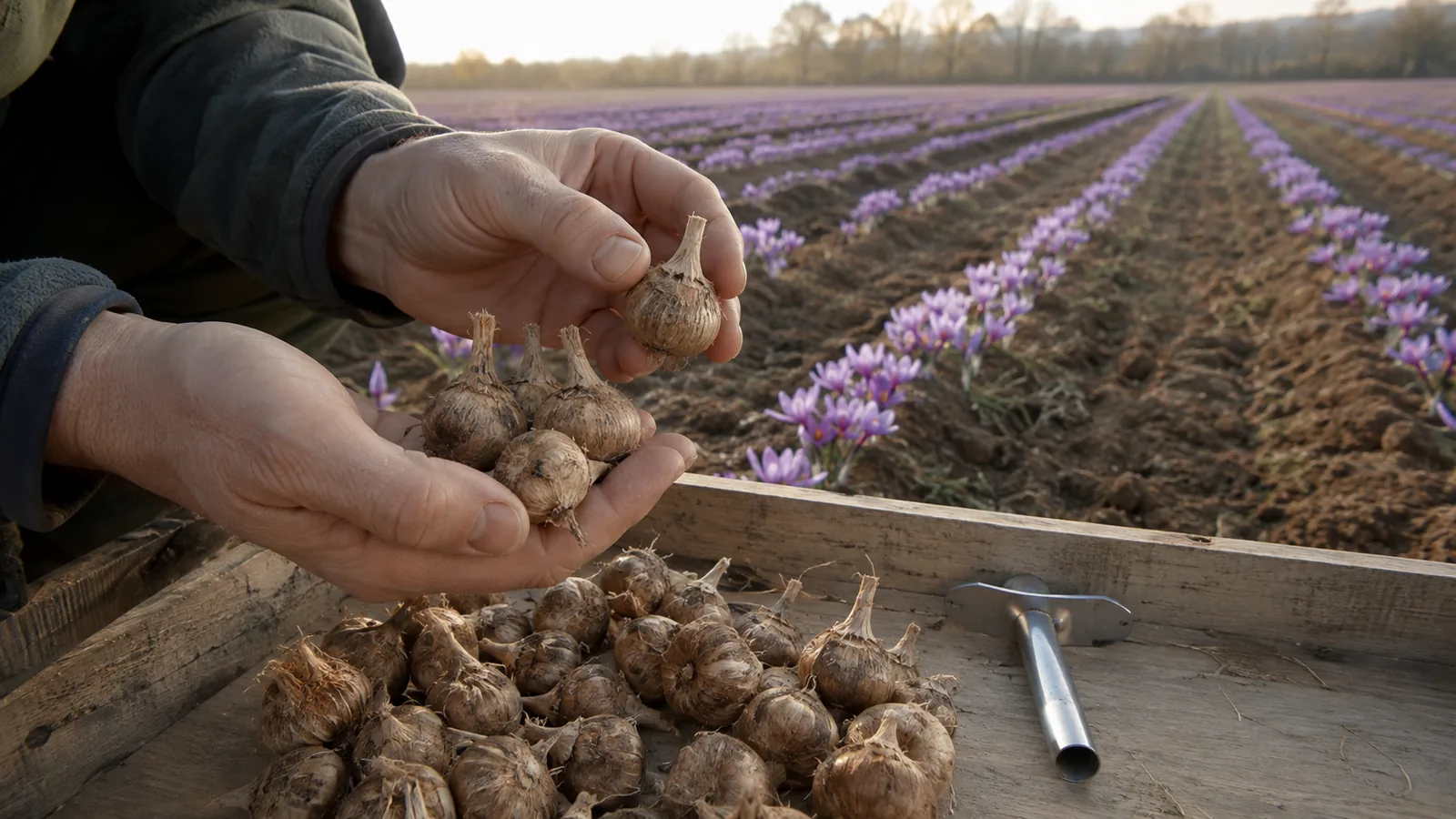
A saffron corm stores the reserves that support emergence and early development. Larger, mature corms tend to have a greater chance of flowering and can produce more vegetative growth than small planting stock. That makes corm size useful, but it is not a promise of yield on its own.
The familiar statement that every flowering saffron bulb must weigh more than eight grams is too absolute. “Eight grams” may be a practical sorting line for a particular supplier or production system, yet corm response also depends on cultivar or stock, climate, planting depth, health and growing conditions. Even the way the corm is weighed matters: fresh weight and dry weight are not interchangeable.
A controlled study of corm size and planting depth compared fresh-weight classes of 5–10 g, 10.1–15 g and 15.1–20 g at three depths. It found interactions between size and depth rather than one combination that can be copied everywhere. Treat those results as evidence that both variables matter, not as a universal field prescription.
Sort and sample corms consistently
When buying or lifting corms, take a representative sample and record the weight distribution instead of reporting only the largest specimen. Separate undersized, injured, soft or visibly diseased material. If a field is already planted, sample marked quadrats after dormancy and compare the daughter-corm distribution with the previous season.
Small corms often put more of their limited reserves into vegetative growth. Good nutrition can help the new corms develop during the leaf season, but fertilizer cannot turn damaged or poorly established planting material into uniform mature stock immediately. Protecting green leaves until natural senescence is part of building the following season’s corm reserves.
Bulb quantity: more is useful until crowding begins
A field planted with more viable corms per square metre may produce more flowers in its early years than a comparable field planted sparsely. Density therefore belongs in any explanation of flowering. It should be recorded as corms per square metre and, where possible, as total corm weight per area.
The relationship changes as daughter corms multiply. Increasing bulb quantity can raise the number of potential flowering points, while excessive crowding increases competition for water, nutrients and space. It may also leave a larger share of the corm population in small weight classes. This is why both too few and too many corms can be associated with weak performance.
Count plants or lift a small, repeatable sample from the same field zones each year. Compare flower density, daughter-corm number and corm-size distribution. Replanting should follow evidence of crowding and declining performance, not a calendar anniversary alone.
Choose planting depth for the site and production cycle
Planting depth affects emergence, temperature exposure, soil moisture and the way daughter corms develop. The original ranges often given for saffron—20–25 cm in sandy soils and 15–20 cm in clay soils—should be understood as regional practices, not fixed limits. Published experiments have used shallower and deeper placements, with results that vary by environment, corm size and production year.
The controlled study cited above tested 10, 15 and 20 cm. Its results again showed that corm size and depth interact. Before choosing a depth, examine soil texture, drainage, winter conditions, expected field lifespan and the equipment used for lifting. Record depth from the soil surface to the corm, rather than relying on the furrow setting alone.
What happens as daughter corms form?
The flowering mother corm is replaced through the annual cycle as daughter corms develop around or above it. Over time, part of the population may sit closer to the surface. A field planted at 25 cm can therefore contain corms at less than 20 cm after several seasons, but the change will not be identical in every soil or after exactly five years.
Inspect actual depth before adding soil or deciding to lift the field. Shallow corms may be more exposed to temperature and moisture fluctuations; excessive depth can delay or reduce emergence in some settings. The decision has to balance present flowering with future corm production.
Inspect bulb health before treating the field
Healthy planting stock should be firm and free from cuts, soft tissue, abnormal discoloration and visible decay. Check material from several parts of the field, not only the worst patch. Photograph symptoms, record where they occur and keep suspect corms away from clean planting stock.
Mites and fungal infections are often mentioned when saffron flowering declines, but a symptom is not a laboratory diagnosis. Yellow leaves, poor emergence and corm rot can have more than one cause. A plant pathology service or agricultural specialist can examine representative corm and soil samples before a grower chooses a treatment.
A field study on injury and fungal corm rot found that the tested isolates produced rot when corms were injured, highlighting the importance of handling damage. That does not mean fungi are harmless. It means prevention should include gentle lifting, sorting and planting as well as accurate diagnosis; unchecked fungicide use is not a substitute for either.
Match water management to soil type
Clay soils generally retain water longer than sandy soils, which can buffer a crop during a dry period. The same retention becomes a disadvantage where waterlogging and poor aeration develop. Sandy soils drain more quickly but may expose corms to faster moisture changes. Neither texture is automatically superior in every season.
In a hot year, a moisture-retentive clay soil may perform better than an excessively dry sandy one. In a wet location, a well-structured sandy loam may protect corms better than dense clay. Dig after irrigation or rain and see how deeply water moved, how long the root zone remains wet and whether a compacted layer is restricting drainage.
Balanced soil for saffron is not simply “neither clay nor sand.” It needs workable structure, drainage, adequate water-holding capacity and enough rooting depth for the site. A laboratory texture result, infiltration check and field observation together give a more useful answer than appearance alone.
Where summer moisture fits
Corms are dormant above ground during summer, but their temperature and moisture environment still matters. High summer moisture is not automatically beneficial: in a poorly drained or damaged-corm field, it can increase risk. Severe drying and heat can create a different stress. Local rainfall, soil storage and corm depth determine which problem is more likely.
Do not irrigate a dormant field by habit or withhold water merely because foliage is absent. Check the production system and local research, then confirm soil conditions at corm depth. Any summer operation should also avoid compaction and mechanical injury.
A practical flowering diagnosis
- Map the result: mark strong and weak areas and record flowers, dry stigma and emergence dates separately.
- Sample corms: compare weight classes, number, depth, firmness, injury and rot between those areas.
- Inspect the profile: record texture, rooting depth, compaction, drainage and moisture at corm depth.
- Review the previous leaf season: note early cutting, grazing, disease, weeds or drought that could have limited daughter-corm growth.
- Change one justified variable: define what improvement should look like and measure the next harvest in the same way.
For practical handling and selection guidance, see the detailed article on saffron bulbs. Water quality, weeds, leaf care, mixed cropping and field age are covered in Part Two of the saffron flowering guide.
Saffron flowering improvement is strongest when it follows evidence from the field. Measure the corm population, planting environment and crop response first; then make the smallest change that addresses the limiting factor and keep enough records to know whether it worked.

![Exporting Saffron to Turkey + Price Guide [Complete 0 to 100]](https://img.rowhanisaffron.com/20260827003933/saffron-export-turkey-quality-inspection.webp)



