


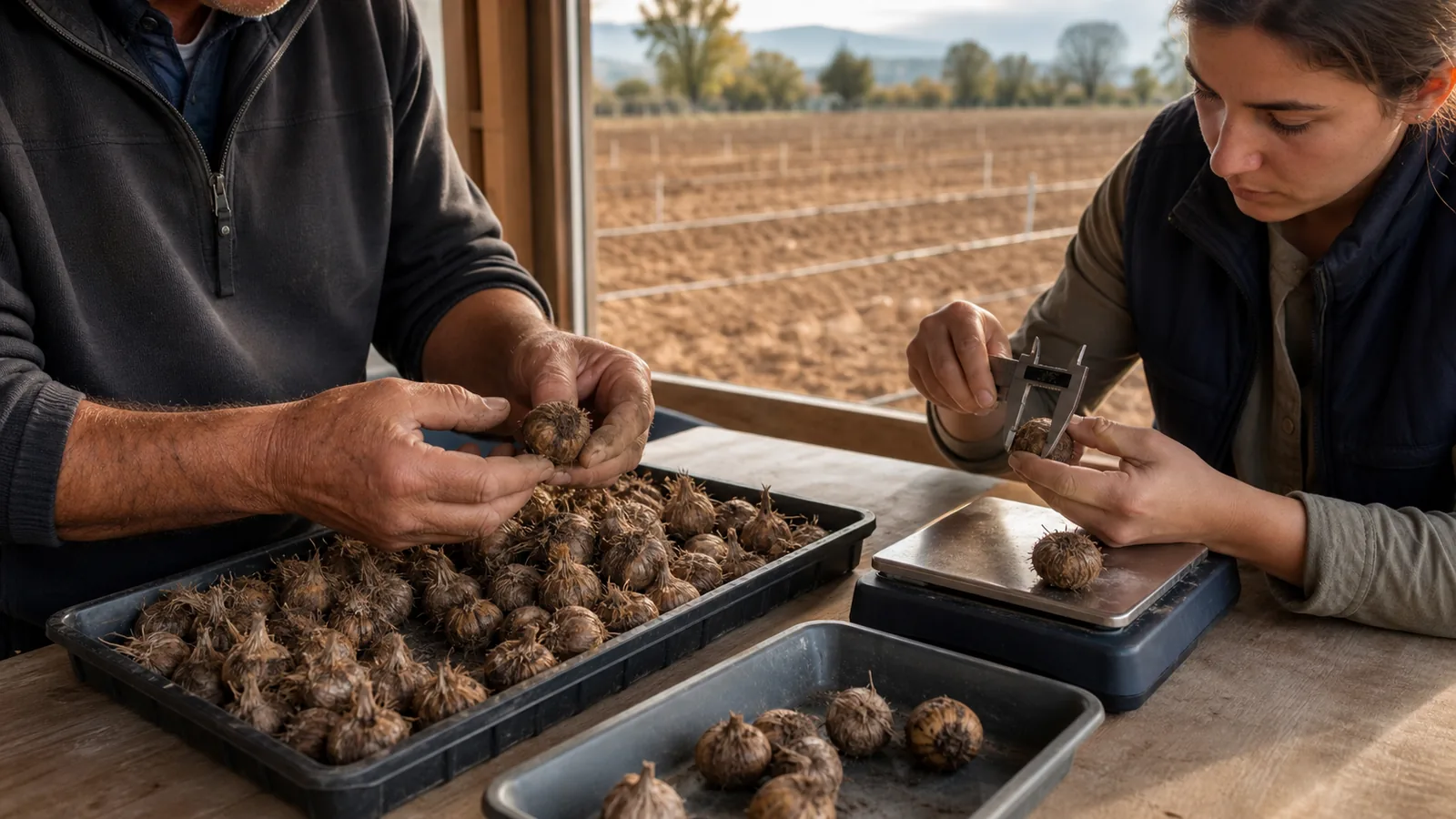
Saffron bulbs are more accurately called corms. They are the living planting material from which every commercial Crocus sativus crop is propagated, so their identity, health, size and handling affect the field long before the first flower opens. Buy or lift them with enough time to inspect the lot, then plant promptly into prepared, well-drained soil.
The old advice on this page contains useful Khorasan field practice, but some numbers were compressed by translation. The safer approach is to understand what each number was trying to control: corm maturity, storage stress, disease, planting density and the balance between first-year flowers and future daughter corms.
Saffron has corms, not true bulbs
A corm is a short, swollen underground stem covered by a dry fibrous tunic. It stores energy and carries buds that can produce flowers, leaves and daughter corms. A true bulb has fleshy layered scales, like an onion. Growers and sellers often use “saffron bulbs” because customers recognise the phrase, but the botanical distinction helps when checking planting material.
Cultivated saffron is sterile and does not establish an ordinary commercial crop from seed. New fields therefore depend on corms divided from existing stock. That makes provenance important: a corm lot can carry useful local adaptation, but it can also carry rot, pests, mixed identities or damage into clean ground.
There is no separate “Sargol saffron bulb”
The search phrase Sargol saffron bulbs joins two different stages of production. Sargol is a commercial name for a red-stigma saffron grade after the flowers have been harvested and separated. It is not a recognised cultivar or corm type.
A seller should not imply that a corm will automatically produce Sargol. The final commercial grade depends on flower separation, the amount of style retained, drying, sorting and the specification used by the buyer. The planting material should instead be described by species identity, source, harvest or lifting date, size or weight grade, health status and lot traceability.
For cultivation, ask for those planting-material records rather than a finished-spice grade name. They tell the grower what can be inspected before the corm enters the field.
How to select saffron corms
Choose firm, mature corms with an intact dry tunic. Reject material that is soft, water-soaked, badly shrivelled, cut through the body, deeply scraped or showing suspicious mould, lesions, tunnels or abnormal odour. Surface soil can hide defects, so inspect a representative sample from every lot rather than the best handful shown by the seller.
The original article compared corm sizes with hazelnuts and walnuts and recommended large, healthy pieces without wounds or disease. It also cited Khorasan research favouring corms heavier than eight grams. The direction is sound: larger mother corms generally carry more reserves and have a greater flowering capacity than very small cormlets. The exact threshold is not universal.
A three-year mother-corm size study measured a strong relationship between planted corm weight, flowers, stigma production and daughter-corm grades across many weight classes. Buyers should therefore request a measured weight or diameter range, not rely on vague labels such as large or premium.
Keep small cormlets separate if the aim is multiplication rather than immediate flower yield. Record the number and total weight sampled, the range observed and the percentage rejected. A uniform lot makes planting depth, emergence and later comparisons easier to manage.
Lift corms during the dormant window
The old Khorasan calendar placed the main lifting window between late May and late August, when the leaves had finished and the corm was described as resting or “sleeping.” It also referred to lifting from early June into autumn, named June as the best time in one industrial-research account and mentioned late July or early August as another practical point. These overlapping dates show why leaf stage and local temperature are more reliable than one universal month.
Wait until the foliage has naturally senesced and the replacement corms have matured. Lift in soil dry enough to separate without smearing, but take care not to slice the corms with a fork or machine. University of Vermont guidance on harvesting saffron corms likewise warns that cutting them opens a route to disease.
Do not confuse dormancy with inactivity. Flower development begins inside the corm before autumn emergence. A peer-reviewed study of temperature and saffron flower formation found that temperature and duration strongly influenced initiation, abortion and emergence. This is why a storage decision can change first-year flowering even though no green shoot is visible.
Plant promptly after lifting or delivery
The original recommendation was to move corms from the old field to the prepared new ground without a long delay. It warned against leaving lifting until late August because roots or shoots may have begun to develop. That remains sensible: once active growth starts, handling and transport can break new tissue.
University of Vermont’s planting guide recommends planting delivered corms as soon as possible in August or September rather than holding them until the following spring. Iranian dates may begin earlier because climate and production systems differ, but “promptly” always depends on having the field, irrigation and labour ready.
If temporary holding is unavoidable, keep lots labelled and separated in a clean, dry, well-ventilated, shaded place. Use shallow containers that do not crush the lower layers, and inspect for heat, condensation, sprouting or rot. Do not wash corms and seal them wet.
The old translation appears to mention months of cold storage and a “20–30” value, but its unit and intended condition are unclear. It should not be turned into a refrigeration recipe. Research shows that low and high storage temperatures can alter floral induction; a commercial protocol must control temperature, humidity, duration and corm developmental stage together.
Clean without damaging the protective tunic
Brush off loose soil and remove dead roots or loose outer fibres only as needed for inspection. The earlier instruction about removing dry layers from the base was probably intended to expose the lower surface to moisture and make sprouting easier. Aggressive peeling is unnecessary and can wound the corm.
Keep the main fibrous tunic intact unless a qualified inspection protocol requires otherwise. Disinfect tools and containers between suspect lots. If a corm has to be cut open for diagnosis, do not return it to the planting batch.
Any pesticide or disinfectant treatment must be legal for the crop and use, compatible with destination-market residue requirements and, where relevant, approved by the organic certifier. A healthy appearance does not justify an unlabelled treatment, and a treatment cannot repair physically damaged or rotten stock.
Choose spacing from the production goal
The original article gave a planting-material range of roughly three to ten tonnes per hectare. It mentioned 25 to 30 centimetres, three corms per hole averaging six grams each, single-corm planting at six to eight centimetres apart and a traditional method using five corms per hole. These figures represent different systems; they cannot all describe one density.
Closer spacing can put more flowering corms into the first season, but it also brings earlier crowding and uses more planting material. Wider spacing reduces the initial population and leaves more room for daughter corms. Clusters of three or five make a different stand from evenly spaced single corms even when the same total weight is planted.
Calculate density before ordering. Define row spacing, within-row spacing, corms per position and planted area, then multiply by the measured average corm weight. That arithmetic should reconcile with the tonnes-per-hectare estimate. If it does not, one of the figures or units is wrong.
Depth also interacts with climate, soil and the intended life of the stand. Use local trials and equipment capability rather than copying a single depth from another region. Our guide to preparing the ground for saffron covers drainage, soil testing and bed formation before the corms arrive.
Keep lot records from delivery to emergence
- Record the supplier or source field, lot code, lifting and delivery dates.
- Measure the corm weight or diameter distribution from a representative sample.
- Photograph and count rejected, injured or suspicious material by reason.
- Map each lot to its bed, row, density, depth and planting date.
- Record temporary storage conditions and any approved treatment.
- Compare emergence, flowering and daughter-corm results by lot rather than by memory.
These records turn tips on saffron bulbs into a repeatable selection system. The best lot is not simply the heaviest bag or the one with the strongest sales name. It is correctly identified, physically sound, consistently graded, handled during the right developmental window and planted into a field prepared for its intended density.
Corm-selection and flowering research reviewed 28 August 2026. Planting and storage schedules must be adapted to local climate, corm stage and applicable plant-health rules.

![Exporting Saffron to Turkey + Price Guide [Complete 0 to 100]](https://img.rowhanisaffron.com/20260827003933/saffron-export-turkey-quality-inspection.webp)



