


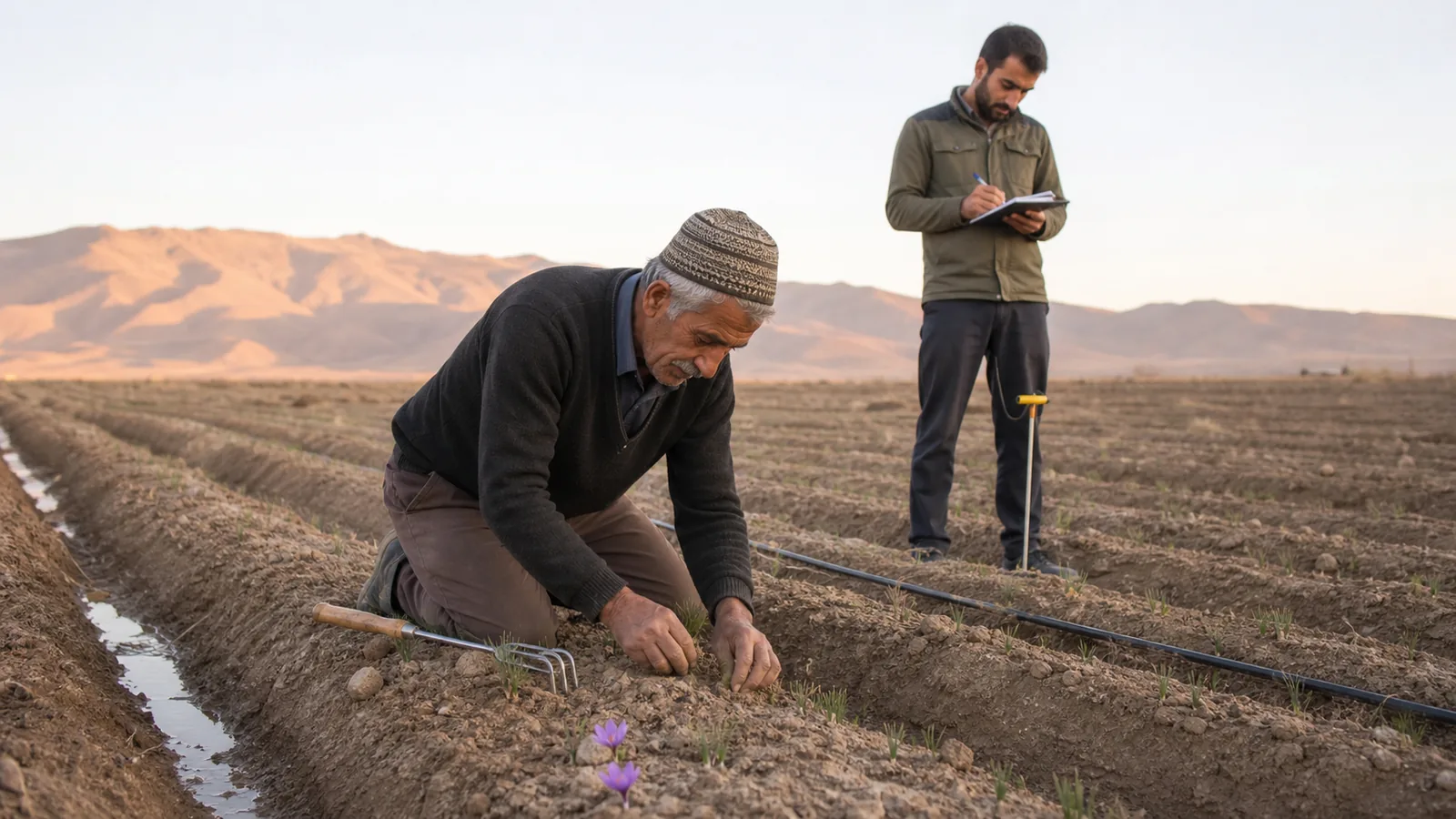
The job description of saffron growers changes with the crop. In late summer it centres on corms and field readiness. In autumn it moves quickly through irrigation, surface management and flower harvest. Winter and spring are quieter above ground, but leaf health, weeds, water and daughter-corm development still need attention.
A grower’s real task is to make timely decisions from field evidence. A calendar is useful, especially in Khorasan, but soil texture, weather, crop age and the available irrigation method determine how a particular block should be managed.
Finish planting before the first irrigation decision
The old account said saffron planting continued until the end of September, with irrigation 10 to 15 days after planting. It then described first irrigation across Khorasan from October to the beginning of November. These statements refer to different field situations: a newly planted site and established saffron entering its autumn growth cycle.
For a new field, saffron growers should record the lot, corm size, planting depth, density and date before the rows disappear from view. Our guide to saffron corms explains why those details matter. Irrigation must then be matched to soil moisture and temperature, not applied automatically on day ten.
On an established field, check the irrigation system, outlets and bed surface before autumn water begins. Repair blocked lines and eroded channels. Dig into the active root zone at several points so the decision is not based on a dry-looking surface alone.
Use first irrigation to start the season evenly
Pre-flowering irrigation is one of the most consequential autumn operations in many Iranian systems. It helps create the soil conditions associated with emergence, but the correct volume depends on the field. The soil should be wetted through the intended root zone without leaving corms in prolonged saturation.
The old text advised giving the whole block enough water and noted that the first irrigation affects the flower flush. Research in Qaen comparing saffron irrigation methods also treated the first irrigation as a defined autumn event and measured very different water volumes under sprinkler, drip, furrow and basin systems. That variation is a warning against copying one volume between systems.
Watch where water reaches late or collects too deeply. Uneven wetting can turn one nominal irrigation date into several crop responses. Record start and finish times, estimated volume, weather, soil condition and any blocked or ponded area.
Stagger blocks only for a clear reason
The earlier article described dividing the first irrigation across sections over several days so flowering would not peak everywhere at once. For a grower with limited harvest labour, that can be a practical way to spread the workload. It is not guaranteed control over flowering.
Temperature, corm condition, soil and the timing of previous growth all affect emergence. If sections have different textures or irrigation capacities, staggering them by an arbitrary number of days may create unequal water stress rather than an orderly harvest. Treat each block as its own record and compare the outcome after flowering.
Before using staggered irrigation, confirm that flowers can still be collected daily from every active block. The labour plan should include picking, transport, stigma separation and drying capacity; moving the bottleneck from the field to an overloaded processing room does not protect quality.
Inspect the surface before breaking a crust
Water can leave a hard surface layer on soil that is prone to sealing. The old Khorasan practice was to break that crust after first irrigation with a hoe, shovel, four-pronged local tool or Iranian plough so emerging flowers could pass more easily. It repeatedly warned against damaging the corms.
That warning is more important than the name of the implement. First confirm that a restrictive crust exists. Work only when the surface will fracture rather than smear, and set the tool shallow enough to stay above known corm depth and new shoots. Mark a small test strip before treating the whole field.
In the Qaen irrigation study, researchers broke the surface to a depth of 10 centimetres after first irrigation to facilitate flowering. That was the protocol in a specific experiment, not a universal safe depth. A field planted shallowly, eroded since planting or carrying rising shoots may require much less disturbance.
A two-season experiment on irrigation intervals and soil texture found that the two factors interacted in their effects on flower and corm outcomes. It supports the larger point: a crust, infiltration problem and irrigation schedule have to be read together rather than managed as separate routines.
Do not use crust breaking as a fertiliser shortcut
The old article said crust breaking could mix animal manure with the surface. It also proposed broadcasting required fertiliser before irrigation when a grower had not applied manure, then mixing it during cultivation. That sequence describes a local practice, but it does not identify the material, rate, soil result or corm-safety limit.
Use a representative soil test and a crop plan before applying nutrients. Surface placement, incorporation depth and timing affect whether a nutrient stays available, moves away or contacts sensitive tissue. Manure has its own nutrient, salt, maturity and hygiene considerations. A shallow crust pass should not be asked to correct an unmeasured fertility problem.
Keep application and field-operation records separate: product and analysis, lot, rate, area, date, weather, incorporation method and operator. That makes later crop responses traceable.
Expect flowering to move with the season
The original guide expected the first flowers about 15 to 20 days after first irrigation. A South Khorasan on-farm study likewise observed flowering beginning 19 to 21 days after first irrigation in many surveyed fields. Both are planning ranges, not promises.
Begin scouting before the earliest expected date. Harvest crews, clean containers, transport and drying equipment should already be ready. Once flowers appear, collect at the frequency needed to protect them from heat, rain, contamination and physical damage, then move them promptly to separation.
The translated sentence about the first year is ambiguous: it may mean that a new field does not produce a significant crop, or that first-year production deserves special attention. Either way, do not set labour or sales expectations from a generic statement. Corm size, density, planting date and establishment conditions can make first-year flowering very uneven.
Manage weeds after water, not by habit
Irrigation can trigger a flush of weeds along with saffron growth. The old article advised delaying weeding until those weeds had emerged, which can make the operation more effective than disturbing bare soil too early. Timing still depends on the species and method.
Identify the weed before acting. Pulling a young annual and fragmenting a perennial underground stem have different results. Work carefully around saffron leaves and corms, remove flowering weeds before they set seed and clean tools when moving between infested and cleaner blocks.
Where the crop is organic, every input and method must fit the approved organic system plan. Elsewhere, any herbicide still has to be legally authorised for the crop and use; saffron’s value does not make an unlabelled application acceptable.
Protect leaves and daughter corms through spring
After flowering, the leaves continue to support replacement corms. The older calendar appears to call for irrigation from early April until the foliage turns yellow, at intervals of six to 12 days. Treat that as a local observation, not a fixed schedule. Rainfall, temperature, soil water-holding capacity and rooting depth can lengthen or shorten the interval.
Do not stop monitoring simply because the spice has been harvested. Check soil moisture below the surface, leaf condition, weeds, ponding, salinity signs and disease patterns. A final appropriate irrigation may support daughter-corm growth, which the old translation called making “large onions,” but excess water near senescence can also leave wet soil around maturing corms.
Our article on timely saffron irrigation explains how stage, soil and weather should replace a copied calendar. Allow foliage to senesce naturally unless a diagnosed problem requires action; green leaves are still doing work for next season.
The grower’s field record
- Map blocks, corm lots, planting dates, depths and densities.
- Record each irrigation date, method, duration, estimated volume and soil response.
- Note crust condition, tool, depth, test strip and any shoot or corm injury.
- Track first flower, peak bloom, last flower, daily harvest and processing capacity.
- Log weeds by species and location before each control operation.
- Follow leaf condition and soil moisture until natural senescence.
- Compare results by block before changing next year’s schedule.
The job description of saffron growers is therefore not a list of chores performed on fixed dates. It is a cycle of observation, preparation, careful action and record keeping. Khorasan’s October-to-November irrigation window, 15-to-20-day flowering estimate, surface-crust practice and spring-water intervals remain useful historical guides when the grower checks them against the field in front of them.
Irrigation and field-management evidence reviewed 28 August 2026. Water schedules, cultivation depth and input decisions must be adapted to local soil, climate, crop stage and regulation.

![Exporting Saffron to Turkey + Price Guide [Complete 0 to 100]](https://img.rowhanisaffron.com/20260827003933/saffron-export-turkey-quality-inspection.webp)



