


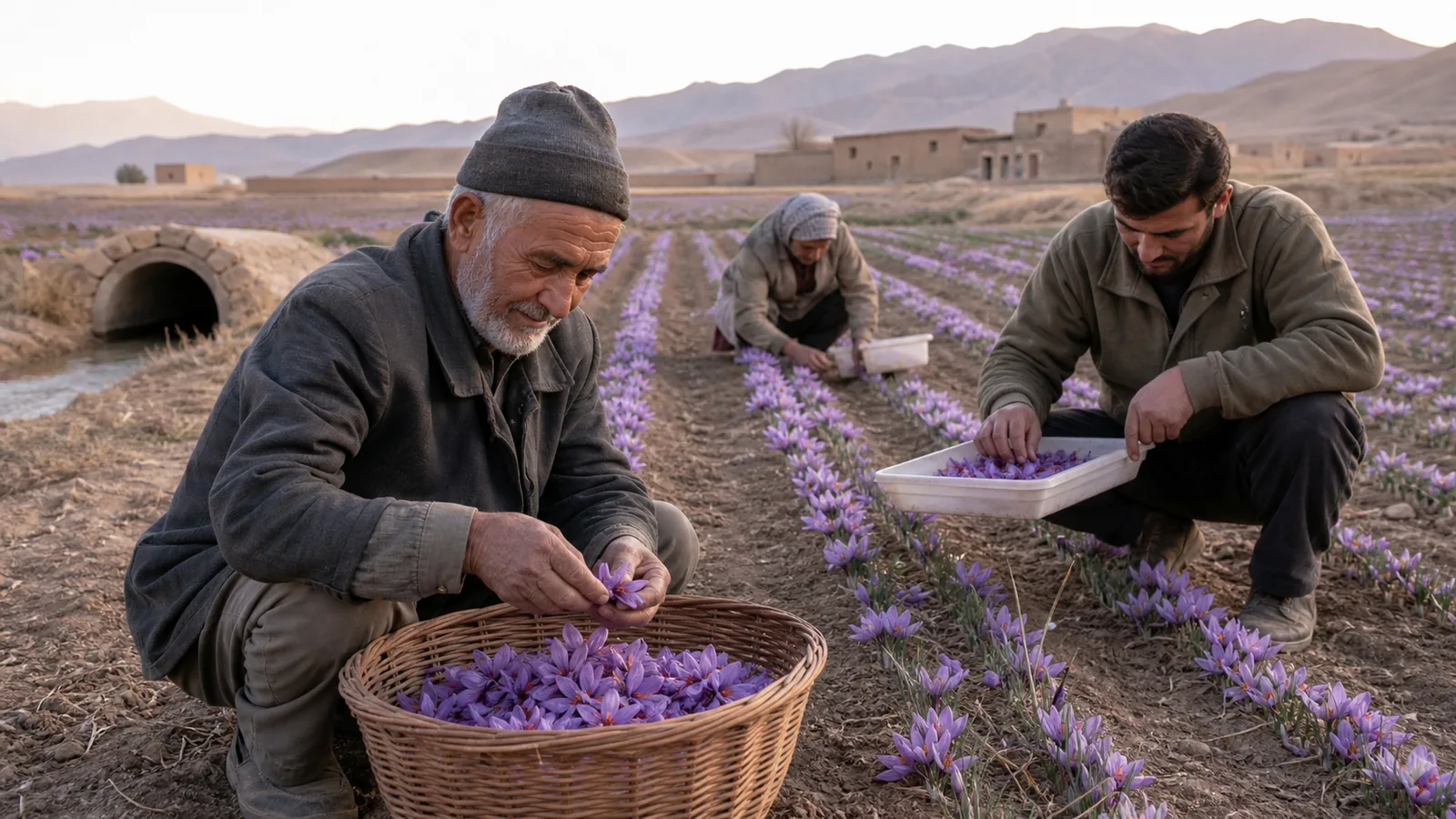
Iranian saffron producers belong to a farming and trading tradition that has developed over centuries, especially in Khorasan. Their history is not one straight line from an ancient origin to a modern export industry. It is a story of a sterile crop carried by people, adapted to dry land, supported by irrigation systems such as qanats, and made valuable through a remarkable amount of seasonal hand work.
Iran’s place in that story is central. It is also important to separate two claims that are often blended together: Iran has a deep history of cultivating and using saffron, but current genetic research does not identify Iran as the original place where Crocus sativus was first domesticated.
Saffron has more than 3,000 years of human history
Saffron imagery, texts and use can be traced across ancient Aegean, Persian and Mesopotamian cultures. Producers moved the crop, preserved corms and developed local ways to plant, harvest, dry and trade the spice. Iran’s long cultivation history is therefore real even though a precise “first field” is harder to establish from cultural records alone.
A 2022 review of ancient art and saffron genetics describes cultivation across the Mediterranean, including ancient Greece and Persia, for more than three millennia. Drawing on modern genetic evidence, it points to emergence and domestication in ancient Greece. A 2019 genomic study likewise connected cultivated saffron to wild Crocus cartwrightianus from Attica.
That evidence corrects the old article’s statement that Iran was necessarily the plant’s biological origin. It does not diminish Iranian producer history. Once people had a valuable sterile crop, every new production region depended on growers carrying and multiplying living corms, then learning how the plant behaved in local soil and climate.
Why the crop depends on producers
Crocus sativus is a sterile triploid. It does not establish a commercial crop from ordinary seed, so growers propagate it through daughter corms. That makes the cultivated saffron line unusually dependent on continuous human care.
Each autumn flower carries three red stigmas. Those stigmas—not a root or “radicle”—are separated and dried to make the spice. The bright red material may include a controlled portion of style depending on the commercial form, but petals, stamens and unrelated plant matter are not saffron threads.
The flower count explains much of the labour. The original post said roughly 110 to 170 flowers make one gram and about 150,000 make one pound. The first range is plausible; the unit in the second statement is not. The University of Vermont Extension estimates about 150 to 170 flowers for one gram, which is roughly 150,000 to 170,000 flowers for one kilogram—not one pound. The exact number varies with stigma size and dry weight.
Khorasan became the centre of Iranian production
Khorasan’s arid and semi-arid landscapes, cold-season growth pattern and generations of local knowledge allowed saffron to become an important farm income. Ghaenat is closely associated with Iranian saffron, while Gonabad shows how cultivation and water management grew together.
In 2018, the Food and Agriculture Organization designated the qanat-based saffron farming system of Gonabad as a Globally Important Agricultural Heritage System. FAO describes qanat water, the dry climate, biodiversity, livelihoods and community knowledge as parts of one agricultural system rather than isolated production inputs.
The old post said saffron history in South Khorasan went back about 700 years and singled out Ghaenat as having a tradition of more than 3,000 years. These familiar local-history figures are retained as historical claims, not converted into exact archaeological dates. “Khorasan saffron” covers several places and traditions; it should not be treated as one farm with one documented starting year.
From household plots to a specialised chain
The word producer can hide how many people create one finished lot. The grower selects and plants corms, manages water and weeds, watches the bloom and organises labour. Pickers work through a short harvest window. Other workers separate stigmas, operate or supervise drying, inspect the material, pack it and maintain lot records.
A wholesaler or exporter may also be called a producer when it controls processing and packing but does not own every field. Buyers should ask which role a company performs and how it traces the spice back through its supply chain. Our guide to Iranian saffron suppliers explains how to qualify that commercial relationship.
This distinction matters to history as well. A village could be a major source of flowers while the final sorting, branding or export took place elsewhere. Production leadership is not only a national tonnage; it rests on the people and facilities between the corm and the sealed pack.
Iran’s dominant share needs a date
The original article placed Iran at 90 to 93 percent of world production and gave a range of 200 to 300 tonnes a year. It put Spain second at about 25 tonnes, then listed India, the “Asprvn Islands,” Russia, Singapore, Malaysia, Japan, Taiwan, China, France, Italy, Germany, Australia and Greece as a combined third group.
Those figures and categories came from an older account and should not be read as a current league table. The country list appears to mix growers, markets and places involved in saffron trade or research. “Asprvn Islands” is not a clearly identifiable production region in the English translation.
FAO’s Gonabad heritage profile, prepared around the 2018 designation, also described Iran as the largest producer with more than 90 percent of world output. That supports Iran’s dominance at the time, not a permanent annual percentage. Crop area, yield, weather, stocks and the definitions used by each source can all change a share.
Trade data create another source of confusion. A country can import bulk saffron, pack or re-export it and appear important in customs records without growing the same volume. Producer, exporter and country of final dispatch are different measures.
Water practice grew from local conditions
The old text said Khorasan fields needed water only twice a year: around early November before harvest and early December after it, with spring rain and snow supplying the rest. That describes a sparse traditional schedule, not a safe prescription for every saffron producer.
Soil depth, rainfall, temperature, corm stage, irrigation method and the timing of flowering all affect water decisions. The plant is dormant in summer and dislikes prolonged waterlogging, but “low water demand” does not mean every field can use the same two dates.
Qanats were valuable because they delivered a managed supply in a water-scarce landscape. Modern wells, drip systems and other sources change the mechanics, while the producer still has to match water to the crop and protect the corms from saturated soil. Our practical guide to saffron farming operations covers this field-to-storage sequence in detail.
Harvest work shaped the producer community
Saffron flowering is brief and concentrated. Flowers need to be collected and moved for separation without a long delay, which creates a sudden need for organised labour. Families, neighbours and seasonal workers have historically shared that load across Khorasan.
The crop is called “red gold” or “desert gold” because a small mass of dried stigmas represents so many flowers and hours. The name should not be confused with guaranteed wealth. A producer still faces corm cost, labour, water, yield risk, quality loss, market prices and the expense of testing and packaging.
FAO’s heritage profile linked the Gonabad system with stable livelihoods and reported that saffron activity supported about 400,000 people in the wider region at the time of the designation. That number describes direct and related work in a dated profile, not a current count of farm owners.
How Iranian producers created product value
The fresh stigma has an appearance and aroma that change during drying and storage. Experienced producers learned to separate cleanly, control heat and protect the finished spice from moisture, light and foreign odours. Modern equipment can make those controls more repeatable, but it cannot replace careful flower handling or a representative sample.
Saffron has long been valued in food, fragrance, dyeing and traditional medicine; modern pharmaceutical and chemical research also studies its constituents. Food sales should describe it first as the dried stigma of Crocus sativus and avoid turning historical use or laboratory research into a treatment claim. Pharmaceutical or research use has its own specifications and evidence.
For today’s buyer, producer credibility appears in records: field or supplier identity, harvest year, lot code, drying batch, test result, pack material and chain of custody. A romantic history cannot prove the quality of the package in hand, just as one laboratory result cannot replace the history of the people who built the crop.
The history worth preserving
Iranian saffron producers did not merely occupy a large share of a market. They maintained a sterile plant through countless cycles of corm selection, fitted it to dry landscapes, mobilised labour for the autumn bloom and developed processing and trading knowledge around the red stigmas.
Some familiar numbers in the original account were mistranslated or undated. The deeper history remains: ancient Persian use, centuries of Khorasan cultivation, qanat-supported farming, demanding hand production and the growth of a specialised chain that still connects fields with buyers around the world.
Historical, production and botanical sources reviewed 28 August 2026. Production shares and employment figures are date-specific; use current official data for present-day market decisions.

![Exporting Saffron to Turkey + Price Guide [Complete 0 to 100]](https://img.rowhanisaffron.com/20260827003933/saffron-export-turkey-quality-inspection.webp)



