


Iranian saffron suppliers remain central to international trade, but a buyer cannot choose one from a country name or a low price alone. The useful comparison is between real lots and real businesses: product style, test results, traceability, packing capability, export documents and the consistency of supply after the first sample.
The title of this article says Iranian suppliers “still top the charts.” It began as a 2014 comment about Iran’s dominant position and the growth of competing origins. That is not a permanent league-table result. Trade reporting varies by country and year, and a supplier’s reliability has to be checked at the company and lot level.
What the original market warning said
The first version attributed its view to Iran’s National Saffron Council and to a representative named Manouchehri. It said the international market was dependent on Iranian supply and suggested that no serious threat would emerge for at least ten years. More than ten years have now passed, so that statement belongs to the record; it is not a forecast for today.
The report also treated the rise of Afghan saffron as both a useful regional opportunity and a future competitive risk. It cited roughly 650 hectares under cultivation in Afghanistan in 2011 and a yield figure of 10 kilograms per hectare, then characterised Afghan output as only a small percentage of Iran’s. Those figures were quoted in the old account and have not been carried forward as current production statistics.
Greece and Morocco were named as other origins that could expand production, compete on price and build their markets. The practical warning was sensible even though the old wording was rough: a leading supplier country can lose value if it relies on historical scale while competitors improve quality, presentation and buyer relationships.
What current trade evidence shows
Iranian-origin saffron is still visible across many destination markets. The World Bank WITS presentation of UN Comtrade data lists 2024 imports under HS 091020 reported as coming from Iran in China, the European Union and individual markets across Europe, the Gulf, Asia, North America and Oceania.
Destination reporting is particularly useful when direct exporter data is incomplete. It demonstrates trade flows, not a complete ranking of producers or supplier quality. Customs value does not identify the grade, terms, pack format or net price received by the Iranian exporter. It also cannot show whether a later reseller supplied the final customer.
Other origins are active as well. Global trade data records saffron exports from Spain, Greece, Morocco, Afghanistan and several re-exporting or packing centres. A “top supplier” claim therefore needs a definition: production volume, export value, laboratory quality, contract performance or consumer brand recognition can lead to different answers.
Iranian, Iran and Persian saffron suppliers
Buyers use the phrases Iranian saffron suppliers, Iran saffron suppliers and Persian saffron suppliers for much the same search intent. The wording does not establish where the crop was grown or who handled it. Verify the legal company, physical facility, export role and lot origin rather than treating “Persian” as evidence by itself.
A business may be a grower, collector, processor, wholesaler, exporter, broker or a combination of these. Each role can be legitimate. What matters is that the company explains which work it performs and does not borrow another facility, certificate or photograph to appear more integrated than it is.
Ask where the lot was produced, where it was cleaned and packed, and which legal entity will appear on the invoice. A supplier should be able to connect the sample to a lot, the lot to a processing record and the shipment to consistent documents.
What an industrial saffron supplier must be able to do
An industrial saffron supplier serves a food manufacturer, packer, ingredient distributor or other repeat user. The buyer usually needs more than attractive whole threads. It needs a defined input that can be ordered again without unexpected changes.
The specification should state the commercial style—filaments, cut filaments or powder—together with agreed physical and analytical limits, foreign-matter controls, packaging, net weight, shelf-life basis and sampling method. The Codex standard for dried saffron provides an international baseline. A buyer may add tighter contractual or destination-specific requirements.
Capacity should be described honestly. A processor that can prepare one excellent sample may not be able to reproduce it across a larger seasonal contract. Ask for typical lot size, lead time, retained-sample practice, testing frequency, segregation controls and what happens when a result falls outside specification.
How to qualify an Iranian saffron supplier
Verify the business and its role
Confirm the legal name, registration details, physical address, authorized contact and bank beneficiary. Identify whether the business will manufacture, pack, export or act as an agent. An unexplained change of company name, invoice issuer or payment beneficiary is a reason to pause.
Approve a representative sample
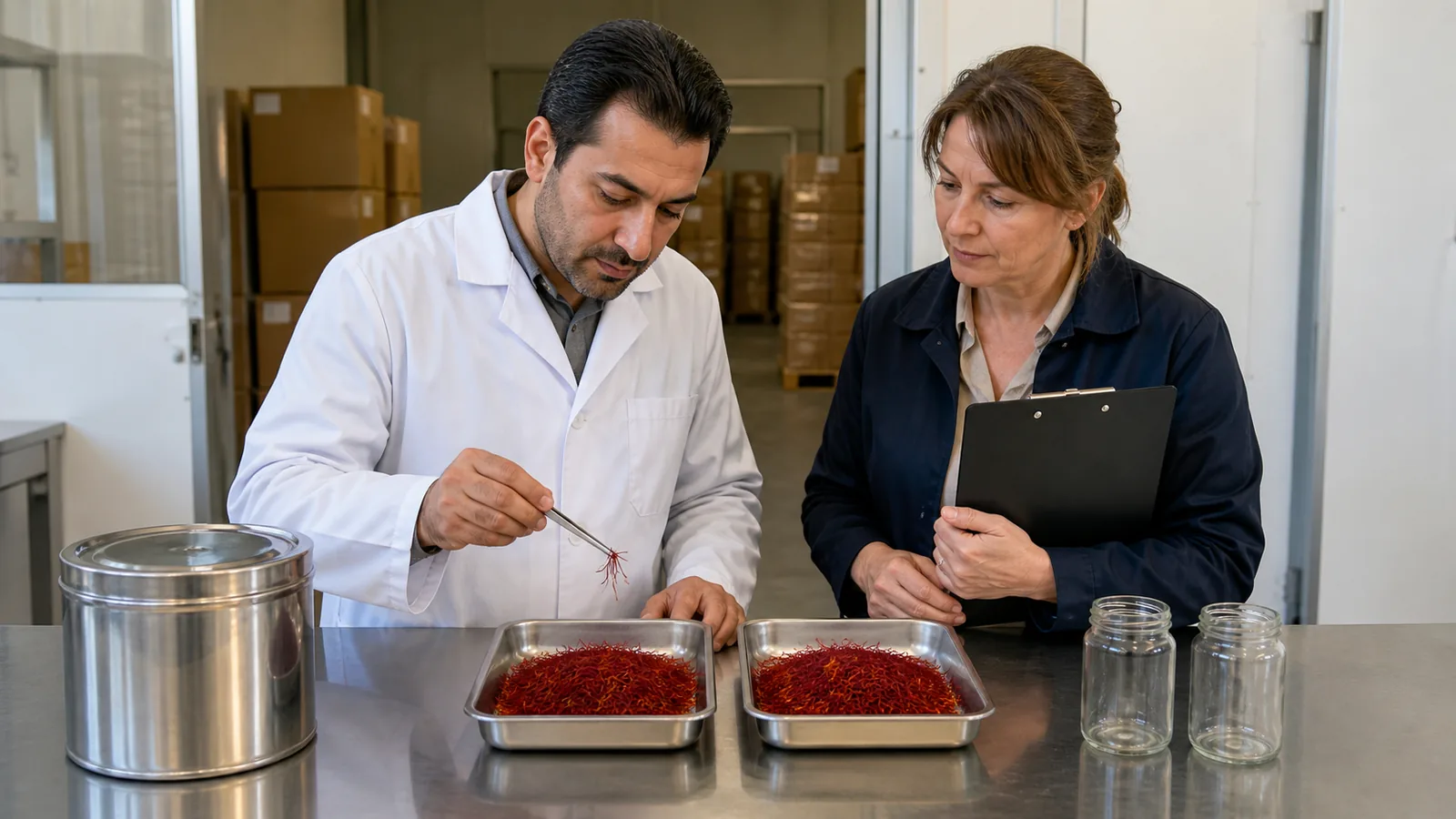
A sample should come from an identified lot or be clearly marked as a pre-production reference. Record its weight, condition and agreed tests. Visual comparison is useful, but colour in a photograph depends on lighting and does not establish purity, moisture or analytical quality.
Match tests to the intended use
The required evidence depends on the buyer, product form and destination. It may include composition and quality measurements, moisture, foreign matter, microbiology, contaminants or adulteration screening. Decide the laboratory, method, acceptance limits and who pays for a retest before the order is placed.
Review the packing operation
Bulk food-grade packs, small glass jars and private-label cartons have different controls. Check food-contact materials, seals, lot marking, weight control, storage and the way packs are protected in the shipping case. Artwork should not be printed until the importer approves current market requirements.
Build a consistent document file
The contract, invoice, packing list, transport document, origin evidence, test records and labels need matching names, weights, package counts and lot identifiers. Our guide to Iranian saffron exporter requirements explains how to prepare the file while confirming the rules for the actual destination.
Saffron sellers, wholesalers and exporters are not interchangeable
Saffron sellers may serve local retail customers and have no export operation. A wholesaler may assemble or redistribute bulk lots but rely on another company for processing and customs. An exporter may handle international documents without owning the farm or packhouse. None of those models is automatically weak; undisclosed roles are the problem.
If a broker adds useful inspection, consolidation, finance or local service, that value should be visible in the agreement. If the broker cannot identify the processor or provide lot evidence, the buyer is carrying avoidable risk. Direct-from-farm language is not a substitute for a controlled processing and export chain.
Understanding saffron wholesale price in Iran
A saffron wholesale price in Iran is meaningful only when it describes a product and a date. Grade name alone is not enough. Crop availability, filament cut, style content, moisture, test status, lot size, pack format, currency, payment terms and delivery basis all affect the quote.
Ask whether the price is ex-works, delivered to an Iranian dispatch point, freight paid to a foreign airport, or landed after import. Clarify who pays for inspection, insurance, export handling, customs, duty, tax and a failed test. Two offers cannot be compared if one includes those costs and the other does not.
Customs unit values from trade databases are useful for broad analysis but should not be presented as a supplier’s current price. They combine shipments of different quality and commercial terms. A serious quotation identifies the specification, quantity, currency, validity period and Incoterm.
Red flags when comparing suppliers
- A price is offered without product style, lot size or delivery basis.
- One certificate is presented as proof of every future lot.
- The sample cannot be linked to the goods that will ship.
- Company, bank and invoice names do not match and no clear explanation is given.
- Photos, facility claims or laboratory reports belong to another business.
- Origin, harvest year, organic status or regional claims cannot be documented.
- The seller promises customs clearance or compliance in every destination.
- A large advance payment is pressed before specifications and rejection terms are agreed.
A problem in one area does not always mean fraud; agents and group companies can create legitimate complexity. It does mean the relationship should be clarified before money or goods move.
What keeps a supplier competitive
Iran’s historical production strength gives its suppliers access to knowledge, specialised labour and a deep trading network. That advantage is not self-sustaining. Repeat supply depends on the second and third lots matching the first, questions receiving precise answers, documents arriving on time and any problem being traced to its source.
Competitors do not need to replace Iran’s total output to win a valuable customer or market segment. They can compete through a protected origin, a reliable small crop, strong branding, easier finance or closer distribution. Iranian suppliers protect their position by making quality and service measurable rather than repeating a claim of national dominance.
The old ten-year prediction has run its course. The useful conclusion is more demanding: Iranian saffron suppliers can remain preferred partners when they prove origin, define the lot, meet the buyer’s specification and deliver the same standard consistently.
Trade data and standards reviewed 28 August 2026. Prices, supplier capacity and import requirements change; verify them for the specific lot, destination and contract.

![Exporting Saffron to Turkey + Price Guide [Complete 0 to 100]](https://img.rowhanisaffron.com/20260827003933/saffron-export-turkey-quality-inspection.webp)



