


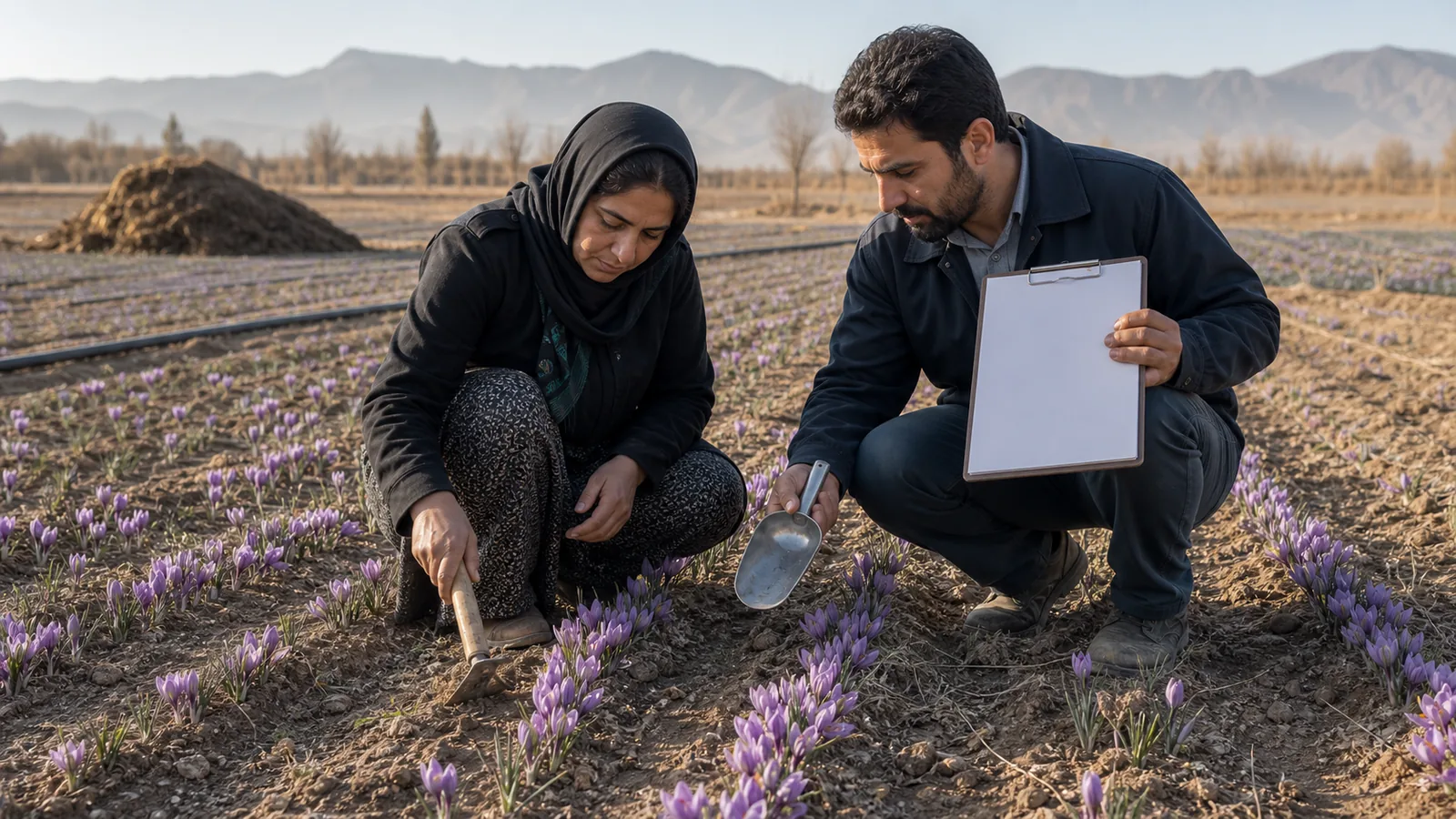
Organic saffron is produced in Iran, but neither the country name nor the appearance of the threads proves that a particular lot is organic. The claim belongs to a documented production and handling system: an approved farm, permitted inputs, inspected operations, segregated processing, traceable records and certification accepted by the market where the saffron will be sold.
This article began with a 2014 village programme intended to improve the cleanliness and identity of Iranian saffron. Its practical work is still relevant. Its use of “organic,” however, needs a sharper definition. Food hygiene and organic certification support each other, but they answer different questions.
The 58-village programme behind the original article
The original report attributed the project to Gholam Hossein Shafei, then identified as president of Iran’s National Saffron Council, in a conversation with IRIB. It described training and quality-identification work in 58 villages: 40 in Razavi Khorasan and 18 in South Khorasan.
The programme aimed to reduce impurities and respond to concerns from foreign customers. It moved saffron flower separation away from home settings and into a more hygienic working environment, where physical, biological and chemical hazards could be controlled more consistently.
Shafei said exporters were prepared to buy product from the quality-improvement programme for at least US$300 to US$400 more per kilogram than traditionally processed saffron. That was a quoted premium attached to a historical project. It is not a current organic saffron price, a guaranteed margin or a conversion to today’s money.
The report also said physical, biological and chemical contamination had ceased. That wording is too absolute for a food product. Hygiene controls can reduce risk and testing can report results for a defined sample. Neither establishes that every possible contaminant is permanently zero in every lot.
What makes saffron organic?
Organic status begins before the flower appears. The grower works under the rules of a recognised organic programme and an approved plan. Land history, soil management, crop inputs, pest management, neighbouring activity, harvest records and storage all need to fit that system.
The exact requirements depend on the certification programme, so a farmer should not substitute a generic internet list for the certifier’s rules. Common organic principles restrict prohibited materials and require records that allow an inspector to follow the crop. Traditional practice may help a farm comply, but “we have always grown it this way” is not certification.
After harvest, organic identity has to survive every handoff. Flowers, fresh stigmas and dried saffron must remain identifiable and protected from mixing with conventional product. Collectors, processors, packers and traders may need to be included within the certified chain, depending on their activity and the destination rules.
Organic does not mean chemical-free
The phrase chemical-free is scientifically meaningless: food, soil and water are made of chemicals. Organic standards control production methods and permitted substances. They do not promise that a product contains no naturally occurring compound, no environmental residue and no detectable contaminant.
Organic also does not mean sterile. Saffron is an agricultural food that needs hygienic harvesting, separation, drying, packing and storage. Physical matter, microorganisms, moisture, cleaning chemicals, unsuitable packaging and cross-contact can still create problems if the process is poorly controlled.
The Codex General Principles of Food Hygiene describe Good Hygiene Practices and hazard-based control. These controls apply whether a lot is organic or conventional. Certification of the farming system does not replace the food business’s responsibility for safe, suitable product.
From an Iranian organic field to a certified lot
Farm and harvest identity
The certificate scope should cover the grower, location and crop being sold. Harvest records connect dates and quantities to the field. If several village growers combine material, the collection system must show how much came from each approved source and how non-organic flowers are excluded.
Controlled flower separation
Fresh flowers need clean containers, prompt movement and a suitable separation room. Workers require hygiene training and clean tools. Each tray or batch should retain its lot identity. A clean room improves control, but it does not create organic status for flowers that did not enter through the certified system.
Drying and storage
Drying equipment, trays and storage areas should be clean and managed to prevent mixing. Time, temperature, airflow and load need to suit the validated process. Dried saffron then needs protection from moisture, light, pests, foreign odours and unauthorized access.
Packing and records
The amount packed, lost, sampled and remaining should make sense against the amount received. Lot codes connect the finished jar or bulk tin to processing and farm records. Labels and claims need certifier and importer review before release.
Certification must match the destination
A certificate is not automatically portable to every market. Organic rules cover the certified operation, the product, the period and the programme named on the document. The buyer should verify the certificate directly rather than accepting an image sent through a messaging app.
For the United States, USDA organic guidance explains that products represented as organic generally require certification under the applicable rules and that labels are reviewed by an accredited certifying agent. Each imported organic shipment also needs the required NOP import record.
For the European Union, the European Commission’s TRACES guidance identifies the electronic certificate of inspection used for imported organic products. The importer, control body and exporter need time to prepare that chain; it should not be left until the goods reach the port.
Other countries have their own arrangements. Confirm recognition of the certifier, required transaction or inspection certificate, label presentation and the status of every operator before signing the contract.
Organic certification and saffron quality grade
An organic certificate does not state that a lot has the highest colour strength, the longest threads or the best aroma. Those are product-quality questions. A conventional lot can be excellent in those respects, and an organic lot can fail a buyer’s grade specification.
The Codex standard for dried saffron defines product forms and essential composition and quality factors. A commercial contract can add analytical, microbiological, contaminant and physical requirements. The organic claim and the quality specification should both be written into the order instead of allowing one to stand in for the other.
How a buyer can verify organic Iranian saffron
- Check the certifier and certificate in an official source or directly with the certifying body.
- Confirm that the named operator, saffron product and current dates are within scope.
- Identify every grower, collector, processor, packer and trader involved.
- Match the lot, quantity and shipment to the required organic transaction or import certificate.
- Review how organic and conventional material are separated in time or space.
- Approve the product specification and lot tests separately from the organic claim.
- Have the importer and certifier approve the label before printing.
- Retain the release record and a representative sample from the shipment.
Watch for claims that cannot be checked: “wild organic,” “naturally certified,” “no chemicals ever,” or a certificate with a different business name and no documented relationship. A genuine small grower may need help presenting records, but the chain still has to be verifiable.
Does organic saffron earn a higher price?
It can, but a premium is not automatic. Certification, inspection, separate handling, smaller lots, recordkeeping and market access all add cost. The buyer must also have a channel where customers value the certified claim.
A price comparison should use the same style, grade, lot size, packaging, test scope, currency and delivery term. The historical US$300–US$400 premium from the village project cannot be applied to another crop year or contract. Current value has to be negotiated from current evidence.
For the exporter, the useful calculation is the net return after certification, segregation, testing, packing, freight, rejected material and distributor margin. Organic production that loses identity during collection or processing cannot recover its premium at the end.
How this differs from clean export processing
The 58-village story overlaps with the wider effort to improve saffron hygiene, but the two subjects should not be collapsed. This page explains what qualifies the crop and chain as organic. Our separate guide to organic Iranian saffron exports examines hygienic flower separation, controlled drying, contamination language and destination paperwork in more detail.
The durable lesson from the village project
The programme recognised that quality depends on coordinated work, not on the final seller alone. Training 58 villages, improving identification and moving separation into controlled spaces were attempts to make many small production steps visible and repeatable.
The modern standard adds one essential discipline: use each claim for what it proves. Organic certification demonstrates compliance with an organic system. Hygiene controls manage food hazards. Tests describe the sampled lot. Traceability connects the finished pack to its source. Together, those elements can support credible organic saffron produced in Iran without relying on a zero-contamination promise or an outdated price premium.
Organic, import and food-standard guidance reviewed 28 August 2026. Certification and labelling rules change; verify the farm, operator, lot and destination documents before purchase or export.

![Exporting Saffron to Turkey + Price Guide [Complete 0 to 100]](https://img.rowhanisaffron.com/20260827003933/saffron-export-turkey-quality-inspection.webp)



