


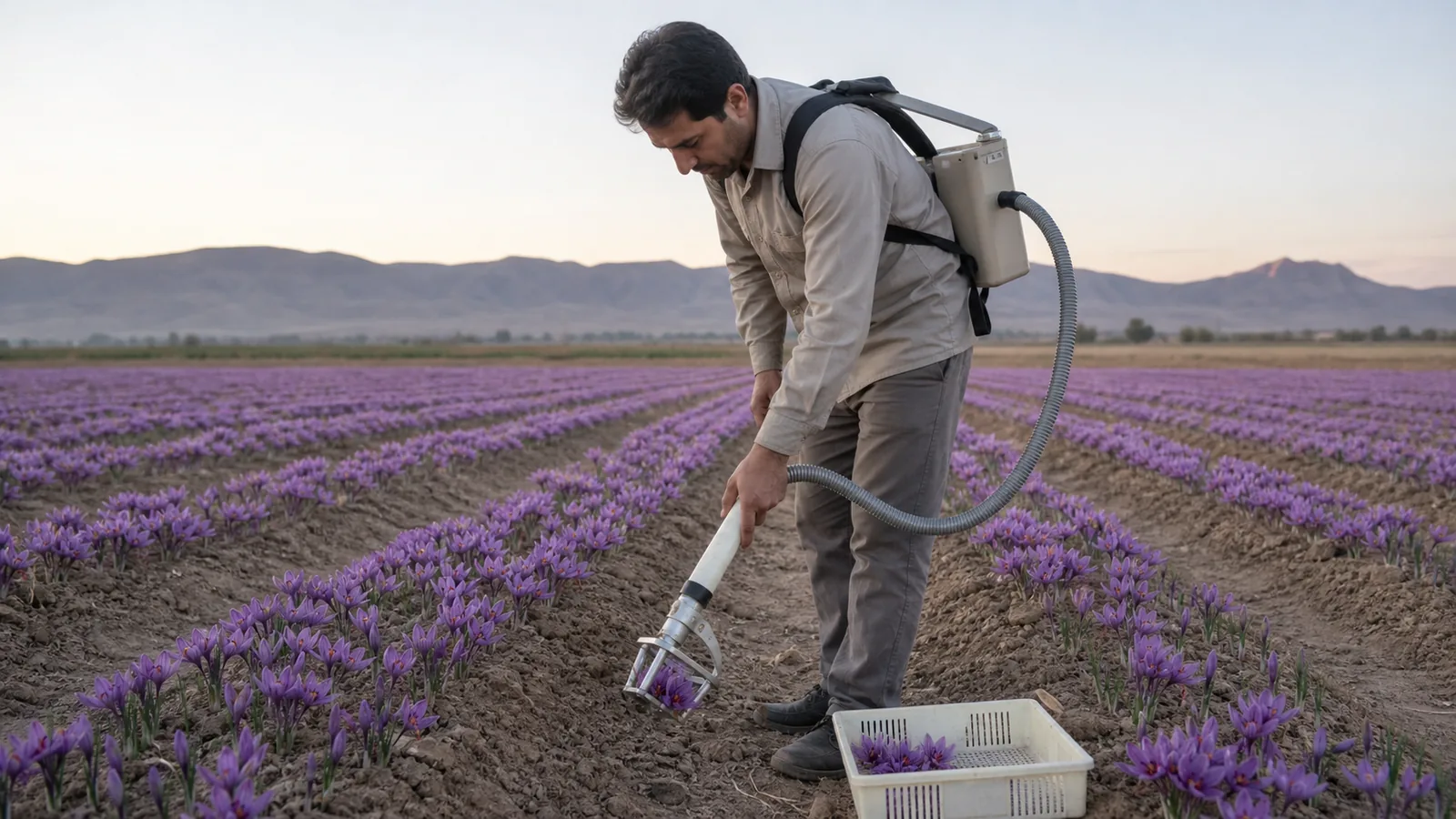
Turning freshly picked flowers into saffron for sale is still unusually dependent on careful handwork. A saffron harvesting machine can help with one part of that job, but “harvesting” is often used too loosely. Picking flowers in the field, separating the red stigmas, drying them and preparing a clean commercial lot are different operations. A machine that performs one of them should not be assumed to perform the others.
This article began as a short 2014 news report about an Iranian portable harvester. That account remains worth preserving because it records the kind of problem inventors were trying to solve. The machine-related search terms that bring readers here also deserve a fuller answer: what equipment exists, what it can realistically do, and what a grower should check before relying on a speed or cost claim.
The Iranian machine described in the original report
The report attributed the invention to Mohammad Haji Ahmadi in an interview carried by the Iranian Students News Agency’s regional service. It described a device worn like a backpack, with a cord or picking head used to remove saffron flowers while leaving the plant’s narrow leaves behind. The inventor said that it separated the useful flower material quickly and worked about five times faster than one person harvesting by hand.
The same account said the device had been registered with Iran’s Industrial Property Organization and designed or built following an order from the Ministry of Agriculture. Those were claims in the 2014 interview. We have not treated them as current product specifications, and they should not be used to make a purchase decision without a model number, patent record, independent field data and support from the present manufacturer.
The old article said flowers should be picked before sunrise and connected that timing with bees reaching them. Contemporary harvest research puts the emphasis elsewhere: the stage of flower opening, exposure to sun and weather, gentle handling, and separating the stigmas promptly. The practical point survives, even though the explanation needs care. Harvest timing is tight, and a labour shortage during a short flush of flowers can reduce the amount that is handled at its best.
What a saffron harvesting machine actually harvests
A field machine normally removes and collects the whole flower. It does not produce finished saffron threads at the moment of picking. The valuable product is the stigma, which still has to be separated from the petals and stamens and then dried under controlled conditions.
Researchers have tested several ways to detach the flower without cutting the leaves. A 2014 paper on a shoulder-carried mechanical saffron flower harvesting system described a gripper that detached the flower and a vacuum collector that carried it away. Laboratory work was used to study the prototype’s behaviour; it was not presented as proof that every field or flower stage could be harvested automatically.
A later semi-automatic saffron harvester study used a small battery-powered mechanism to bend and detach the stem. Its authors called it a proof of concept and reported preliminary tests. That wording matters. A functioning prototype can demonstrate an engineering idea without yet being a durable commercial machine.
Other systems use cameras, grippers, cutting mechanisms, suction or a vehicle moving along prepared rows. Each design faces the same difficult combination: flowers are delicate, leaf damage matters, bloom height varies, the crop may be wet or partly open, and a machine has to find the flower against the soil and leaves. A successful test under controlled conditions is only the beginning of field validation.
Saffron picking machine, separator or processing line?
These names are often mixed together in advertisements and search results. Before comparing equipment, decide which labour step is causing the bottleneck.
Flower picking or harvesting equipment
A saffron picking machine works in the field. It should detach or cut the flower at an appropriate point, avoid damaging the leaves and developing buds, and collect flowers without crushing them. Portable machines are guided by a worker; autonomous concepts add cameras, positioning and vehicle control.
Flower-opening and stigma-separation equipment
This equipment is used after the flowers arrive at the workroom. Its job is to separate the red stigma from petals, stamens and unwanted style material. The separation has to be clean without shortening or scattering the delicate threads. Machine capacity is of little value if it raises the percentage of floral matter in the final lot or mixes damaged material into good stigmas.
Drying equipment
Fresh stigmas are not yet shelf-stable saffron. Drying develops the familiar aroma and reduces moisture, but excessive heat or an inconsistent load can damage quality. The dryer is therefore a separate, controlled step. Our detailed guide to saffron flower drying methods explains the difference between harvesting, separation and dehydration.
Cleaning, grading and packing equipment
Later machines may sieve or inspect the dried product, divide a bulk lot, weigh small quantities and seal packs. Those are saffron processing machines in a broad commercial sense, yet they solve a different problem from a field harvester. A complete processing line may connect several units; the word “machine” does not make it a single operation.
From the field to saffron for sale
Good machinery should fit the biology of the crop rather than forcing the crop to suit a demonstration. Flowers are generally collected in the morning when they are developed and beginning to open. Picking too early can mean underdeveloped stigmas, while waiting until flowers wilt makes handling and separation harder. Conditions differ by climate and field, so opening stage is more useful than a rigid clock time.
Collected flowers need shallow, clean containers and protection from crushing, heat and direct sun. They should move to a clean processing area without an unnecessary wait. A machine that gathers faster can create a new bottleneck indoors if there are not enough people or suitable equipment to separate the increased flower volume.
Separation should keep the red stigma material intact and exclude petals, stamens, soil and other foreign matter. The Codex standard for dried saffron defines commercial styles such as filaments, cut filaments and powder and sets composition and quality expectations. Machinery has to support the intended style; it cannot compensate later for dirty or badly damaged material.
After controlled drying, the lot should be protected from moisture, light, foreign odours and contamination. Only then do grading, test evidence, pack format, accurate labelling and the buyer’s specification turn the crop into a saleable product. The wider saffron manufacturing process follows those stages from harvest to storage.
How to evaluate a saffron harvester
Start with the field, not the brochure. Row spacing, bed shape, plant density, soil surface, leaf height, flower stage, slope and stones can all change how a mechanism behaves. A demonstration in a prepared row may not predict performance in an older, uneven field.
A useful trial should record more than flowers per hour. At minimum, observe:
- the proportion of ready flowers collected and the number missed;
- damage to flowers, leaves, buds and corm-area soil;
- foreign matter and crushed material in the collection container;
- performance with open, partly open and damp flowers;
- time spent emptying, cleaning, adjusting and clearing blockages;
- battery or fuel endurance and the weight carried by the operator;
- how many workers are still needed for sorting and stigma separation.
Compare the result against the same field harvested manually on the same day. “Five times faster” has little meaning unless the test defines the starting condition, usable output, crew size, missed flowers, damage and downtime. Speed should be measured at the next quality checkpoint, not only at the picking head.
What determines saffron processing plant cost?
There is no responsible single figure for a saffron processing plant cost. A small farm buying a dryer and bench-scale separator is not building the same operation as an exporter installing receiving, sorting, laboratory, bulk packing and retail packing areas. Country, capacity, power supply, food-premises requirements and local service support also change the investment.
Break the estimate into the actual stages required: field collection, flower transport, stigma separation, drying, conditioning, quality control, weighing, packing, storage and waste handling. Then add the room, washable surfaces, ventilation, electrical work, labour, cleaning time, maintenance, replacement parts and testing. Request output figures for the same raw material and finished specification that the business intends to handle.
A sensible calculation uses cost per accepted kilogram, not nominal machine throughput. Include rejected or downgraded material, seasonal idle time and the crew needed around the equipment. Saffron flowers arrive during a concentrated harvest, so reliability and rapid local repair can be more valuable than a high theoretical rate.
Questions to ask before buying a saffron machine
- Is the machine for whole flowers, fresh stigmas or dried saffron?
- Has this exact model been tested in a field laid out like ours?
- Are the results from an independent trial or the seller’s demonstration?
- Does quoted capacity mean raw flowers entering or acceptable output leaving?
- What happens to closed buds, open flowers and wet material?
- How are leaves protected and missed flowers recovered?
- Which parts touch food, and how are they cleaned between lots?
- Are spare parts, training and repairs available during the harvest window?
Ask to see a continuous run rather than a short clip. Weigh the material before and after, inspect the plants, and time every interruption. If the seller cannot define the test conditions, the capacity figure is not yet useful.
Where mechanisation helps—and where judgement remains
Saffron machines can reduce repetitive work and help a farm cope with a short flowering period. Research has moved from simple cutting devices to portable grippers, vacuum collection, controlled-environment systems and computer vision. The technology is real, but it exists at different levels of readiness. A research prototype, a locally built tool and a supported commercial machine should not be evaluated as though they were interchangeable.
The strongest system keeps people responsible for the quality decisions that determine saleable output. Workers still need to judge flower readiness, watch for damage, keep lots separate, inspect the stigma material and respond when field conditions change. Machinery is most valuable when it removes a clearly measured bottleneck without creating a quality problem at the next stage.
The 2014 backpack-machine report captured an important ambition: collect more flowers during the narrow harvest window without sacrificing the plant. For a grower considering a saffron harvesting machine today, the safe conclusion is practical. Preserve the promising idea, verify the exact machine, and judge it by clean accepted saffron—not by speed alone.
Research and standards reviewed 28 August 2026. Equipment availability and specifications change; verify the exact model with an independent field trial before purchase.

![Exporting Saffron to Turkey + Price Guide [Complete 0 to 100]](https://img.rowhanisaffron.com/20260827003933/saffron-export-turkey-quality-inspection.webp)



